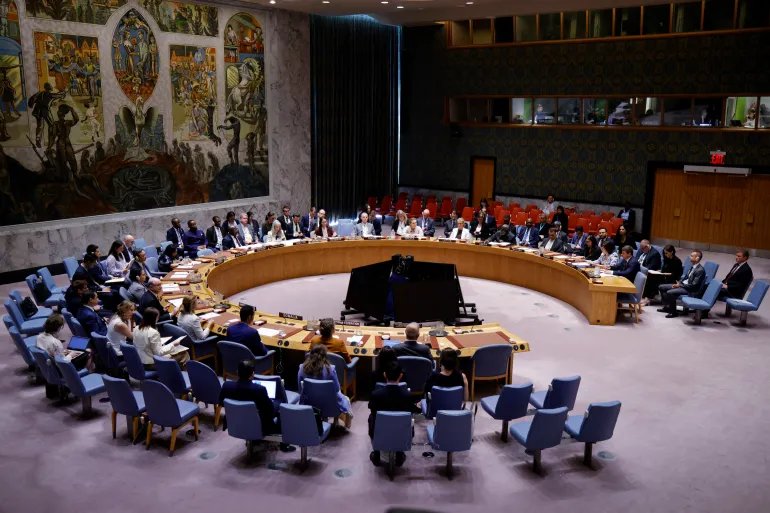



Russia and China have blocked a United States-led resolution at the United Nations Security Council that aimed to authorize independent experts to monitor sanctions against Iran. The failed measure, which sought to extend the monitoring mandate, was rejected on Thursday following accusations by Western powers that Iran continues to breach the 2015 nuclear agreement—a claim Tehran consistently denies.
The Security Council originally reinstated an independent panel in 2025 to evaluate and report on sanctions violations. However, the panel remained unstaffed due to persistent disagreements among member states. While 11 nations voted in favor of the renewal this week, the process was derailed by the two permanent members, while Pakistan and Somalia chose to abstain.
Vassily Nebenzia, the Russian ambassador to the UN, defended the opposition by warning Western colleagues to cease what he described as dangerous actions in the Persian Gulf. He argued that these policies risk further destabilizing the region. Conversely, Jennifer Locetta, the deputy US representative, cautioned that the council has now lost its primary source of impartial reporting, warning that the resulting oversight vacuum serves only to benefit the Iranian regime and entities profiting from sanctions evasion.
Tehran welcomed the deadlock, with its UN mission expressing appreciation for the principled stances taken by Moscow and Beijing. In a statement posted on social media, officials described the US draft as a politically motivated attempt to misuse the Security Council for its own strategic agenda.
Tensions remain elevated following the “snapback” of UN sanctions in September 2025, when France, Germany, and the United Kingdom triggered mechanisms to reinstate earlier resolutions concerning Iran’s military and nuclear activities. These measures include strict travel restrictions on officials tied to the country’s ballistic missile and nuclear programs.
The impact of these sanctions was illustrated earlier this week when Iran’s nuclear chief, Mohammad Eslami, was blocked from attending the International Atomic Energy Agency (IAEA) annual conference in Vienna. After the Security Council denied a waiver to lift his travel ban, Austrian authorities revoked his visa, forcing Eslami and his delegation to cancel their participation in the five-day summit. The report also notes that shut down on Thursday, would have extended the mandate for the independent monitoring of sanctions that were reimposed last year after western powers accused Iran of violating the 2015 nuclear pact, the resolution. The report also notes that leading to a lack of consensus among the 15-member Security Council, but the experts were never appointed due to disagreements among member states.