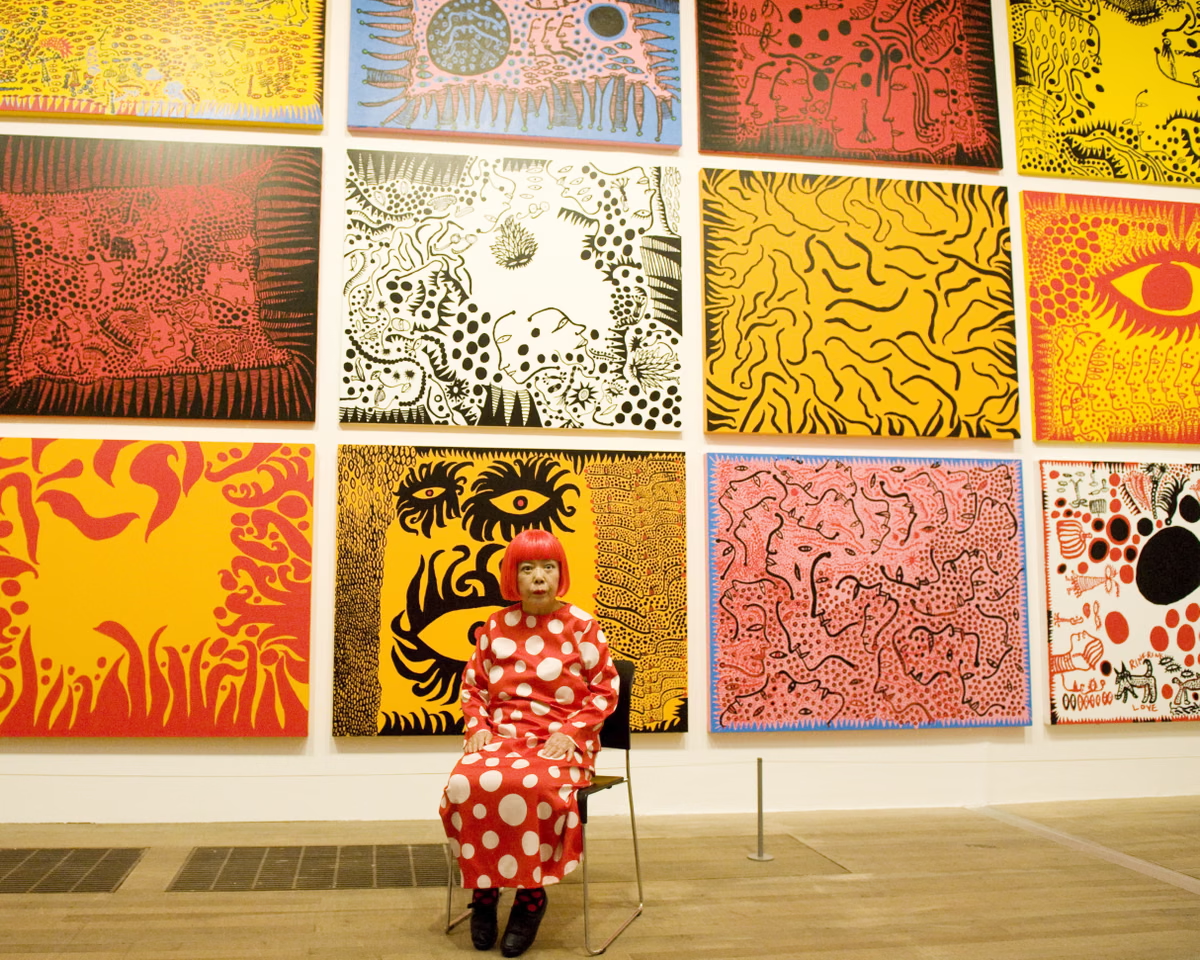









Yayoi Kusama, the celebrated Japanese artist who has died at the age of 97, spent her life turning the internal intensity of her mental health struggles into a globally recognized aesthetic. From the age of 10, Kusama experienced vivid hallucinations, which she described as “flashes of light, auras, or dense fields of dots.” These visual and auditory disturbances became the foundation of her creative output. A 1939 drawing of a woman in a kimono—believed to be her mother—depicts the figure being consumed by these dots, a motif that would define Kusama’s career. She also frequently hallucinated flowers, noting that she would see patterns from a tablecloth spread across the walls, ceiling, and her own body, eventually feeling as though she were “reduced to nothingness” while revolving in the “infinity of endless time and the absoluteness of space.”
For Kusama, the act of creation was a vital survival mechanism. In a 2012 interview, she explained that she fought pain, anxiety, and fear daily, finding that art was the only path that allowed her to live. She famously stated, “If it were not for art, I would have killed myself a long time ago.” This dedication propelled her to the forefront of the New York avant-garde, where she influenced the pop art movement and staged groundbreaking happenings. Her work maintained its massive appeal decades later; in 2022, the Tate Modern in London extended her popular Infinity Mirror Rooms exhibition due to overwhelming demand, keeping it open until 2024.
Kusama’s legacy arrives at a time when the art world is increasingly acknowledging the contributions of neurodivergent and disabled artists. Figures such as the schizophrenic painter Louis Wain and Andy Warhol, who displayed traits consistent with autism, are now being re-examined through the lens of neurodiversity. Recent years have seen significant recognition for this community, including the 2023 Turner Prize win by Nnena Kalu, an artist who is autistic and has a learning disability. A spokesperson for ActionSpace, a London-based organization supporting learning-disabled artists, noted that Kusama’s path proved that great art does not require a traditional route, adding that the art world is richer for the diverse voices that shape it.
Throughout her life, Kusama remained transparent about her mental health, even as she faced the stigma of her era. In the 1970s, she voluntarily checked into a mental-health facility in Tokyo, maintaining a studio nearby to continue her work. Her signature use of repetitive dots and flowers served as a way to process her experiences of “obliteration,” while her infinity rooms transformed sensory overload into immersive, magical environments. Kate Adams, director of Project Art Works, suggests that Kusama’s practice channeled her intrinsic compulsions, using them to describe a world of intense pattern and form rather than escaping it.
Adams, whose collective was nominated for the Turner Prize in 2021, notes that while mental illnesses like OCD and neurodivergence are distinct, they can overlap when anxiety impacts wellbeing. These sensory sensitivities are increasingly recognized in broader society; for instance, sensory rooms are now common features in schools, hotels, and airports. The impact of Kusama’s work continues to resonate, offering a profound way for audiences to view the world through her unique perspective, while paving the way for future generations of artists to embrace their own diverse ways of seeing. The report also notes that of a woman in a kimono assumed to be her mother, shows her obliterated by those dots; they would become Kusama’s artistic obsession, a drawing from 1939. The report also notes that “I was looking at the red flower patterns of the tablecloth on a table, and when I looked up I saw the same pattern covering the ceiling, the windows and the walls, and finally all over the room, my body and the universe”, she once said, when asked about that recurring motif. The report also notes that “I fight pain, anxiety, and fear every day, and the only method I have found that relieved my illness is to keep creating art. The report also notes that she said in a 2012 interview, i followed the thread of art and somehow discovered a path that would allow me to live”. The report also notes that her exhibitions and major retrospectives draw huge crowds. The report also notes that in 2022, due to enormous public demand, Tate Modern in London extended her Infinity Mirror Rooms show for a whole extra year (it ended up running until 2024). The report also notes that in this way, we were granted a powerful glimpse through Kusama’s eyes.