







Saudi Arabia’s crucial petroleum shipments faced a severe setback after drone strikes damaged a section of the vital East-West pipeline, forcing a temporary halt in crude flow and removing between 4 million and 5 million barrels per day from international markets.
While repair timelines remain uncertain, estimates from The Associated Press suggest restoration could require three to five weeks, based on information provided by two regional officials.
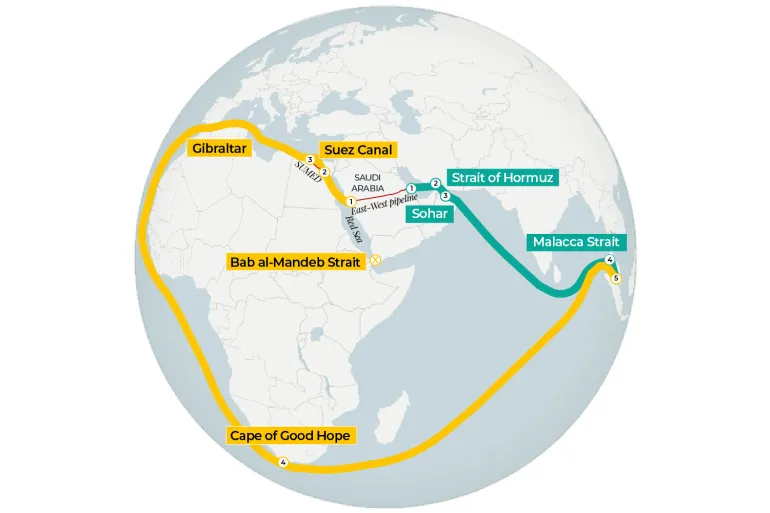
Spanning 1,200 kilometers, the pipeline links major eastern production fields directly to the western Red Sea terminal of Yanbu, allowing the kingdom to bypass the heavily restricted Strait of Hormuz.
As the world’s second-largest oil producer, the disruption to Saudi supply chains carries substantial implications for global energy markets and pricing stability.
Overall crude loadings dropped significantly, falling from peak levels above 7.5 million barrels per day in January and February down to approximately 2.3 million barrels per day in August and roughly 2.1 million during the first half of September, representing a decline exceeding 70 percent.
Industry analysts note that actual shipments might be somewhat higher since shuttle tankers navigating the Hormuz passage with tracking transponders deactivated are not always captured by standard monitoring.
Historically, Saudi shipments rely heavily on two primary outlets: eastern terminals discharging through the Strait of Hormuz and western infrastructure facing the Red Sea.
Before the disruption, the kingdom exported between 7 million and 8 million barrels daily, with primary seaborne volumes clearing through Ras Tanura and Ras al-Ju’aymah, where the former handled an average of about 5.4 million barrels per day through 2025.
This maritime lane serves as the most direct and economical pathway to major Asian consumers who purchase the vast majority of Saudi crude.
With western pipeline operations suspended and the southern Red Sea corridor increasingly hostile, authorities have few alternatives other than directing exports back through the Persian Gulf.
LSEG Data & Analytics oil research specialist Rishi Rajanala explained that options are limited, pointing to increased shipments from Gulf terminals through Hormuz, alongside ship-to-ship transfers conducted outside the channel near Sohar in Oman.
Regional producers have utilized similar transport methods previously, though volumes ultimately depend on vessel availability, freight rates, insurance expenses, and potential security threats.
A secondary approach involves drawing upon petroleum reserves stored along the western coast alongside Egyptian terminals at Ain Sukhna and Sidi Kerir to maintain supplies for European buyers.
Gibson Shipbrokers research director Richard Matthews warned that routing vessels back through Hormuz will further fuel higher freight costs for Middle East exports and create additional inefficiencies.
To mitigate security risks, certain tankers operate “dark” by deactivating automatic identification system transponders while navigating Omani coastal waters.
Rystad Energy vice president Rahul Choudhary reported that Hormuz-route exports expanded during the first two weeks of September to exceed two million barrels daily, marking an increase of roughly one million barrels compared with August figures.
Originally constructed in 1981 amid the Iran-Iraq conflict, the East-West pipeline was designed specifically to minimize vulnerability during regional crises and features a maximum design capacity of approximately 7 million barrels per day.
Crude dispatched from Yanbu typically proceeds through the Red Sea either northward toward the Suez corridor or southward through the Bab al-Mandeb strait toward Asian destinations.
However, recent military advances by Iran-backed Houthi forces in September, which included capturing the Yemeni port of Mocha, Dhubab, and Mayyun island, severely restricted southern navigation.
Consequently, tankers attempting to reach Asian markets must bypass the blocked southern exit and travel northward instead.
Vessels can transit the Suez Canal directly or offload cargo at Egypt’s Ain Sokhna facility to utilize the Sumed pipeline, although Very Large Crude Carriers remain too large to navigate the canal fully laden.
Refiners across Asia and Europe, including China which accounts for 22 percent of Saudi exports, South Korea at 14 percent, Japan at 13 percent, India at 10 percent, and the United States at 5 percent, now face shifting supply dynamics.
Rajanala observed that European refiners experiencing cancelled Saudi shipments are actively procuring alternative grades from the North Sea, the Americas, and Central Asia.
Because the government depends heavily on financial transfers, royalties, and taxation from Saudi Aramco, petroleum sales generating over half of state revenue—totaling 606.5 billion riyals or $162 billion in 2025—remain critical for public finances.
UBS Research currently projects the 2026 budget deficit will widen to 5 percent of gross domestic product, exceeding the initial projection of 3.3 percent. The report also notes that halting oil flow and removing 4-5 million barrels per day (bpd) of oil from global supply, saudi Arabia’s oil exports took another blow last week when drone attacks knocked out part of the country’s East-West pipeline. The report also notes that the 1,200km (746-mile) pipeline connects the kingdom’s main oil-producing fields in the east of the country with Yanbu port on the Red Sea coast in the west, allowing Saudi crude to bypass the Strait of Hormuz, which has largely remained closed since the United States-Israel war on Iran began on February 28. The report also notes that how the disruption could affect buyers worldwide, and what it means for the kingdom’s revenues, asked experts what alternatives remain. The report also notes that most Saudi crude left on ships through the Strait of Hormuz, the 39km (24-mile) shipping choke point connecting the Gulf to the Gulf of Oman, and the open sea beyond, before the crisis. The report also notes that depending on the extent of the damage.”, the third is a phased restart of the pipeline itself. The report also notes that one way to reduce that risk is for tankers to go “dark” by switching off their AIS transponders – used in maritime navigation to identify and track vessels – as they transit Omani coastal waters. “They will transit with transponders off and likely coordinate with the US Navy but still face the risk of attack as everyone else does,” Matthews said. The report also notes that saudi Arabia can lean further on dark tanker activity in the coming days to offset Yanbu losses,” he added.