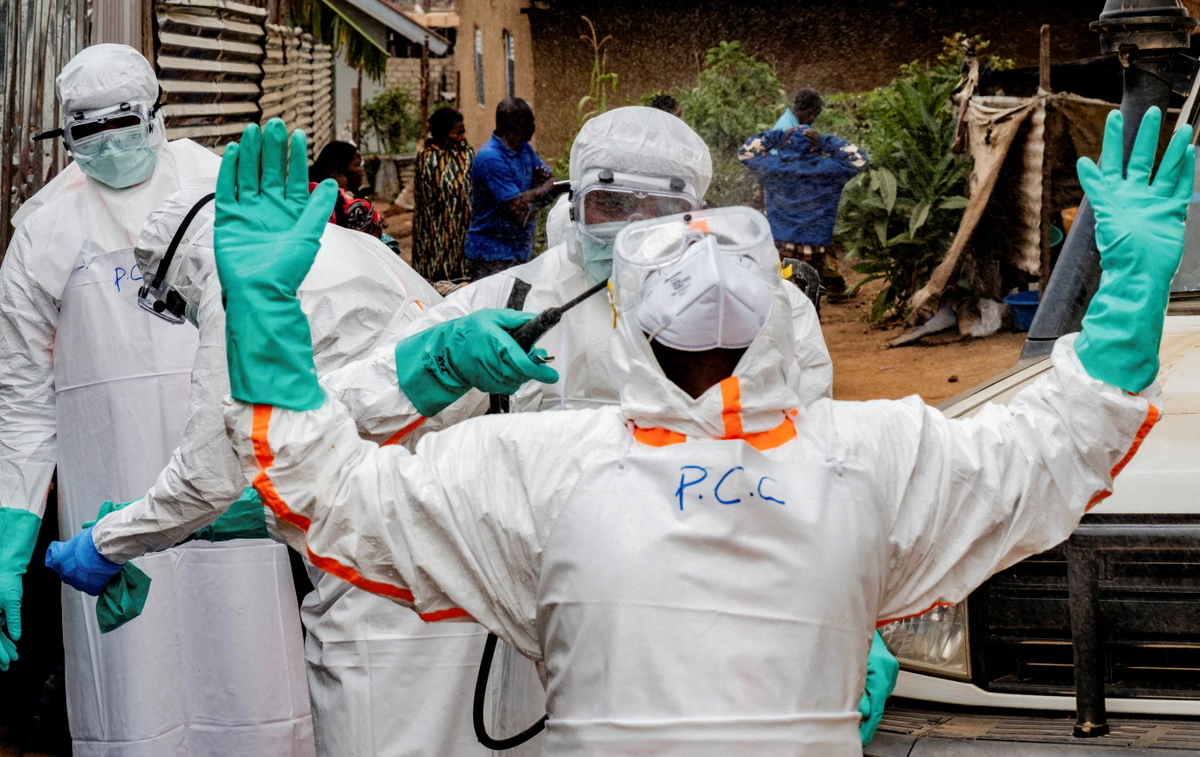









Frontline health workers in the Democratic Republic of the Congo (DRC) are struggling to contain an accelerating Ebola outbreak while facing significant personal risks and a lack of promised wages. Sophie Mwadawa Kabundo, a nurse at an Ebola treatment centre, described the daily fear of contracting the virus and potentially exposing her family. She noted that admissions are rising rapidly and that several of her colleagues have already succumbed to the disease.
The situation has placed immense psychological strain on staff, according to Martin Bolombi, a hygiene worker at the Elikya treatment centre in Bunia, the capital of the heavily affected Ituri province. Bolombi, who participated in a strike last month alongside roughly 100 other workers to protest unpaid bonuses, stated he has only received payment for June despite working since May. Both Kabundo and Bolombi confirmed they are currently missing wages, leaving them to manage high-pressure environments without financial support.
The scale of the crisis is vast, with the virus currently affecting six of the DRC’s 26 provinces. Senior UN Ebola coordinator Julien Harneis warned that the outbreak is spreading exponentially across an area larger than France. As of late August, more than 2,500 people have died, and 160 healthcare workers have been infected, with 43 fatalities recorded among the staff. Harneis cautioned that existing aid funds are expected to be exhausted within weeks and called for an urgent increase in international support.
The World Health Organization (WHO) has indicated that this outbreak is on track to surpass the 2014-16 West African epidemic, which claimed over 11,325 lives. The current strain in the DRC is the rare Bundibugyo species, for which there are currently no approved vaccines or treatments, though clinical trials are ongoing. The WHO declared the situation a public health emergency of international concern in May, though genetic sequencing suggests the virus began circulating as early as February.
Beyond financial and logistical hurdles, responders are battling deep-seated community mistrust and widespread misinformation. Manon Dumortier, an emergency coordinator for Mercy Corps in Bunia, explained that the rapid pace of deaths and the secretive nature of burials have fueled rumors and speculation. This fear often prevents symptomatic individuals from seeking medical help until their condition is critical, leading to further transmission clusters.
Dr. Eddy Kambale Kahandukya of Médicins Sans Frontières highlighted that community engagement remains a critical failure point. Patients often avoid health facilities while awaiting test results, choosing instead to remain in their communities, which complicates efforts to break the chain of infection. The virus spreads through direct contact with infected bodily fluids, including those from deceased persons, as well as contaminated surfaces.
Despite these systemic challenges, some progress has been noted at the Elikya treatment centre, where Kabundo reported a significant number of recoveries. However, she emphasized that this success does not diminish the need for immediate government intervention regarding staff compensation. The Congolese health ministry has not yet provided a response to inquiries regarding the unpaid wages.
While the outbreak remains concentrated in the DRC’s north-east, particularly in Ituri where over 4,200 confirmed cases have been documented, the virus has occasionally crossed borders. Uganda previously reported 20 cases and two deaths in Kampala, but the country was declared Ebola-free on July 28 following the discharge of the final patient on July 16. The report also notes that “We fear that, despite our vigilance, workplace accidents may occur and put us in ever greater danger … We go to sleep already worrying about the days ahead, as patients continue to pour in.”. The report also notes that “Personally, this outbreak is causing me a lot of stress,” he said. The report also notes that “But I have no choice but to pluck up my courage and ensure that the situation is brought under control first, before it can stabilise.”. The report also notes that “We are not being paid and we want the government to provide solutions as soon as possible,” she said. The report also notes that community mistrust and infrastructure deficits – hampering efforts to tackle the outbreak in the DRC, one of the world’s poorest countries, u npaid wages are just one of the factors – alongside misinformation. The report also notes that “And all of this is happening in an area that has had three decades of conflict and is generating huge humanitarian needs.”.