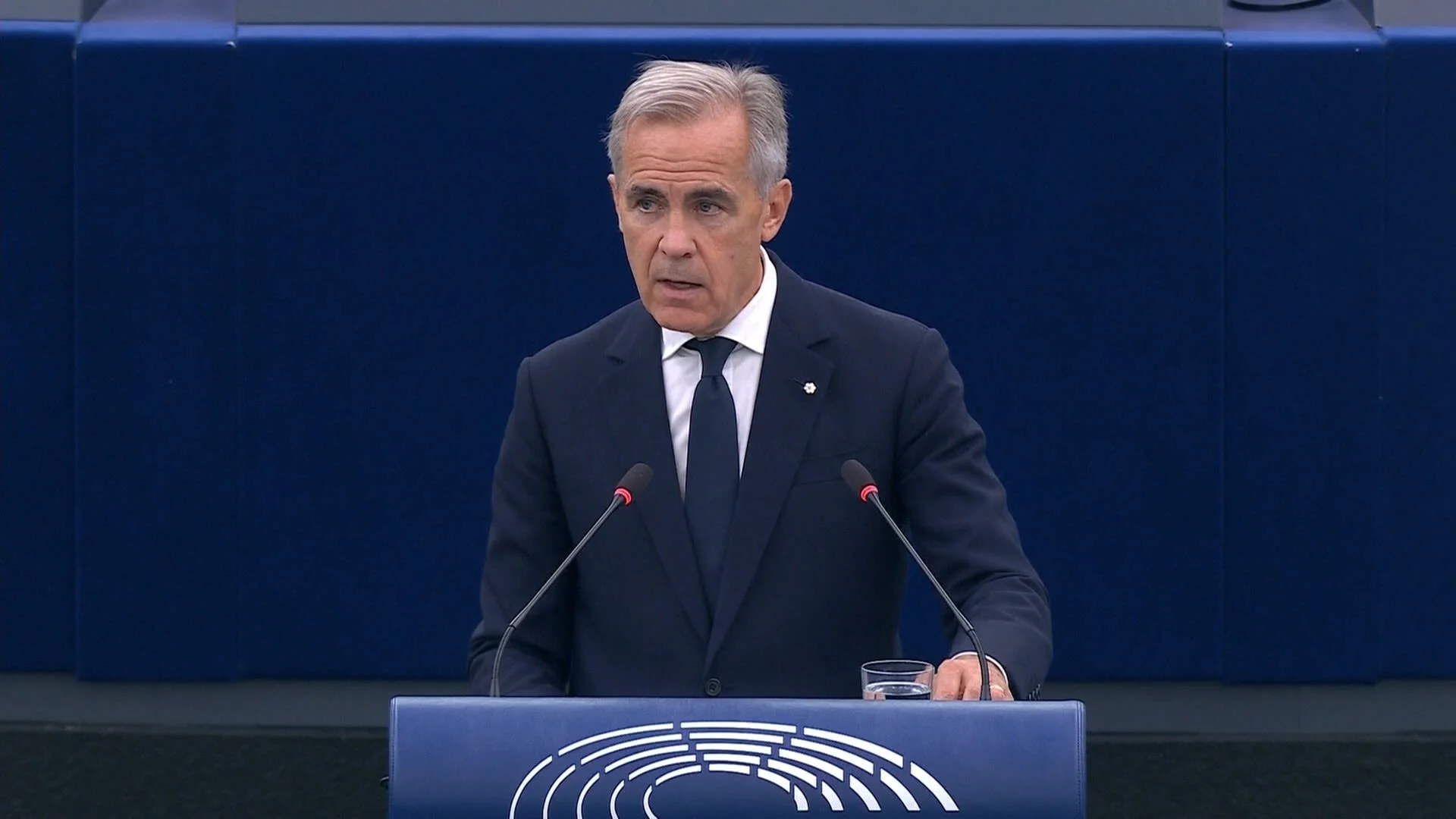








Canadian Prime Minister Mark Carney has pushed back against claims that his effort to forge a tighter alliance with the European Union is meant to challenge the United States. Speaking to EU lawmakers in France, Carney insisted that his proposed partnership is about fostering economic resilience rather than establishing a new, better-mannered version of a competing power bloc. He underscored that Canada is not seeking to dominate others, but rather to protect its markets, sovereignty, and democratic standards from external interference.
The push for closer cooperation follows a proposal from European Commission President Ursula von der Leyen, who suggested granting Canada the status of an “associate member” of the bloc. While that specific designation currently has no formal legal standing, the suggestion prompted President Donald Trump to threaten fresh tariffs on Europe, warning that he would view any new agreement as a potentially hostile act. Trump stated that if the intentions behind such an alliance were deemed unfavorable, the United States could impose heavy tariffs on the region.
Carney clarified that Canadian lawmakers will ultimately debate and vote on the final structure of the alliance. He emphasized that Canada does not intend to become a full member of the European Union, nor is it in a position to do so. Instead, he views this as a chance to bolster Canada’s independence and sustainability. He pointed to energy security, specifically the supply of liquefied natural gas and hydrogen, alongside cooperation on critical minerals, defense production, and artificial intelligence, as primary areas of interest.
Building on these ties, the Prime Minister suggested that Canada could participate in European research and education initiatives like Horizon and Erasmus+. He advocated for improved people-to-people connections, allowing younger generations to live and work across the Atlantic more freely. Currently, Canada and the EU maintain significant economic links, with bilateral trade in goods and services hitting €130.8 billion, or $151 billion, last year. This figure represents an 80% increase over the past decade.
Despite the high-level interest, the proposal faces practical challenges. The comprehensive trade agreement known as CETA, finalized in 2017, still awaits full ratification by 10 EU member states, including Italy, France, and Poland. Furthermore, some officials and experts have expressed caution. Tinatin Akhvlediani, who leads EU enlargement research at the Center for European Policy Studies, noted that “associate membership” does not exist, and existing association agreements for nations like Ukraine or Moldova require legal alignment that Canada may find unappealing.
German government spokesperson Stefan Kornelius noted that Berlin is open to discussing new models for the relationship but indicated that the term “associate member” should be reconsidered. Carney maintained that the specific naming of the partnership is a matter for European officials to resolve, focusing instead on the substance of the cooperation. Further details are expected to be discussed at an upcoming investment summit in Montreal next month.
Public displays of support for the initiative have already emerged. Spanish Prime Minister Pedro Sanchez posted an image on social media featuring an EU flag alongside Canada’s iconic maple leaf. For his part, Carney remains optimistic, suggesting that a formalized Canada-EU alliance could serve as a beacon for other democracies, keeping the door open for future partners to join as they navigate global challenges such as climate change and trade volatility. The report also notes that “This is an opportunity to make Canada stronger, more sovereign, more independent, more prosperous, more sustainable,” he said. The report also notes that we’ll put very heavy tariffs on Europe, which is a possibility,” he told reporters, if it’s a bad intention. The report also notes that during a speech in which he occasionally spoke in French and drew heavily on the historic ties between Canada and the EU, Carney laid out the case for closer cooperation to build resilience against what he called “new st. The report also notes that even with allies, spurring them to seek new alliances to shore up their economies, canada and the European Union have both been on the sharp end of Trump’s combative approach to trade. The report also notes that we are pursuing resilience so no one can control our open markets, impair our sovereignty, threaten territorial integrity or undermine our freedoms, our democracies, our rule of law.”, on the contrary. The report also notes that its largest trading partner, lending urgency to efforts to get closer to the EU, which has itself battled numerous trade spats with America, canada is locked in a trade war with the United States.