
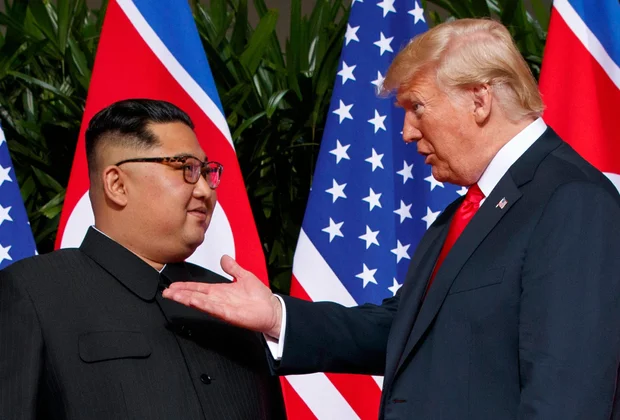





President Trump announced on Wednesday that he anticipates holding another meeting with North Korean leader Kim Jong Un before the end of the year. This statement follows reports that the administration is working to organize a potential summit, possibly coinciding with the APEC gathering in Shenzhen, China, this November.
When asked at the White House if he expected to sit down with the North Korean leader, Trump confirmed the possibility, stating, “Yeah, I will be.” While the White House has not officially confirmed a scheduled date, the president has instructed his staff to initiate contact with Pyongyang to restart negotiations regarding the country’s nuclear weapons program.
The two leaders previously held three summits during Trump’s first term, though those meetings resulted in no significant progress toward denuclearization. Since that time, North Korea has continued to bolster its arsenal. Trump noted that he believes the regime now possesses 57 nuclear warheads, adding, “He has 57 very powerful nuclear weapons. Should have never allowed it to happen. If I were president, I wouldn’t have allowed it. But he’s got them.”
Despite the lack of progress, Trump emphasized his personal rapport with the leader, remarking, “I get along with him. And you know what, the fact that I get along with him, that’s a good thing, not a bad thing.” He remains optimistic that future matters with the nation will be resolved favorably.
However, Kim Jong Un has recently signaled a shift in stance, publicly stating his desire for the international community to recognize North Korea as a nuclear-armed state. The North Korean leader has also explicitly rejected any future diplomatic discussions predicated on the goal of total denuclearization.
The push for new talks follows Trump’s decision to scale back participation in the annual Ulchi Freedom Shield military exercises with South Korea. Trump described the longstanding drills as a “totally inappropriate and hostile signal” to the North, noting that his decision was influenced by his relationship with Kim and South Korea’s lack of assistance regarding the conflict in Iran.
The joint exercises, which typically span ten days, were halved this year under the president’s orders and are set to conclude this Friday. This reduction has caused concern among regional allies, particularly in Japan and South Korea, where officials are questioning the reliability of U.S. security guarantees against potential aggression from North Korea or China.
In response to the shifting security landscape, South Korean President Lee Jae Myung has advocated for greater military independence from the U.S., including the acquisition of nuclear-powered submarines. Meanwhile, Chinese Foreign Minister Wang Yi visited Seoul on Wednesday to meet with his counterpart, Cho Hyun, to discuss cooperation on the denuclearization of the Korean Peninsula. The report also notes that possibly around the November APEC summit in Shenzhen, China, his comments followed a report by the Wall Street Journal that said he was hoping to have such a meeting organized soon. The report also notes that far from signaling any willingness to abandon the program, Kim has said he wants the U.S. The report also notes that trump appears to be trying to rekindle direct talks with Kim on the heels of his decision to reduce the number of U.S. The report also notes that and South Korea have been close allies for more than 70 years. The report also notes that but they have been halved this year, on Mr, the exercises that started this week usually run for 10 days. The report also notes that kathryn Watson contributed to this report. The report also notes that prime minister messages with impersonator of top Trump staffer. The report also notes that fire and Fury 2.0: What Trump’s North Korea Policy Tells Us About Iran.