



The 250th anniversary of the United States began with an evacuation in Washington, D.C., this July. A sudden summer storm forced crowds gathered on the National Mall for fireworks to seek shelter, serving as a stark reminder of the volatility inherent in the current season. While the festivities eventually continued, the event highlighted how weather patterns are increasingly disrupting the routines of millions of Americans.
Across the country, the season typically reserved for leisure has become a period of survival. Texas has endured its second once-in-a-thousand-year flood within a single year, while Indiana experienced a record-breaking 77 tornadoes. Meanwhile, July was officially recorded as the hottest month ever in the Lower 48 states, surpassing a record previously held since the Dust Bowl era.
In Spokane, Washington, these conditions culminated in a devastating brush fire. Ted Chauvin, a local resident, described the harrowing experience of fleeing his home as flames encroached upon his neighborhood. “We just got the dogs, the cat, the kid, and we just got out,” he recounted. Surveying the ruins of his property, he reflected on the loss of his home, noting, “I see where I was diagnosed with cancer, where I beat cancer. Where we had our child, and the memories we gave her in growing up in this place. That honestly has been the hardest part.”
Washington State has faced its most destructive wildfire season on record this year. For Chauvin, the shift in his environment is palpable. He noted that in the first decade he lived in the area, there was no such thing as a “smoke season.” Now, he is uncertain about the future, stating, “Something’s changing. And what we need to do is really ask the questions to figure out what to do about it.”
Climate journalist Jeff Goodell, author of “The Heat Will Kill You First: Life and Death on a Scorched Planet,” argues that these events are not isolated incidents but interconnected symptoms of a warming world. “Summer of 2026 is another step in the escalation of our world into a sort of hotter, more dangerous planet that climate scientists have been telling us about for decades,” Goodell said. He suggests that society tends to normalize these disasters, treating them as abnormal anomalies rather than systemic shifts.
Goodell employs the analogy of a boiling pot to describe the public’s reaction to climate change, noting that people often fail to recognize slow-moving, incremental changes until they reach a critical threshold. Data from the EPA and NOAA support this concern, showing that heat waves now occur three times as frequently as they did in the 1960s, while wildfires consume twice as much land annually compared to the 1990s.
The impact is global, with Europe experiencing record-breaking heat and deadly fires. Because air conditioning is not standard in many parts of the continent, the heat is estimated to have claimed more than 10,000 lives. Goodell emphasizes that human civilization has thrived within a specific “Goldilocks Zone” of temperatures for the last 10,000 years, a range we are now rapidly exiting.
When asked how much of American infrastructure is built for a climate that no longer exists, Goodell replied, “All of it.” He noted that adapting to these changes is particularly difficult in the United States without consistent federal support. Recent policy shifts, such as the Trump administration’s decision to revoke the “endangerment finding” on greenhouse gases and the loosening of federal emission limits, have further complicated the national response.
Atmospheric scientist Maria Molina of the University of Maryland is utilizing artificial intelligence and historical weather data to model future climate trends. She explains that while extreme events have always occurred, the background warming of the planet is changing their frequency and intensity. “The question is, how are these extremes potentially evolving due to that background climate gradually warming?” she asked. “That is what could be concerning.”
Despite the challenges, Molina remains hopeful that collective action can lead to viable solutions. For residents like Chauvin, however, the immediate future remains uncertain. He is still deciding whether to rebuild in Spokane, acknowledging that the emotional toll of the fire has made long-term planning difficult.
Goodell admits that the long-term outlook weighs heavily on him. Reflecting on a recent walk through the woods with his daughter, he expressed concern about the world she will inherit. “I mean, I wonder, when she’s walking through it with her kids, it won’t be the same,” he said. “And she’ll ask what we did, and what we didn’t do.”
The ongoing research into building more resilient habitats and the efforts of scientists like Molina represent a critical attempt to understand and mitigate these risks. As the planet continues to warm, the focus remains on whether society can adapt its infrastructure and policies quickly enough to protect future generations.
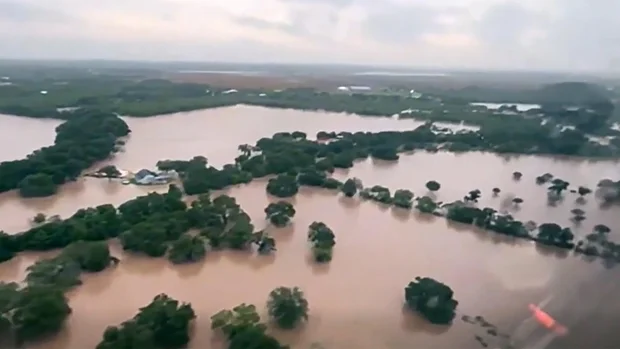
In Texas, a second once-in-a-thousand-year flood in 12 months; in Indiana, outside Tornado Alley, a record 77 twisters; and there through it all, the heat.
Applying the analogy of frogs in a pot that is slowly boiling that do not notice what’s happening around them, Goodel said, “I think that’s a very appropriate analogy, for sure.
Asked whether he would move back, Chauvin said, “I don’t know.
Hours later, the show finally went on, but by then Mother Nature had made her point.
July’s heat, months of drought, and high winds fueled a brush fire in Spokane, Washington, allegedly started by an arsonist.
I do think that it captures this idea of these slow changes that, you know, we don’t recognize until it’s too late.”
It’s a similar pattern across the Atlantic.
“It’s particularly difficult to do here in the United States, even when you have cities with the best intention, if you don’t have a federal government that is really, you know, helping.”
Trump loosens federal rule limiting greenhouse gas emissions
That is what could be concerning, because that could be a very small signal, like a slightly longer wildfire season, which may not seem meaningful when you hear it from, like, a statistical number.
For Ted Chauvin, it’s research that could help him read the signals, and trust his next steps.
Two o’clock yesterday, I would have said, ‘Yeah, sure, let’s go back.’ Five o’clock in the evening?
‘No, we’re not gonna go back,’ you know?
“The Heat Will Kill You First: Life and Death on a Scorched Planet” by Jeff Goodell (Little, Brown & Co.), in Trade Paperback, eBook and Audio formats, available via Amazon, Barnes & Noble and Bookshop.org
Story produced by John Goodwin and Gabriel Falcon.
A city rises again from the ashes – but will it be strong enough?