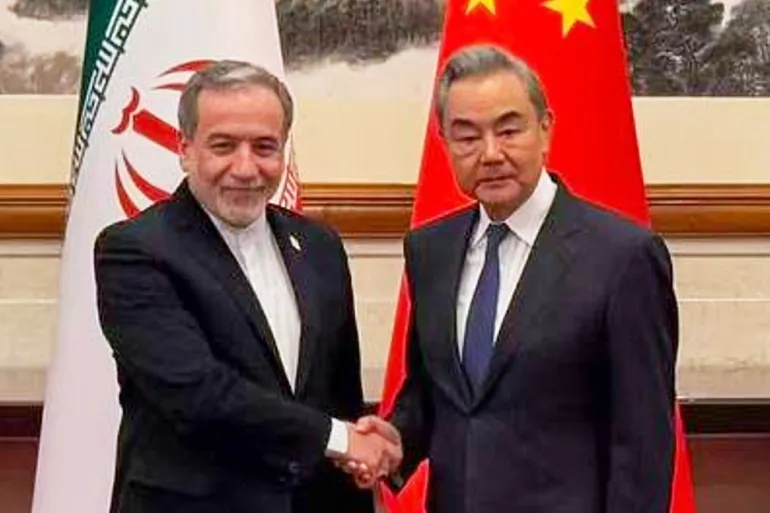









Iranian Foreign Minister Abbas Araghchi is scheduled to arrive in Beijing for discussions with his Chinese counterpart, Wang Yi. This marks Araghchi’s second visit to the Chinese capital since the outbreak of the US-Israel conflict with Iran in late February, coming shortly before an upcoming meeting between US President Donald Trump and Chinese President Xi Jinping in Washington.
During a recent summit in New Delhi, Xi encouraged the BRICS coalition of Global South nations to help mediate the Middle East conflict, stating that Beijing is ready to collaborate toward that objective. While Xi floated the prospect of a potential mediation role, he did not formally unveil a specific peace initiative, instead reiterating a four-point de-escalation framework emphasizing national sovereignty, peaceful coexistence, international law compliance, and balancing security with development.
Observers note that while Beijing seeks to mitigate economic disruption from the war, it typically avoids deep entanglement in external conflicts and uncertain diplomatic efforts. Domestic reception in Iran regarding Xi’s remarks remains mixed. Former Foreign Minister Mohammad Javad Zarif stated that Xi’s constructive initiatives present timely openings to ease tensions and demonstrate that multilateral diplomacy is the sole viable path to stability. Conversely, University of Tehran professor Hamed Vafaei cautioned that interpreting Xi’s statements as a concrete offer to mediate between Tehran and Washington stretches beyond reality.
Alongside regional diplomacy, Araghchi’s agenda includes addressing Iran’s nuclear program. Recently, the United States and European allies including France, Germany, and the United Kingdom successfully led the International Atomic Energy Agency board to refer Iran to the UN Security Council, echoing a similar move from two decades ago that preceded extensive sanctions. However, current measures face strong opposition from veto-holding members China and Russia.
Western pressure persists on multiple fronts. Iranian nuclear chief Mohammad Eslami was barred from the IAEA General Conference in Vienna due to snapback sanctions reimposed by European nations. Concurrently, Washington has intensified its restrictive measures through Operation Economic Outcast, aiming to isolate the Iranian administration via a naval blockade of southern ports while targeting associated financial channels and refineries, though major Chinese banks remain untouched.
The US Treasury recently designated Russia’s VTB Bank under Iranian sanctions due to its direct link to mainland China’s payment system. Despite these pressures, Beijing remains the primary purchaser of Iranian crude oil, utilizing reserves outside the blockade. Additionally, US-China dynamics faced scrutiny following reports that Iran acquired high-resolution satellite imagery from Chinese entities prior to targeting a US military base in Jordan. President Trump minimized the incident, remarking that the actions mirror mutual intelligence gathering between major powers. The report also notes that once again, the trip comes shortly ahead of a planned meeting between Trump and Chinese President Xi Jinping, this time in Washington later in September. The report also notes that framing itself as a neutral party that wants an end to the conflict, the meetings in May and now in September highlight the role China has played during the war. The report also notes that he did not explicitly announce any such imminent diplomatic initiative, while Xi hinted at interest in potentially playing an explicit US-Iran mediation role in his BRICS speech. The report also notes that inside Iran, there have been varied opinions on the significance of Xi’s latest remarks. The report also notes that and sweeping sanctions that hit the country’s economy hard, the last such referral came 20 years ago and was followed by six UN Security Council resolutions being passed against Iran.