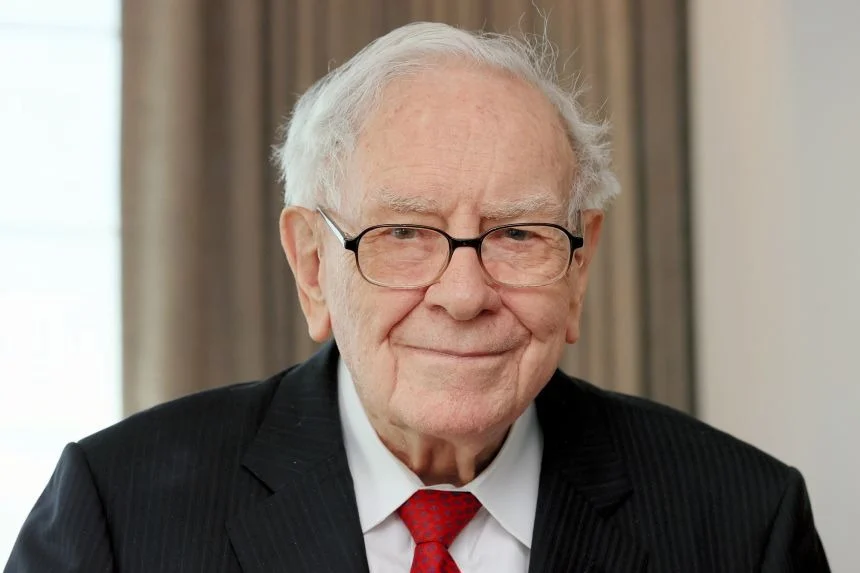






Warren Buffett, the 96-year-old investment icon known as the Oracle of Omaha, has announced his resignation as chairman of Berkshire Hathaway. This move follows his decision to step down as the company’s CEO late last year. Buffett has maintained the chairmanship since 1970 but will now transition to the role of chairman emeritus, remaining on the board of directors. Succeeding him in the chairman role is his son, Howard, who has served as a board member since 1993.
In a letter to shareholders, Buffett explained that he is stepping aside partially because CEO Greg Abel has exceeded his expectations. Reflecting on his own age, he noted that his one-year-old great-grandson is already moving a bit faster than he is. He added that while Father Time always wins, he has been generous in allowing him to see the firm reach a point where he feels more confident than ever about its future. Abel praised Buffett’s leadership, stating that his impact on the company and its owners remains without parallel in American business history.
Buffett’s career began in 1951 as a salesman at his father’s investment firm, Buffett, Falk, & Co. Following a period as a security analyst in New York, he returned to Omaha to launch his own firm in 1956. He began accumulating shares in Berkshire Hathaway in 1962, which was then a struggling textile manufacturer in New Bedford, Massachusetts. By 1965, he had acquired a controlling interest, eventually turning the firm into his primary investment vehicle. Under his guidance, Berkshire evolved into a diverse conglomerate, encompassing businesses such as GEICO, Burlington Northern Santa Fe, Fruit of the Loom, and Dairy Queen, achieving an average annual market value growth of 19%.
Today, Buffett holds a net worth of $145 billion according to the Bloomberg Billionaire Index. Despite this immense wealth, he has long been noted for a modest lifestyle, residing in the same Omaha home he purchased in 1958 for $31,500. A significant philanthropist, he co-founded The Giving Pledge in 2010 alongside Bill and Melinda French Gates to encourage the world’s wealthiest to donate half their assets. However, Buffett ended his donations to the Gates Foundation earlier this year, citing revelations regarding Bill Gates’ ties to Jeffrey Epstein.
Beyond finance, Buffett was a vocal advocate for tax reform, specifically the “Buffett Rule,” which proposed a minimum 30% tax rate on those earning over $1 million annually. The proposal became a key talking point during the 2012 reelection campaign of President Barack Obama but was ultimately blocked by Senate Republicans. Buffett’s own health battles included a prostate cancer diagnosis in 2012, from which he recovered after radiation treatment, allowing him to continue leading the company for another 13 years. Looking toward the future, he has stated that more than 99% of his wealth will be distributed to various charities upon his death, with total donations already reaching $60 billion. The report also notes that he also became the world’s 10th richest person and one of the most generous philanthropists. The report also notes that shares of Berkshire (BRK.A ) were little changed on the news. The report also notes that he wrote in a 2025 letter to shareholders, buffett’s will stipulates than more than 99% of his wealth at the time of his death is to be distributed to various charities. The report also notes that buffett disclosed in April 2012 that he was suffering from prostate cancer but that it was the least serious stage of the disease. The report also notes that arguing it was wrong that he owed a lower percentage of his income in taxes than his secretary and other middle-class taxpayers, buffett became a prominent advocate for higher taxes on the richest Americans. The report also notes that owning insurer GEICO, freight railroad Burlington Northern Santa Fe, clothing-maker Fruit of the Loom and ice cream chain Dairy Queen, berkshire grew to be a hugely successful and diversified company.