
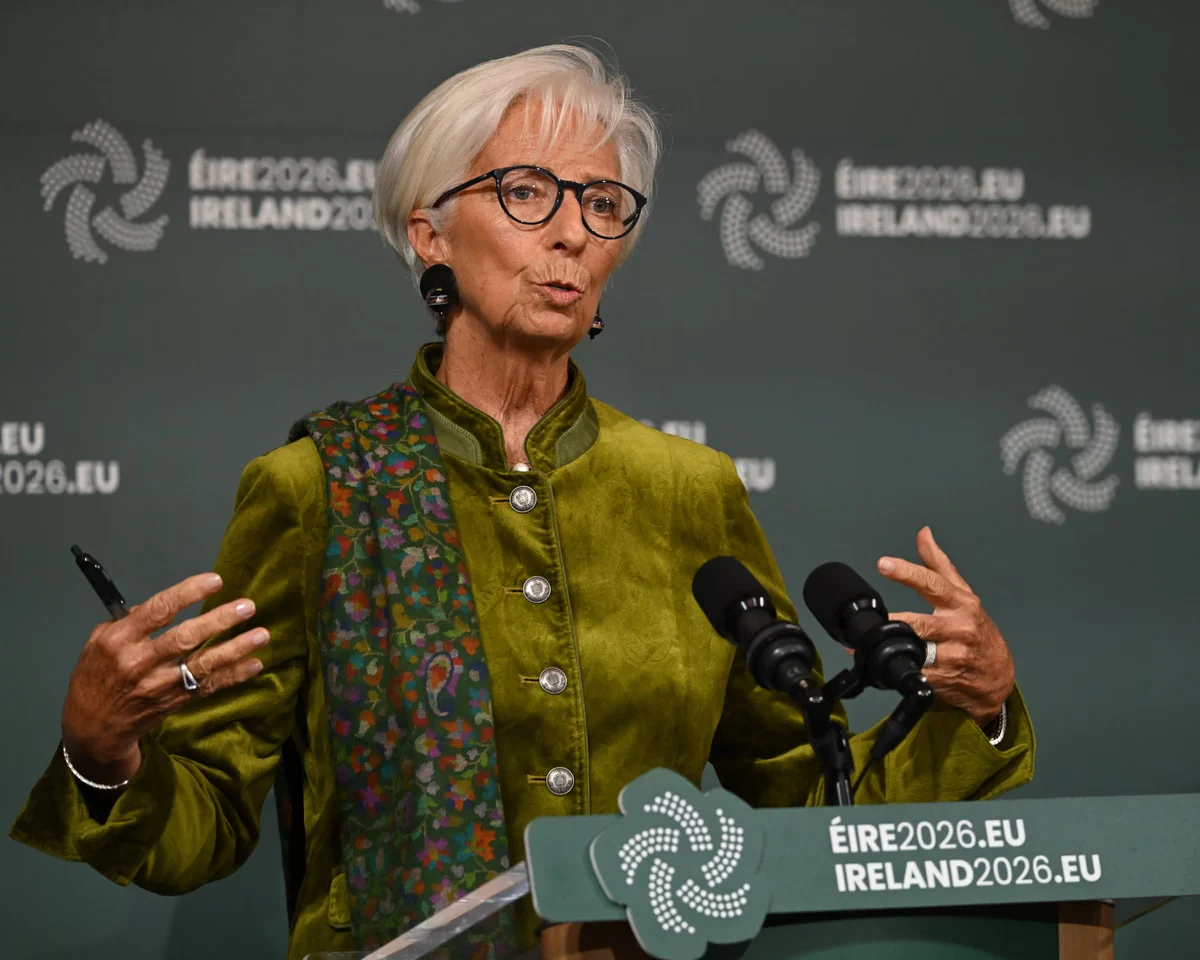









Europe finds itself at a critical crossroads regarding its future in artificial intelligence, a reality brought into sharp focus this week by European Central Bank head Christine Lagarde. She framed the continent’s predicament as a binary choice: either shun the technology and face diminished economic growth, or fully embrace it and risk deep dependence on tools engineered in the United States and China.
As the international debate surrounding AI safety intensifies, this choice threatens to become increasingly difficult. Should catastrophic scenarios occur, the technological impact will likely be felt across the continent regardless of Europe’s level of adoption. Currently, Europe remains largely sidelined in these high-level global discussions, a position stemming from the region’s failure to cultivate a tech titan comparable to Apple, Google, or OpenAI.
While the EU has established itself as a global leader in regulation, the absence of a homegrown champion in the AI sector has left it with a diminished voice. Ursula von der Leyen, president of the European Commission, attempted to assert influence this week, stating she would invite major frontier labs to discuss supporting industry efforts to pace development. However, her remarks failed to gain the same momentum as the dismissive stances taken by leadership in Washington and Beijing, rendering the prospect of global pacing difficult without their cooperation.
Lagarde’s recent address emphasized this inherent vulnerability, arguing that Europe must prioritize the construction of its own datacentres and local AI development to mitigate the danger of being cut off from international advancements. She noted that investing in indigenous technology is the only way for the continent to ensure its strategic autonomy remains intact. This sentiment was mirrored by former competition commissioner Margrethe Vestager in a report titled A Transformative AI Strategy for Europe.
Vestager warned that AI is poised to accelerate current economic hardships, with citizens already suffering from consequences dictated by external forces. The report recommends building more datacentres—the vital infrastructure of AI—to foster resilience against potential crises, such as a powerful model escaping human control. Despite this, Vestager maintains that the EU AI Act provides a necessary platform for dialogue, as it establishes formal requirements for developers of high-risk systems to disclose safety incidents.
The push for European self-sufficiency is driven by a belief that retaining local talent and inspiring innovation is non-negotiable. Vestager argued that if existential threats exist, they demand global cooperation that does not prioritize the interests of the US or China. She suggested that the UN General Assembly offers a vital opportunity to move beyond current power dynamics, creating space for the international community to act with urgency.
Not all observers agree that Europe is failing to compete. Frederike Kaltheuner of the AI Now Institute suggested that the narrative of European technological inferiority is an invention of American industry bosses. She argues that the narrow focus on the so-called AI frontier has obscured the market reality, where many firms are avoiding large models due to prohibitive costs and data security concerns. In this context, the EU’s focus on practical measures—such as content labeling and regulations for hiring and medicine—may provide a more stable foundation.
Itxaso Dominguez de Olazabal, a policy adviser at the digital rights organization EDRI, acknowledged that while Europe faces competitiveness challenges, these should not be blamed entirely on regulations. She warned against a “race to the bottom” fueled by deregulation in an attempt to mimic Big Tech’s growth. Meanwhile, legal experts like Linklaters partner Georgina Kon suggest that the EU AI Act is unlikely to become a universal benchmark due to its heavy compliance burden and territorial focus.
Ultimately, the threat remains that doomsday narratives may coerce Europe into a state of permanent technological dependency. By adopting US models out of a fear of being left behind, the continent risks losing its ability to shape its own digital future. The report also notes that europe’s dilemma over AI was rendered in stark terms this week. The report also notes that a result of the continent’s longstanding inability to produce a Silicon Valley-scale titan like Apple, Google or newcomer OpenAI, europe has largely been absent from the highest levels of that debate. The report also notes that much to the White House’s chagrin, its lack of an Anthropic or Nvidia-sized frontrunner in the AI race has diminished its voice in the safety debate, while it is a powerhouse in regulation. The report also notes that her remarks gained nowhere as much traction as Donald Trump and China’s dismissal of a slowdown. The report also notes that any sort of pacing is impossible – with our without Europe’s input, without the support of Washington or Beijing. The report also notes that lagarde’s speech on Monday underlined the continent’s relative weakness. The report also notes that and that requires a different kind of supranational body.