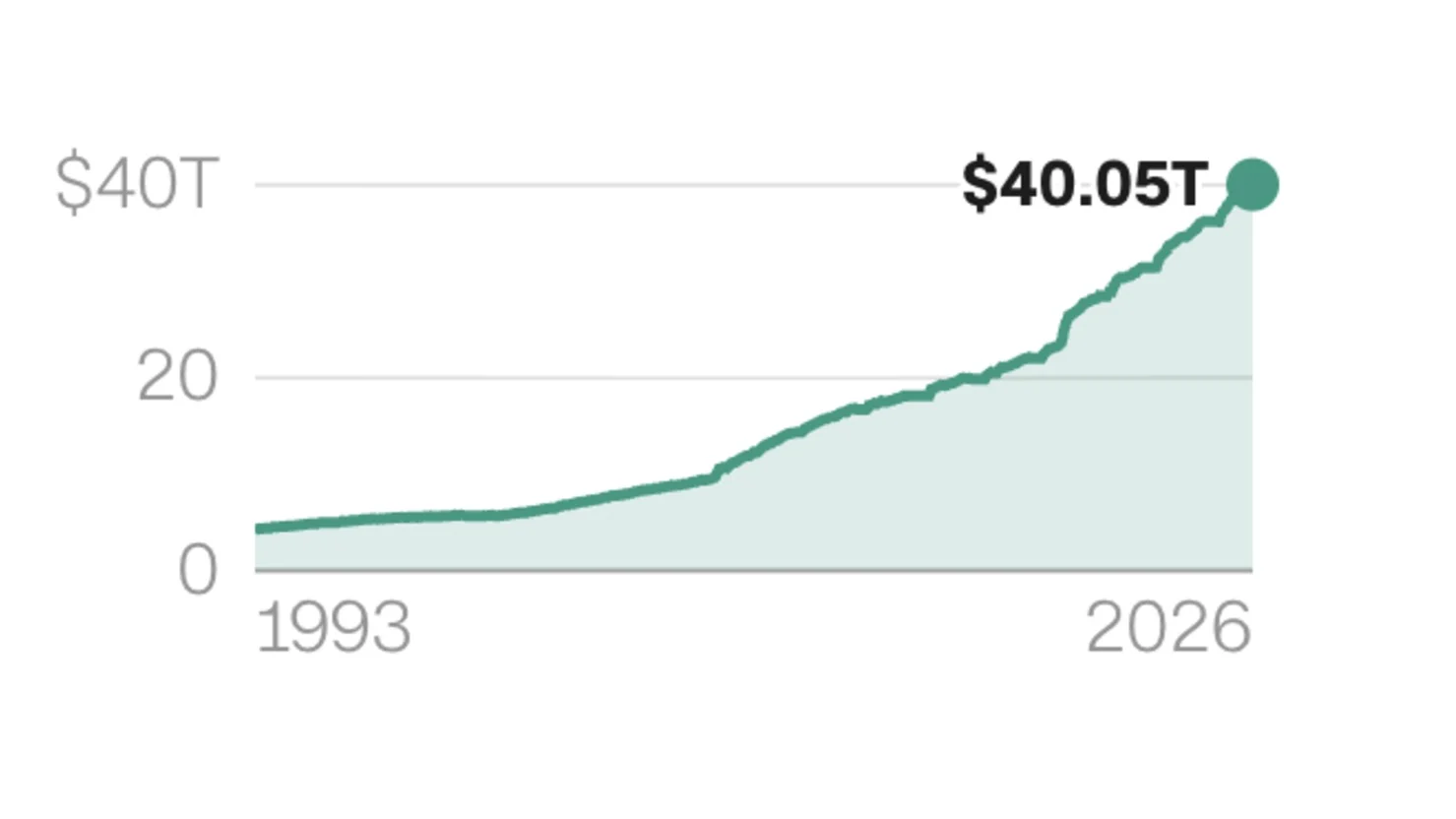









The United States federal debt has officially reached a record $40 trillion, according to the Treasury Department. This significant fiscal milestone arrives sooner than previously anticipated, as the Congressional Budget Office had projected in May 2023 that the nation would not cross this threshold until fiscal year 2028. The debt has surged by $1 trillion in just the last five months, highlighting the rapid pace at which the government is accumulating liabilities.
Michael Peterson, CEO of the Peter G. Peterson Foundation, warned that the country is on a dangerous trajectory. “On our current path, we’re going to be at $50 trillion in just six years. If you look backward, we were at $20 trillion less than 10 years ago,” Peterson stated, adding that the current fiscal situation is putting the economy and the nation’s future in jeopardy. The government has already recorded a $1.8 trillion deficit for the first 10 months of the current fiscal year, which concludes on September 30.
Several structural factors are driving this increase, including an aging population. With approximately 10,000 Baby Boomers retiring daily and seniors living longer, federal spending on Social Security and Medicare has risen sharply. Simultaneously, legislative actions over the past few decades—including the Tax Cuts and Jobs Act of 2017, the One Big Beautiful Bill Act of 2025 under President Donald Trump, and various pandemic relief measures enacted under both the Trump and Biden administrations—have contributed significantly to the debt load.
Rising interest rates have further complicated the fiscal outlook. After years of low-cost borrowing, the Federal Reserve’s efforts to combat inflation have forced the government to pay significantly more to service its debt. Interest payments are now projected to exceed $1 trillion this fiscal year, a record high. Marc Goldwein, senior policy director for the Committee for a Responsible Federal Budget, noted that these costs have tripled over the last five years and now rival Medicare as the government’s second-largest expense, trailing only Social Security. “We’re spending significantly more to service past debt than to invest in our future,” Goldwein said. “Our debt is begetting more debt. It creates a vicious cycle.”
The impact of this debt extends into the broader economy, influencing the bond market and borrowing costs for consumers and businesses. Yields on US Treasuries have climbed as investors demand higher compensation for the risks associated with lending to the government. Earlier this month, an auction for 30-year Treasuries saw the highest yield since 2001, and the 30-year yield hit its highest level since 2007 on Tuesday. These rising yields directly affect mortgage rates, auto loans, and business financing, potentially tightening financial conditions.
Maya MacGuineas, president of the Committee for a Responsible Federal Budget, emphasized that the debt is not merely a government ledger issue. “$40 trillion of debt doesn’t exist solely on the government’s ledgers; it is felt throughout the economy and finds its way to the pocketbooks of people one way or another,” she said. MacGuineas warned that increased borrowing exacerbates inflation and limits the government’s ability to respond to future emergencies.
In response to the rising yields and concerns regarding debt affordability, the Treasury Department announced plans to increase buybacks of long-term bonds. Despite these challenges and a 2025 credit rating downgrade by Moody’s, Congress has shown limited interest in addressing the long-term fiscal path. While the debt ceiling was raised by $5 trillion last year under the One Big Beautiful Bill Act, providing a buffer until 2027, analysts remain concerned about the sustainability of current spending levels. The report also notes that that means the US is spending more on interest payments than on national defense and 50% more than on children’s programs. The report also notes that although former Federal Reserve Chair Jerome Powell and others have said the US is on an “unsustainable fiscal path,” Congress has shown little appetite in recent years to address the nation’s unbalanced finances, which. The report also notes that the United States is digging itself into an ever-deeper debt hole. The report also notes that the tab has been growing more swiftly in recent years; interest payments on the debt have ballooned as interest rates and borrowing have risen; and all this is happening in relatively good economic times. The report also notes that these bedrock programs are on even shakier fiscal ground without enough workers to support the burgeoning number of beneficiaries. The report also notes that also, over the last few decades, Congress has passed multiple packages that cut taxes and increased spending, including the Tax Cuts and Jobs Act of 2017 and the One Big Beautiful Bill Act of 2025 under President Donald Trump, and several Covid-19 pandemic relief bills under Trump and former President Joe Biden. The report also notes that and the speed at which it is rising, is cause for concern, experts say, the size of the debt.