







At the close of a demanding day in the workshop, Mehmet Bulent Fistikci’s mentor, Hayri Akbay, would often share a guiding principle that transcended the technicalities of wood, wire, and shell. He would tell his apprentice, “My son, the work you do reflects your character. The cleaner your work, the cleaner your character will be.” Decades later, these words remain the cornerstone of Fistikci’s professional philosophy.
Born in 1976 and raised in Gaziantep, Fistikci’s path to becoming a master craftsman began almost by accident. As a child, he was frequently in trouble at home, leading his mother to seek out his uncle, a local carpenter, to take him on as an apprentice. “My mother told him, ‘Take him with you. He’s just sitting around doing nothing here again,’” Fistikci recalls. When that uncle later introduced him to a mother-of-pearl workshop, a chance encounter with a primary school friend—who happened to be the master’s son—secured his place. “He told his father, ‘He’s my primary school friend. Let him start working here.’ And I started there,” he says.
Fistikci’s aptitude was evident from the start. On his very first day, he was tasked with creating “kuncu,” a small brass decorative element. This was highly unusual, as apprentices typically spent three years in the workshop before being entrusted with such a task. “I started doing it on my very first day,” he notes. He remained in Akbay’s workshop for 15 years, staying until his mentor’s passing. Beyond the technical skills, he was deeply influenced by Akbay’s personal discipline. Despite the inherent dust and debris of the trade, his mentor always maintained a pristine appearance. “I never saw my mentor unshaved,” Fistikci says. “Even though a mother-of-pearl workshop can be dusty and dirty, he always dressed very neatly.”
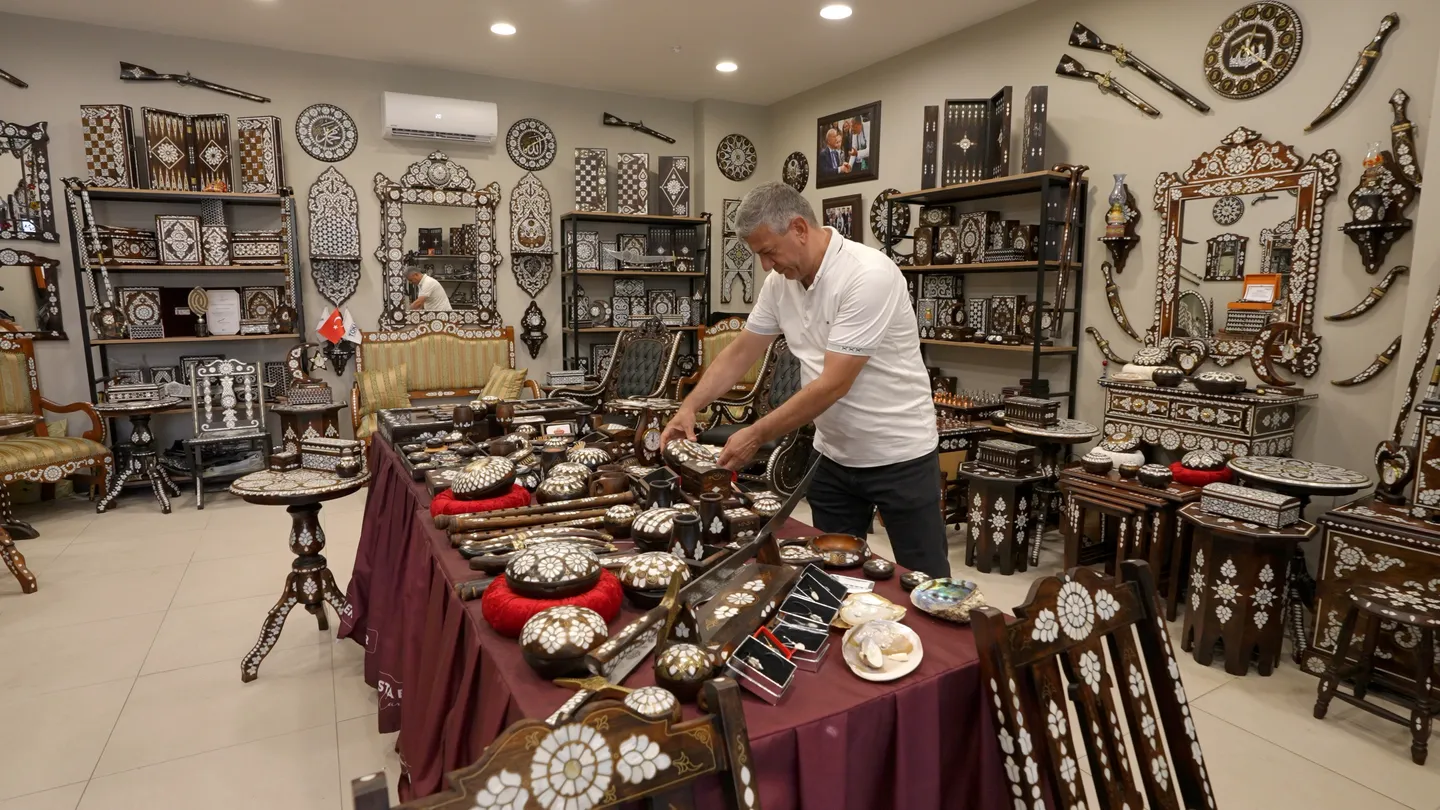
The craft of mother-of-pearl inlay holds a storied place in Ottoman decorative arts, famously championed by masters like Sedefkar Mehmet Aga, the architect of Istanbul’s Sultan Ahmed Mosque. In the late 19th century, Sultan Abdulhamid II further institutionalized the craft by establishing a workshop at Yildiz Palace, cementing the use of geometric compositions and floral motifs like tulips and carnations. Today, Fistikci continues these traditions, sourcing his primary materials from freshwater mussel shells found along the Euphrates River. He collects these shells during the July heat, ensuring they are repurposed rather than left to rot. “We make use of them without harming any living creatures,” he explains, noting that this local material is the finest in Türkiye.
His workshop also incorporates exotic varieties, including abalone, pearl-bearing shells, and red mother-of-pearl, which he views as nature’s own palette. The process is a rigorous, multi-stage endeavor. It begins with walnut wood, which is prepared by carpenters before Fistikci divides the surface into geometric forms. He then uses a “kesi” tool to carve channels for metal wire—typically 0.80-millimetre brass, though silver, aluminum, or alpaca are also used. The shells are broken with pliers, flattened, and hand-shaped to fit the design. Once the pieces are glued and the surface is sanded level, the result is a seamless, intricate object.
Fistikci has dedicated his life to ensuring this legacy continues. He established his own workshop, which was allocated a 60-square-metre space, and has surrounded himself with a long-term team. “It’s the same team, and we’ve stayed together all these years,” he says, describing his colleagues as family. This commitment to continuity extends to his own children. His eldest son, Ali, began working with him at age 10 and now serves as a master instructor at an Institute of Maturation, while his middle son, Hakan, works in the family shop. His youngest, Cagri, has also been trained by his father.
For Fistikci, the value of his work lies far beyond the material. “The material value is not what matters,” he says. “The emotional significance is beyond words.” His dedication has earned him significant recognition, including a prestigious award from the president, which he described as a great honor. Having spent nearly 40 years mastering his craft, the boy who was once led into a workshop by the hand is now the master, passing the same lessons of precision, patience, and character to a new generation. The report also notes that the Gaziantep-based craftsman has worked with walnut wood, thin strands of metal and shimmering pieces of mother-of-pearl, turning them into intricately decorated objects through a process that demands patience, precision and years of experience, for nearly 40 years. The report also notes that the technical skills he acquired during those years were only one part of his apprenticeship. The report also notes that over time, he came to understand that craftsmanship was not simply about producing an object. The report also notes that black, green, red and iridescent surfaces eventually become tiny pieces within much larger geometric and floral compositions. The report also notes that while names can also be incorporated alongside Ottoman numerals and Arabic, Turkish or Latin lettering, tulips and other flowers can form part of the composition. The report also notes that but the process behind it is anything but simple, the finished object may appear seamless. The report also notes that that continuity matters especially in a craft where knowledge has traditionally been passed directly from one pair of hands to another. The report also notes that now he occupies the other side of that relationship.