
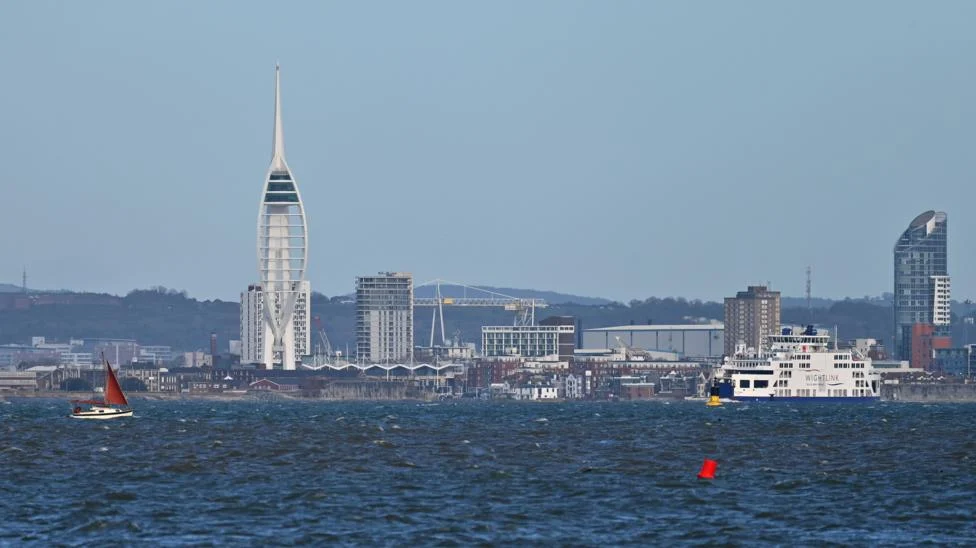







Port authorities in Portsmouth and Southampton both rejected requests to accept 120 migrants who had been intercepted off the Isle of Wight on Sunday. The migrants were eventually brought ashore at Eastney in Langstone Harbour, where their arrival was met with significant public disorder.
The Langstone Harbour Master, Billy Johnson, explained that the migrants were “recovered” onto two RNLI vessels near the Nab Tower. Due to the vessels being heavily overloaded, they were forced to travel at a very slow speed toward the landing site. Johnson noted that the coastguard was managing a search and rescue operation and argued there was “no reason not to accept” the vessels at Eastney.
Associated British Ports (ABP), which operates the Port of Southampton, stated it was not the nearest facility and that it “did not have suitable reception facilities available.” Similarly, the King’s Harbour Master in Portsmouth declined a request to allow the migrants into the harbour, though officials there declined to comment further on operational specifics.
The landing at Eastney triggered a major protest, with demonstrators blocking the only road leading into and out of the narrow peninsula. This obstruction prevented coaches carrying the migrants from departing, resulting in a standoff that persisted until the early hours of Monday morning. The incident followed a separate demonstration at the Port of Dover the previous day.
Portsmouth City Council condemned the choice of landing site, describing it as a “completely unsuitable location” that caused “needless disruption” to the local community. Billy Johnson acknowledged that the geography of the area made police management of the public order situation extremely difficult.
“The problem was managing the public order aspect that was also taking place and the geography of the area made that very challenging for the police,” Johnson said. He added that the speed at which public interest and reaction mobilized in the Solent was both unusual and surprising.
Despite the challenges, Johnson praised the coordination between emergency services. “The way the emergency services mobilised was really effective, with the police, Border Force, coastguard, the RNLI, ambulance and fire service working completely together – all of whom were hindered by the activities of protesters,” he stated.
The RNLI has expressed frustration regarding the handling of the situation. An organization spokesperson said they are working with relevant parties to understand why access was denied. The statement added that the charity is “disappointed with the nature of the communication with our crews, who voluntarily give their time to save the lives of others at sea.” The report also notes that more stories from Hampshire & the Isle of Wight.