








The vast expanse of space, once considered empty, is becoming increasingly crowded with man-made objects. Among these is Elon Musk’s personal cherry-red Tesla, launched on February 6, 2018, as a publicity payload for the maiden flight of SpaceX’s Falcon Heavy rocket. The vehicle, carrying a space-suited mannequin nicknamed “Starman” and playing a loop of David Bowie’s “Space Oddity” and “Life on Mars?”, is expected to drift through space for tens of millions of years before eventually colliding with Earth or Venus.
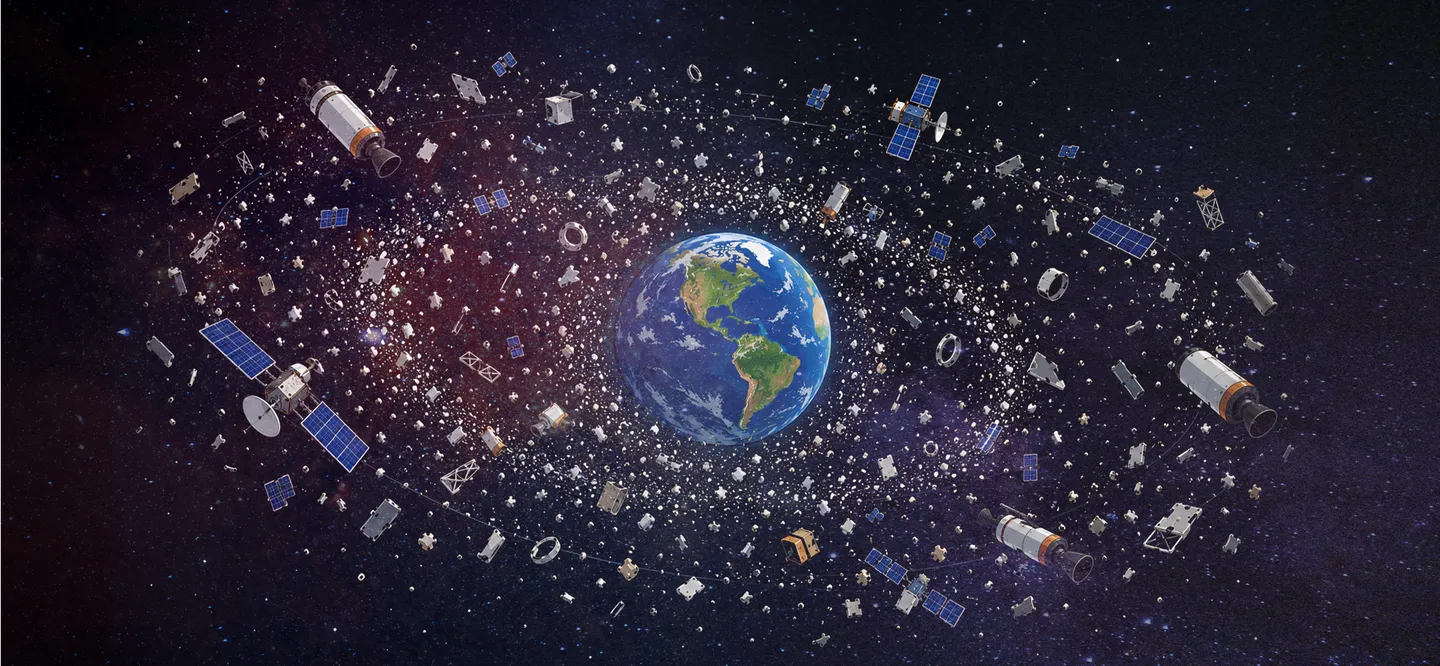
This car is just one of tens of thousands of items—ranging from spent rocket bodies to metal fragments—collectively known as space debris. These objects share orbital paths with a rapidly expanding fleet of satellites, creating significant operational risks. Because there is no air resistance in space, this debris travels at speeds reaching eight kilometres per second, maintaining its momentum and posing a constant threat to space infrastructure.
The situation is intensifying as companies prepare to deploy millions more spacecraft, including sunlight-powered data centres. John L. Crassidis, a professor at the University at Buffalo School of Engineering and Applied Sciences, warns that the risk of catastrophic collisions is no longer theoretical but is rising rapidly alongside the expansion of mega-constellations. A single collision could decimate a satellite and generate thousands of pieces of fast-moving shrapnel, potentially triggering a chain reaction of destruction.
This phenomenon, known as the Kessler syndrome, describes a scenario where repeated collisions create so much debris that entire orbital regions become unusable. Jonathan C. McDowell, a space sustainability analyst with 38 years of experience at the Harvard-Smithsonian Center for Astrophysics, notes that while designers work diligently on collision avoidance, he expects actual collisions to occur within the coming decade.
The current scale of the problem is evident in the maneuvers performed by satellite operators. SpaceX’s Starlink network, for instance, conducted over 355,000 collision-avoidance maneuvers in a single year, requiring individual satellites to dodge other objects on an almost weekly basis. Currently, approximately 54,000 objects measuring 10cm or larger are tracked. When the probability of a collision between two objects exceeds one in 10,000, operators are alerted. SpaceX has tightened this threshold to one in 1,000, with Starlink satellites programmed to move automatically.
However, relying on constant maneuvers presents its own challenges. Satellites have limited fuel supplies, and the cost of avoiding “very improbable” collisions already exceeds $2 billion annually. As constellations grow, the frequency of these maneuvers will increase, forcing operators to choose between expensive fuel resupplies or accepting higher collision risks.
The core issue, according to experts, is the absence of a binding international mechanism to enforce traffic rules. While the United States and its allies have established guidelines, and the United Nations released its own set in 2010 and 2021, these remain voluntary. Not all nations adhere to these standards, and there is no global authority to penalize those who break them.
Regulatory enforcement is currently inconsistent. For example, on October 2, 2023, the US Federal Communications Commission fined Dish Network $150,000 after its EchoStar-7 satellite ran out of fuel unexpectedly, leaving it 160km short of its agreed graveyard orbit. Crassidis emphasizes that the world needs leaders to transform existing guidelines into a formal international treaty that all countries are obligated to follow.
McDowell agrees that the current legal architecture under the UN is a bottleneck. Without an international body empowered to enforce rules and impose penalties, the risk of a Kessler-style chain reaction remains high. If left unaddressed, the space services that have become integral to the modern global economy may begin to degrade, threatening the future of orbital operations. The report also notes that the reason is not a lack of awareness. The report also notes that “Nevertheless, the risk is real, and I expect collisions to start happening in the coming decade,” he said. The report also notes that dedicated science and space publications have documented a sharp rise in last-minute dodges as mega-constellations fill the most useful altitudes in outer space. The report also notes that crassidis describes how the present warning system works. The report also notes that “Currently, we track about 54,000 objects that are 10cm or greater in size,” he says. The report also notes that “If the chance is greater than one in 10,000, then we will call one of the satellite companies and tell them they should move to avoid a possible collision. The report also notes that “(SpaceX founder Elon) Musk reduced that down to one in 1,000, and that information is uploaded directly to the Starlink satellites, which automatically move,” he says.