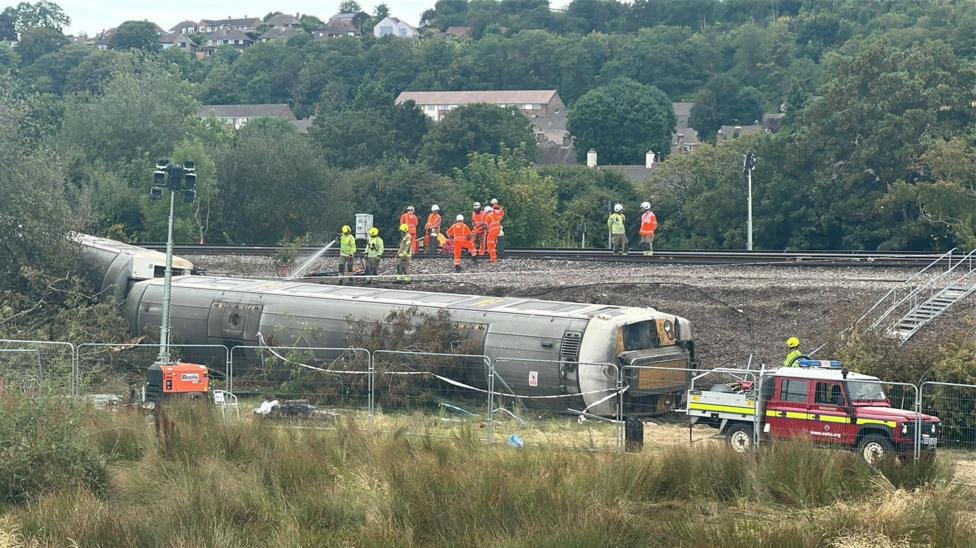









A formal investigation into the derailment of a Southern Rail train near Lewes has identified a specific defect in the track geometry. The Rail Accident Investigation Branch (RAIB) reported that an “irregularity” was detected at the Landport site where three carriages tumbled down an embankment last Thursday.
The incident occurred at approximately 15:54 BST as the 14:24 service from London Victoria to Eastbourne traveled through the area. According to the RAIB, the eight-carriage train was moving at 65 mph, which was within the designated 70 mph speed limit, and the driver had already initiated braking maneuvers as the train approached the location.
CCTV footage captured by a train passing the site at 14:04 BST confirmed the presence of the track irregularity just before the point of derailment. Furthermore, the RAIB noted it had received “several reports of rough riding at the location of the derailment from passengers on other trains” prior to the crash.
The derailment resulted in 30 total injuries. Two individuals sustained serious injuries, while 18 others were hospitalized for less severe conditions; all 18 have since been discharged. Recovery operations at the site remain ongoing.
Investigators are now examining the potential impact of extreme weather, as the accident occurred during a period of sustained heat. Temperatures reached 33°C (91.4°F) shortly before the derailment. The RAIB highlighted that the local clay embankment and underlying materials are highly sensitive to moisture fluctuations, which can cause ground movement.
The ongoing inquiry will evaluate track maintenance and inspection protocols, the condition of the embankment, and the effectiveness of existing hot-weather mitigation strategies. Martin Frobisher, group safety and engineering director at Network Rail, previously confirmed that no speed restrictions were in place on that section of the line at the time of the incident, though he maintained that the network remains safe.
In a joint statement, Lucy McAuliffe, Network Rail’s route director for Sussex, and John Whitehurst, chief executive of Greater Thameslink Railway, expressed their apologies for the event. They committed to reviewing all recommendations emerging from the investigation to enhance safety across the industry.
The Department for Transport emphasized that safety remains the “absolute priority” for the national rail network. Officials noted that the UK’s railways continue to be among the safest globally, citing a 45% reduction in delays attributed to track faults since the late 2000s. The report also notes that recovery work is continuing after a train left the tracks near Lewes. The report also notes that and 18 were taken to hospital with less serious injuries, the derailment left two people seriously injured. The report also notes that the eight-carriage train was travelling at about 65 mph when it derailed – within the 70mph speed limit – and the driver had begun to brake as the train approached the site. The report also notes that and may move as moisture levels change, the RAIB says the clay embankment and the material underneath it are sensitive to changes in moisture content. The report also notes that with the shared goal of making an already safe railway even safer for our customers, colleagues and the communities we serve, they added: “We will carefully consider any recommendations arising from the investigation and work across the industry to implement them.