
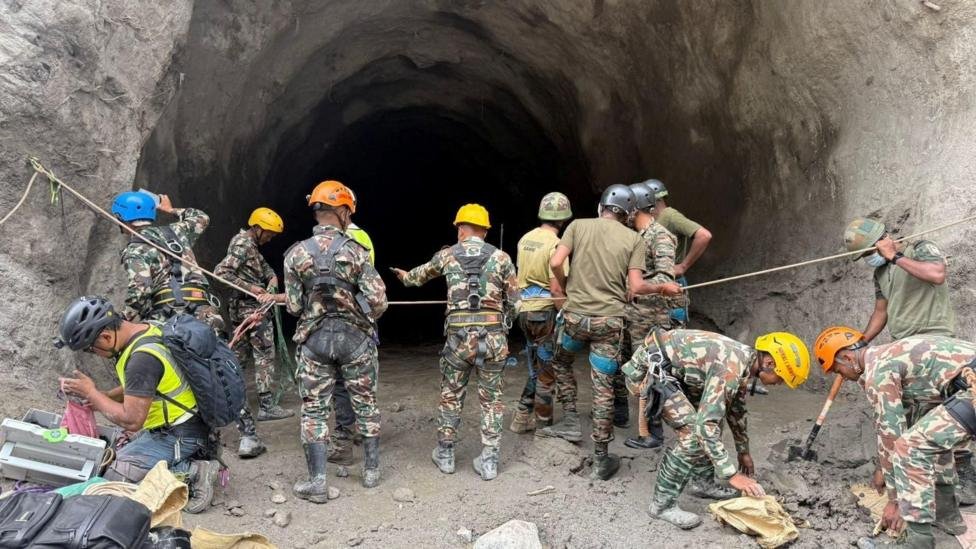





Rescue teams are working against time to reach more than 600 workers believed to be trapped within a vast, mud-choked network of tunnels along Nepal’s Trishuli River. As the critical window for finding survivors narrows, military personnel have begun using explosives to blast through hillsides, allowing them to pump air into the Trishuli-3A site.
The disaster has claimed 939 lives along the Nepal-Tibet border, according to Nepal’s disaster management authority. Officials have also Approximately one in seven of those missing are employees at various hydropower plants, which serve as vital infrastructure for the nation.
Prime Minister Balendra Shah confirmed that 279 individuals have been rescued from these sites so far. Despite the grim conditions, some family members remain hopeful. Sita Pandey, whose husband was working at a plant when the flooding struck, told the daily newspaper Kantipur that she maintains a 50% hope for his survival, citing the presence of an oxygen system within the facility. Anushila Bhandari, wife of 33-year-old engineer Aurus Bhandari, expressed the anguish of many, stating, “I wish we could find him. I wish he would come home.”
The rescue effort is a complex international operation involving military teams from Nepal and China, with technical support from experts based in India, Korea, and Australia. Arnold Dix, a former head of the International Tunnelling Association who is assisting remotely, described the landscape as unrecognizable. He noted that the search is hindered by boulders larger than houses, making the operation extraordinary in scale and difficulty.
While rescuers managed to enter one tunnel earlier on Monday, they were forced to withdraw after finding no one inside. This slow progress has drawn criticism from families like Jiban Khadka, who argued that the operation must accelerate, as every second is vital for those trapped underground.
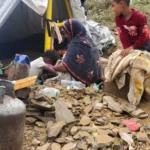
The impact on Nepal’s energy sector is significant, with at least 11 hydropower projects either completed or under construction suffering damage. In the downstream district of Chitwan, the situation has taken a somber turn. With local river systems depositing nearly 300 bodies along the banks, authorities have been forced to conduct makeshift burials.
Chief District Officer Ganesh Aryaal explained that the district is overwhelmed by the volume of remains and lacks sufficient freezer capacity. Medical teams are working to extract DNA from the unidentified victims so that families may eventually recover their loved ones. The area is currently marked by the heavy scent of decay, with workers in protective equipment transporting remains to burial sites.
Across the border in Tibet, official reports indicate 16 deaths and 546 people missing. Chinese authorities have restricted public discourse on the disaster, imposing administrative penalties—ranging from fines to short-term detention—on individuals who speculate online that actual casualty figures exceed official counts. Similarly, Nepalese authorities have ordered the removal of online content they classify as misinformation regarding the flood response.
Despite the devastation, experts like Dix maintain a degree of optimism for those underground, suggesting the subterranean environment may have provided some protection against the surface deluge. As the search continues, the families of the missing remain in a state of anxious vigil, waiting for news from the disaster-stricken river valleys. The report also notes that the agency also revised its estimate of the number of missing to 3,925, of whom 592 are foreign nationals. The report also notes that including local and migrant labourers and high-skilled engineers, each hydropower plant employs hundreds of workers. The report also notes that the more our hope dies, the longer it takes. The report also notes that noting that 11,379 people had been rescued so far, nepalese leader Shah said rescue operations had been “intensified”. The report also notes that whose brother Milan was working as an engineer in the Upper Trishuli-1 plant when the floods hit, another family member anxiously awaiting news is Priya Kharel. The report also notes that they can be saved, so there is hope that if the army reaches them quickly. The report also notes that the actual signature of them has gone – everything is just missing.