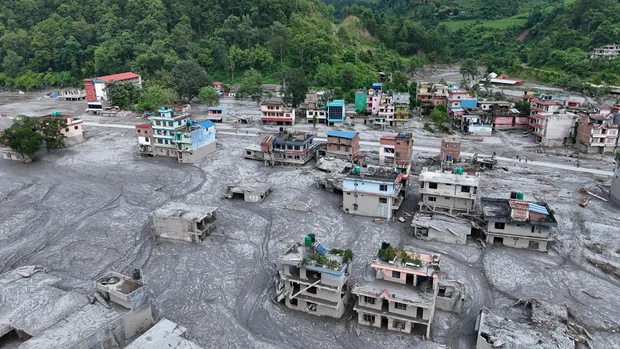







The death toll from Wednesday’s catastrophic flash floods in Nepal and along the border with China has climbed to at least 676, with approximately 3,000 individuals still reported missing. As rescue efforts enter their fourth day, authorities are struggling against severe weather and treacherous terrain, which have repeatedly forced the suspension of helicopter operations.
While more than 3,700 people have been rescued within Nepal, the situation remains dire. On the Chinese side of the border, state media reports that 558 people remain missing. In Nepal’s Rasuwa district, Brigadier General Raja Ram Basnet stated that officials believe over 100 people are trapped inside a mud-filled tunnel at a hydropower construction site. Rescuers have attempted to reach survivors using ropes and baskets, but progress is hindered by four to five feet of thick debris and a severe lack of viable landing zones for aircraft.
Priti Kharel, whose brother Milan is an engineering geologist at the site, expressed the growing desperation of families. “It’s already four days,” she said. “We want the government to rescue him as soon as possible.” Foreign Minister Shisir Khanal emphasized that locating the missing is the nation’s top priority. The government has requested specialized international assistance, including survivor-detection technology and forensic support. An 11-member reconnaissance team from India has already arrived, with a similar contingent expected from China.
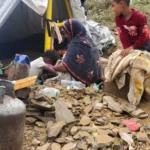
In Kathmandu, hospitals and government offices have become hubs of grief and uncertainty. Families gather daily to scan lists of the missing and view photographs of unidentified victims. Security official Gajendra Rawat noted that families have registered roughly 1,600 missing persons at the main hospital help desk alone. Many, like Dil Maya Lama and Nelza Moktan, continue to search for relatives employed in the Rasuwa hydropower sector, clinging to the hope that their loved ones might still be found.
The scale of the disaster is vast, with the Red Cross estimating that 90,000 people have been affected. India has provided over 57 metric tons of relief supplies to support the ongoing recovery. Meanwhile, rescue teams remain on high alert due to the risk of secondary flooding from a new lake formed in the Himalayas. While Chinese water resource monitoring indicated the lake’s water level dropped by 32 feet from its Thursday peak, the threat persists.
Geoscientist Jakob Steiner of the University of Graz explained that the initial disaster was likely triggered by the collapse of bedrock beneath a Himalayan glacier. He warned that such events are becoming the “new normal” as the Hindu Kush Himalayan region warms rapidly, destabilizing snow, ice, and mountain slopes. Approximately 78% of the region’s glaciers are undergoing significant changes.
International involvement remains critical as the search continues. The U.S. State Department confirmed that five Americans have reached safety, while about 90 U.S. citizens remain unaccounted for. The U.S. Embassy in Nepal is coordinating with local authorities to deliver essential supplies, including food, blankets, and mosquito nets through partners like Caritas Nepal. Among the missing are 22 Americans associated with a pilgrimage organized by the Isha Foundation. Community liaison Leslie Crespi stated that the foundation is awaiting word on the group, which included 13 women and nine men. President Trump addressed the tragedy on Thursday, describing the destruction of well-built structures as “terrible to see” and offering U.S. support to Nepalese leadership. The report also notes that in Nuwakot, one of the Nepali districts devastated by the floods, helicopters resumed operations before noon Saturday after poor weather temporarily obstructed their activities. The report also notes that including clothes, instant noodles, crackers and rice, some helicopters were loaded with boxes and bags of aid. The report also notes that others returned from the flood-hit areas carrying survivors. The report also notes that trek or make a pilgrimage to a sacred peak on the Tibet side of the border, hundreds of the missing are foreigners who were in the area to work. The report also notes that rescuers pulled and pushed a man covered in dark brown mud out of the tunnel, in a video from the scene. The report also notes that but the operation remained difficult because of 4 to 5 feet of mud and the limited number of places where helicopters could land, basnet said rescuers had used baskets and ropes to reach some people. The report also notes that and his family has not heard from him since the floods, he works as an engineering geologist at Doosan Enerbility.