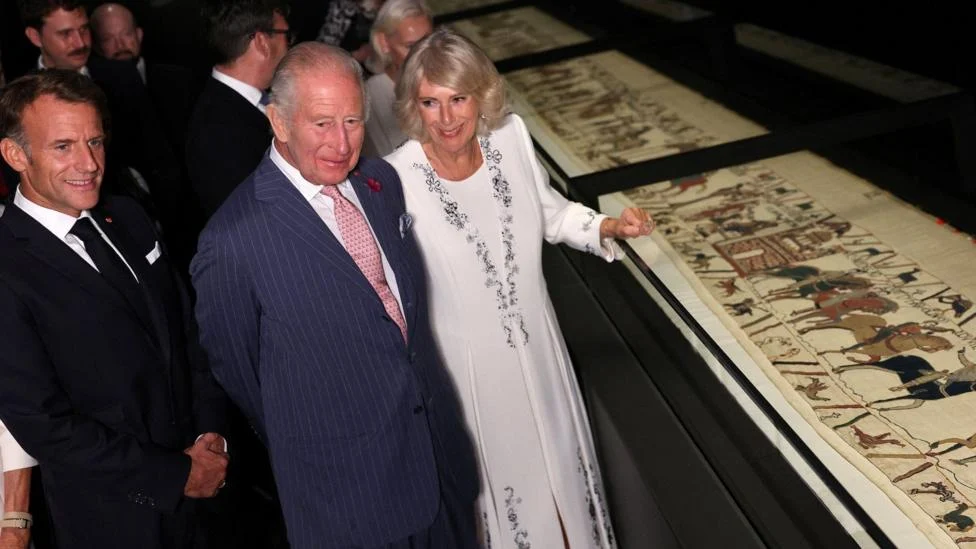








King Charles has officially welcomed the arrival of the Bayeux Tapestry at the British Museum, describing the artifact as an “unprecedented loan” and the “best possible symbol” of the enduring ties between the United Kingdom and France. The monarch viewed the medieval masterpiece in London on Wednesday, just one week before it opens to the public.
The event was attended by French President Emmanuel Macron and UK Prime Minister Andy Burnham. During his address in the museum’s Great Court, the King noted his own ancestral connection to the tapestry, identifying as a direct descendant of William, Duke of Normandy. He remarked that the embroidery documents the “French side of my family’s history in these islands,” referencing the 1066 Norman invasion and the subsequent defeat of King Harold at the Battle of Hastings.
The 70-meter (230-foot) tapestry, believed to have been crafted by English women for Norman rulers in the 1070s, depicts the Norman Conquest through 58 distinct scenes. It features 627 human figures, 737 animals, 37 ships, and 23 trees, all accompanied by Latin narration. While the King praised the exhibition as a sign of unity between two nations sharing “fundamental values,” the leaders engaged in some lighthearted banter regarding the historical narrative. President Macron observed the “happy end” of the display, while Prime Minister Burnham joked that the English creators “couldn’t bear to show the end” of the story.
For Prime Minister Burnham, the visit marked his first official joint engagement with the King since taking office in July. French officials indicated that the summit provided a valuable opportunity for President Macron to build a rapport with the new Prime Minister. Their discussions reportedly covered significant geopolitical issues, including the conflict in the Middle East, support for Ukraine, and ongoing relations with the European Union. The topic of small boats crossing the Channel was also expected to be on the agenda, mirroring the maritime themes depicted in the ancient embroidery.
President Macron, who first proposed the loan during a state visit in July 2025, expressed his delight that the project had finally come to fruition. He described the exhibition as a powerful reminder of what the two countries can achieve when they “join forces.” The viewing was also attended by notable figures, including former Prime Minister Theresa May and historian Dame Mary Beard.
The tapestry is currently displayed in a specialized, illuminated glass cabinet that allows visitors to view the work lying flat. Experts believe this orientation is superior for the long-term conservation of the fragile fibers. The display also provides a clearer view of the intricate details in the margins, which include various animals, plants, and even bawdy imagery. Culture Secretary Lisa Nandy noted that the dramatic final scene, depicting King Harold’s death, has already resonated strongly with school groups visiting the museum.
The artifact has a storied history, having survived near-destruction during the French Revolution when it was nearly repurposed as covers for military carts. Given its age and significance, the exhibition has seen immense public interest, with tickets already sold out through the end of 2026. The British Museum announced that the next batch of tickets, covering the period from January to March 2027, will be released on 21 October. The report also notes that if not accusations of a stitch up, there was also some cross-Channel teasing about the outcome of the Norman invasion story. The report also notes that of oaths and journeys, of ships, councils, kings, comets and consequences,” said the King, the tapestry’s story is one of ambition and uncertainty. The report also notes that indeed, from the moment of its creation, it may have brought together our two peoples,” he said, weaving in the historic importance of the artwork. The report also notes that burnham joked about his own new role as prime minister – saying the tapestry “showed a new leader emerging from a northern territory and travelling to the south of England”. The report also notes that originally embroidered in England but kept for centuries in France, tells the story of the Norman Conquest and the Battle of Hastings in 1066, the 70m (230ft) tapestry. The report also notes that with the figures remarkably vivid for something almost a 1,000 years old, and visitors file along, following the story of the Norman invasion, it’s displayed in a long glass illuminated cabinet.