








One week after Saudi Arabia, Pakistan, and Turkiye formalized a joint defence agreement, the Turkish defence ministry has provided further clarity on the alliance’s structure. Officials confirmed that the pact includes commitments to conduct joint military exercises and significantly deepen cooperation between their respective defence industries.
This initiative to bolster security ties among three major Muslim-majority economies arrives during a period of heightened military volatility in the Middle East. Amid the ongoing US-Israeli conflict with Iran, Saudi Arabia has faced repeated strikes from Iranian forces, which claim to be targeting US military assets within the Gulf region.
Pakistan’s foreign ministry clarified that the agreement stipulates that an armed attack on any one of the three nations will be treated as an attack on all, mirroring the collective defence clause found in NATO’s Article 5. During a briefing in Ankara on Thursday, the Turkish defence ministry emphasized that the primary objective is to place military and defence relations on a more institutional and sustainable footing.
The accord aims to establish strategic political and military mechanisms involving defence ministers, foreign ministers, and chiefs of general staff or armed forces commanders. These structures are designed to ensure that coordination between the three nations is conducted at the highest levels of government.
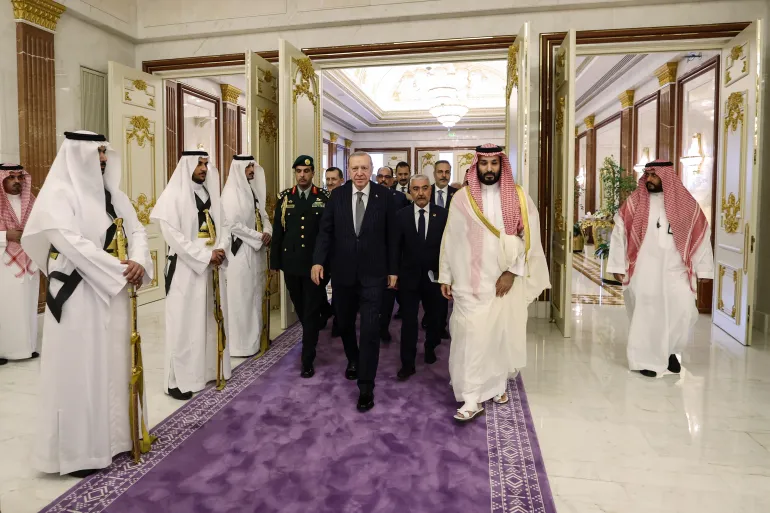
The agreement follows a diplomatic visit to Saudi Arabia by Pakistan’s Prime Minister Shehbaz Sharif, who was accompanied by army chief Asim Munir to perform the Umrah pilgrimage in Mecca. Shortly thereafter, Turkish President Recep Tayyip Erdogan traveled to the kingdom to meet with Saudi Crown Prince Mohammed bin Salman.
Turkiye, which maintains the second-largest army within NATO, has indicated that the pact is open to expansion, with Egypt cited as a potential future candidate. Officials stressed that the agreement is not intended to replace existing alliances. Historically, mutual defence pacts have been used to deter large-scale interstate wars, though analysts note their effectiveness often diminishes when conflicts shift into “grey zone” scenarios, such as proxy violence, internal repression, or military occupation.
The concept of collective security is well-established in international law. NATO, which grew from Cold War concerns regarding Soviet expansionism, was signed by 12 founding nations in 1949 and has since expanded to 32 members, including Sweden. Its Article 5, which defines an attack on one as an attack on all, has been invoked only once, following the September 11, 2001, terrorist attacks on the United States.
Similarly, the Treaty on European Union (TEU) established a mutual defence obligation in 2009. Under Article 42(7), EU members are required to provide aid and assistance by all means in their power if a member faces armed aggression. France notably invoked this clause in 2015 following the Paris attacks that resulted in 130 deaths.
Other regional frameworks include the Collective Security Treaty Organization (CSTO), established in 2002 with members including Russia, Armenia, and several Central Asian states. Its Article 4 mandates military aid in the event of aggression. The CSTO deployed troops once, in 2022, to assist Kazakhstan in managing civil unrest.
The Arab League, formed in 1945, also signed a mutual defence treaty in 1950, while the 1947 Rio Treaty in the Americas established a similar principle of collective response, which was utilized during the 1962 Cuban Missile Crisis and after the 2001 attacks on the US. Additionally, the 1951 ANZUS treaty between the US, Australia, and New Zealand provided a Pacific security framework, though the US suspended obligations to New Zealand in 1986 over anti-nuclear policies.
Bilateral agreements have also served as cornerstones of US foreign policy, such as the 1951 pact with Japan and the 1954 treaty with South Korea. These frameworks have allowed for the long-term stationing of approximately 50,000 and 28,500 US military personnel in Japan and South Korea, respectively.
Finally, the Gulf Cooperation Council (GCC), founded in 1981 by six Arabian Peninsula states, sought to promote regional cohesion. In 1984, the GCC created the Peninsula Shield Force, a standing coalition land force intended to provide a collective security response during the Iran-Iraq War.
The US, Canada, Belgium, Denmark, France, Iceland, Italy, Luxembourg, the Netherlands, Norway, Portugal and the United Kingdom signed the initial treaty on April 4, 1949.
The group has expanded into a 32-member alliance, with Sweden being the most recent member two years ago.
The US also entered multiple bilateral treaties with different countries in the 1950s and 1960s.
The mutual defence pact is similar to several others in the region and beyond, yet many have had mixed records in practice.
Experts say they often serve merely as a signal of a strengthened political alliance rather than being a true collective defence.
This provided Washington with strategic reassurances to its pact partners and went some way to shape their domestic and foreign policies.
A key provision of the NATO treaty, the so-called Article 5, states that if one member of the alliance is attacked in Europe or North America, it will be considered an attack on all members.
That effectively put Western Europe under the ‘nuclear umbrella’ of the US.
According to NATO, the alliance plays an important role in fighting “terrorism”.
It came amid the formation of Israel and its threats to countries in the region.
This agreement was signed in 1951 in San Francisco alongside the World War II peace treaty.
This treaty came into effect in 1954.
While it was never invoked, it gave the US a legal framework to station about 28,500 troops in South Korea.
It is composed of infantry, armour, artillery and combat support elements from each of the states, with 40,000 personnel.
The 2000 Joint Defence Agreement was signed to develop a joint military industry for arms manufacturing.
In September 2025, when Israel attacked Hamas leaders in Qatar, the GCC pledged to “activate a joint defence mechanism”.
The modern EU was officially formed in 1993 in the Netherlands with the signing of the Maastricht Treaty.
The CSTO has deployed troops once, in 2022 in Kazakhstan upon the request of Kazakh President Kassym-Jomart Tokayev to help manage demonstrations caused by rising fuel prices.