






Houthi forces secured control of the Yemeni port city of Mocha on Thursday, marking a significant escalation in the ongoing conflict between the Iran-aligned group and the Saudi-backed government. The offensive, which began on September 3, saw the Houthis exert pressure across three key fronts: western Taiz, southern Hodeidah, and Mocha itself.
The fall of the city followed the withdrawal of the National Resistance Forces, a central component of the Saudi-backed alliance. Led by Tareq Saleh—nephew of the late former President Ali Abdullah Saleh—these forces reportedly moved toward Mocha at dawn. While the exact reasoning for this retreat remains unclear, correspondent Maha Ali noted that Saleh ordered a tactical repositioning to counter Houthi advances in the al-Waziyah and Mawza sectors.
The military shift has triggered an immediate humanitarian crisis. Hundreds of women and children have fled the area, seeking refuge in the government-controlled provinces of Lahij and Aden. This movement adds to the broader instability in Taiz and al-Hodeidah, where more than 20,000 people have already been displaced over the last two weeks due to intensifying clashes.
Yemeni affairs editor Ahmed al-Shalafi emphasized the severity of the situation, noting that the displacement is directly linked to the collapse of government-aligned defenses. Defense policy analyst Wolfgang Pusztai described the loss of Mocha as a potential turning point in the war, warning that it could lead to the breakdown of government forces in southern Yemen, as the port was the last major harbor fully held by the internationally recognized administration.
The conflict is rapidly expanding into maritime and inland territories. Reports indicate that Houthi fighters have launched attacks on the strategic Red Sea islands of Hanish. In response, pro-government air forces have targeted Houthi positions in Al-Tuhayta, Al-Salif, and Kamaran Island, while the Houthis have fired ballistic missiles toward Zuqar Island. Further inland, warplanes have struck Houthi reinforcements moving toward Marib and Fardhat Nihm.
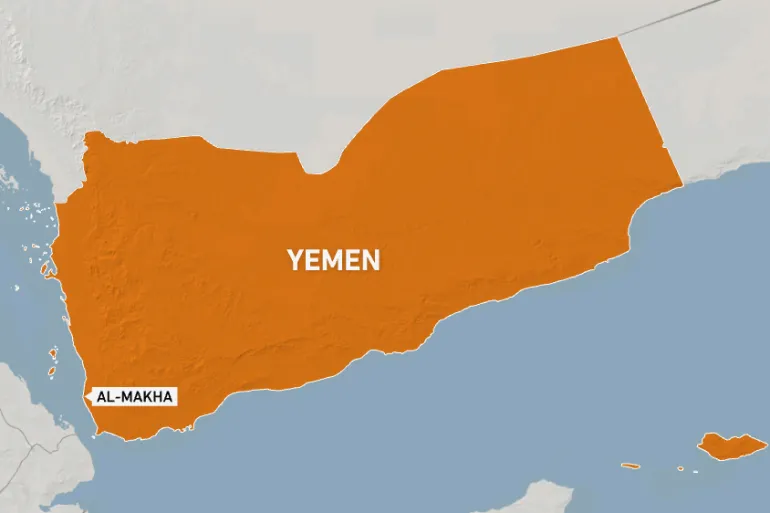
Mocha’s strategic importance cannot be overstated. Located roughly 75km north of the Bab al-Mandeb Strait, the city serves as a critical gateway for global energy and commodity shipments moving between the Gulf and the Mediterranean via the Suez Canal. Analysts warn that control of the port grants the Houthis a potential stranglehold over this vital maritime artery, while simultaneously severing essential supply lines connecting Mocha to Taiz.
The international community has responded with concern, with the United Kingdom’s Foreign Commonwealth and Development Office holding the Houthis responsible for the crisis and calling for an immediate cessation of hostilities.
Historically, Mocha is renowned as the birthplace of the global coffee trade. The city, mentioned in ancient Himyarite texts as “Makhn,” rose to prominence in the 17th and 18th centuries after Sufi scholar Ali bin Omar al-Shadhili introduced coffee to the region. The Ottomans began exporting beans through the port in 1536, eventually drawing European traders like the Dutch, who secured commercial deals in 1628.
The city’s influence waned in the late 19th century due to geopolitical friction between the British and Ottomans, alongside the rise of competing ports in Aden and Hodeidah. This economic decline saw the local population drop from approximately 20,000 in the 1800s to just 1,000 by the 1930s. While the population had recovered to over 10,000 by 2004, the current military offensive now threatens the stability and future of this historic coastal hub. The report also notes that “Areas south of Hodeidah and Mocha witnessed waves of displacement towards Dhubab and Aden,” he said. The report also notes that the combat was intense on the outskirts of Mocha. The report also notes that or for a military reason, or due to their inability to withstand the intense military formations”, he added that it is unclear whether the National Resistance Forces withdrew “to arrange their ranks. The report also notes that mocha’s geography makes its capture a global concern. The report also notes that which connects the Red Sea to the Gulf of Aden, the city sits approximately 75km (47 miles) north of the Bab al-Mandeb Strait. The report also notes that this narrow passage is a critical artery for crude oil and fuel travelling from the Gulf to the Mediterranean via the Suez Canal, as well as for Asian commodities and Russian oil, known as the Gate of Tears. The report also notes that yousef Mawry explained that controlling Mocha could give the Houthis a “stranglehold along the Bab al-Mandeb”. The report also notes that the city was first seized by Abyssinians in 517 AD before they were expelled by the Himyarite King Dhu Nuwas, mentioned in ancient Himyarite texts as “Makhn”.