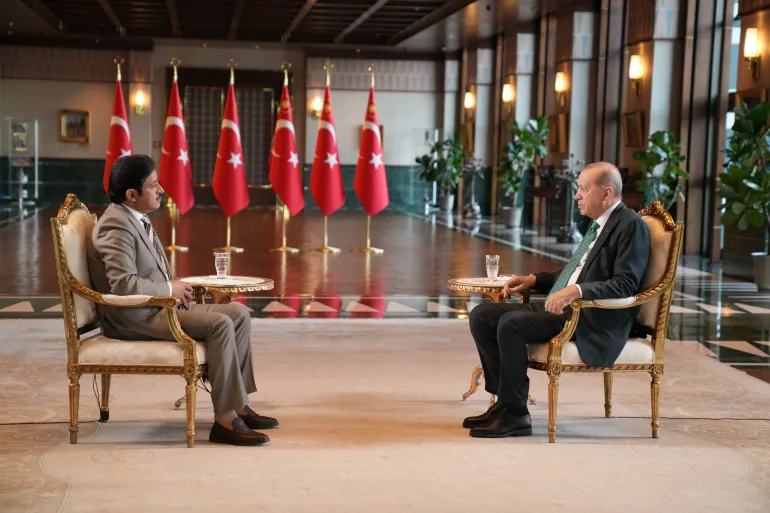






Turkish President Recep Tayyip Erdogan has suggested that Egypt could eventually join the newly formed joint defence agreement between Turkiye, Saudi Arabia, and Pakistan. In an exclusive interview for Al Jazeera’s Al Muqabala, set to air this Sunday, Erdogan characterized Cairo’s potential inclusion as “possible” and emphasized that the pact remains open to further expansion.
The agreement, formally known as the Mecca Pact, was signed last Friday in the holy city by Erdogan, Saudi Crown Prince Mohammed bin Salman, and Pakistani Prime Minister Shehbaz Sharif. The treaty functions as a collective-deterrence mechanism, stipulating that an armed attack against any one of the three signatories would be treated as an aggression against all of them. While analysts have drawn parallels to NATO’s Article 5, officials in Islamabad have cautioned against viewing the pact as a direct equivalent to the alliance or as a move targeting any specific nation.
During the interview, Erdogan addressed a broad spectrum of regional challenges, including the ongoing conflicts in Syria, Gaza, and Lebanon, as well as tensions surrounding the Strait of Hormuz. He identified the reopening of the strait as a key priority for Ankara, asserting that its closure serves no party’s interests. He also highlighted the mediation efforts led by Qatar as instrumental in attempting to de-escalate regional hostilities.
The Turkish leader reaffirmed his commitment to regional stability, pledging that Turkiye would not abandon its neighbors. Regarding Syria, he stated that Ankara is dedicated to supporting the country and plans a future visit, noting that he expects Syria’s Kurdish population to share in the benefits of peace and stability. He further committed to strengthening ties with Kurdish communities and protecting their rights throughout the region.
On the situation in Gaza, Erdogan declared that Turkiye cannot remain indifferent, promising to provide whatever support is necessary. He noted that Hamas has been acting in good faith regarding its commitments, while criticizing the ongoing Israeli military campaign. Regarding Lebanon, he expressed deep concern over persistent Israeli strikes and confirmed he had discussed the necessity of ending the conflict with U.S. President Donald Trump during their recent meeting in Turkiye, emphasizing Washington’s pivotal role in achieving a ceasefire.
Erdogan also addressed broader diplomatic relations, confirming that Turkiye continues to support Sudan and maintains positive ties with the head of its Sovereignty Council, Abdel Fattah al-Burhan. He described Ankara’s relationship with Libya as stable, vowing that Turkiye would remain a steadfast partner.
Turning to Europe, the president suggested that the European Union appears unwilling to admit Turkiye as a member. He stated that accession is no longer a priority for his government, warning that Europe would ultimately be the “loser” due to its stance. He also touched upon his desire to rejoin the F-35 fighter jet program, stating he is awaiting the fulfillment of a promise made by President Trump.
Turkiye was excluded from the F-35 program in 2019 following its acquisition of the Russian-made S-400 air defense system, which the U.S. argued posed a security risk to the aircraft’s technology. During the recent NATO summit in Ankara, Trump indicated his administration would lift the CAATSA sanctions imposed in December 2020 and suggested that a return to the program was under consideration. However, any potential sale faces significant hurdles, as a 2020 U.S. law currently prohibits the Pentagon from transferring F-35s to Turkiye while the S-400 system remains in its possession.
“This agreement has sent an important message to the world,” Erdogan said, adding that Egypt’s participation was among the options for its future expansion.
He also said he had received a promise from Trump regarding F-35 fighter jets and was waiting for it to be honoured.