
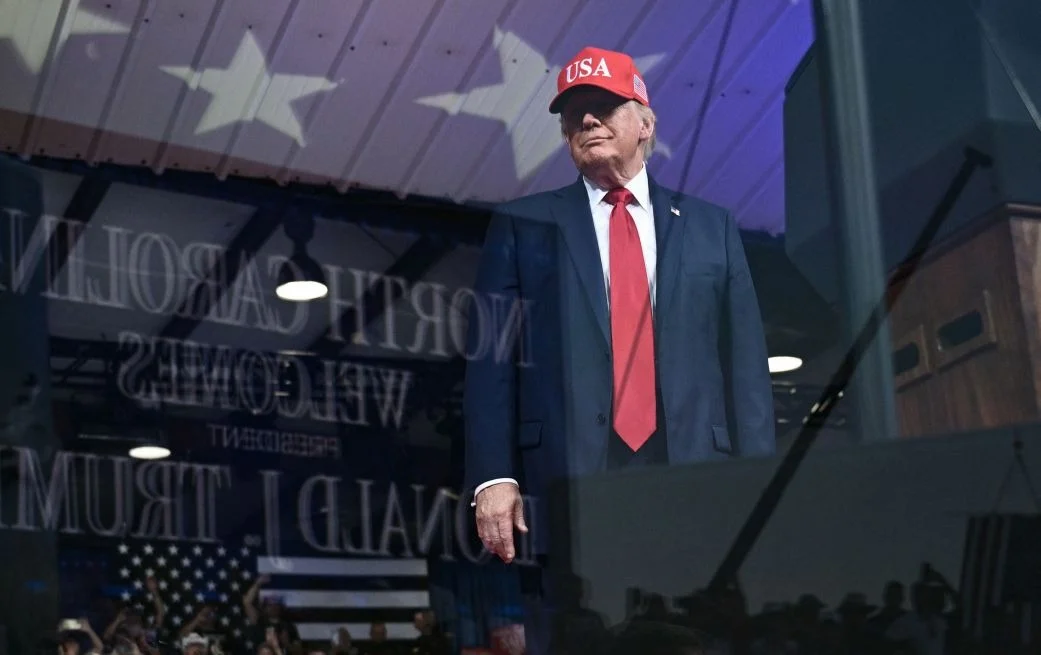






President Donald Trump remains a ubiquitous figure in American political discourse, yet he is notably absent from a critical platform during this year’s midterm elections: Republican television advertisements. While the president has repeatedly urged his supporters to treat the upcoming midterms as if he were on the ballot, his party is pursuing a significantly different strategy on the airwaves.
Analysis of AdImpact data from September 1 to September 15 reveals that Republican advertisers mentioned the president in just 12 spots, representing approximately $1 million in spending. This is a tiny portion of the broader GOP advertising push, which saw over 500 ads produced at a cost exceeding $160 million during the same period. In contrast, Democratic groups have leaned heavily into Trump’s image, airing 95 ads that mention him—accounting for nearly $23 million in spending, or roughly one-fifth of their total ad budget. These Democratic spots frequently aim to tether Republican candidates directly to the president.
The current climate poses a unique challenge for the Republican Party, as Trump’s national approval rating sits at 36 percent. A veteran GOP ad strategist, speaking anonymously to avoid White House tensions, remarked that the president is currently viewed by many in the party as neither the most effective message nor the best messenger for their campaigns. Consequently, GOP candidates and their allies are dedicating less than 1 percent of their advertising budget to mentioning the president, prioritizing instead the task of defining their Democratic opponents and highlighting policy wins, such as tax legislation.
Tax-related messaging has dominated the Republican strategy, with more than 200 ads airing in September focusing on the topic. The party has funneled over $70 million into these spots, comprising about two-fifths of their total ad expenditure for the month. Candidates like Rep. Ashley Hinson of Iowa have used these platforms to highlight the elimination of taxes on tips and overtime, while Senator Jim Risch of Idaho emphasizes his role in passing historic tax cuts for working families. Even when Trump is mentioned in these instances, the focus often shifts quickly toward bipartisan cooperation or specific legislative achievements, such as working to curb health insurance costs.
The disconnect between the president’s campaign rhetoric and his party’s ad spending is further underscored by the massive financial mobilization of outside groups. Although a new super PAC linked to the president’s network has committed over $100 million to assist vulnerable Republicans, these ads have largely ignored the president in favor of aggressive attacks on Democrats. For example, the No Going Back PAC has focused its messaging on figures like Michigan Senate candidate Abdul El-Sayed, former Senator Sherrod Brown in Ohio, and North Carolina’s Roy Cooper. Despite the president’s own bold claims regarding the state of the economy—which he frequently describes as the world’s hottest—these messages are not being echoed in the high-budget television spots funded by his top political allies.
Ultimately, the Republican advertising landscape reflects a calculated effort to navigate a challenging political map. While the president continues to hold rallies and fire up his base, GOP advisers are prioritizing strategies they believe are more likely to secure a Senate majority, even if it means leaving the party’s titular leader out of the spotlight. As the midterms approach, the reliance on policy-based advertising rather than personal association with the president highlights the nuanced, and often cautious, approach Republicans are taking to avoid a potential Democratic wave in November. The report also notes that a new analysis shows that Trump is a bit player – often seldom mentioned at all – in a blitz of Republican messaging increasingly filling the airwaves in some of the biggest races of the year. The report also notes that with his national approval rating just 36% ’s Poll of Polls, his near absence from GOP advertising underscores the degree to which he has become a political liability. The report also notes that the ads are designed to closely tie Republican incumbents or challengers to Trump. The report also notes that with a TV spot pointedly arguing that state’s Republican senator: “Susan Collins does what’s best for Trump.”, a similar argument is being made in Maine. The report also notes that a sprawling coalition of outside groups is now fully engaged and has opened a massive financial spigot, after months of questions about whether Trump’s political network would fully invest in the midterm elections. The report also notes that but the ads those groups are producing rarely include Trump. The report also notes that the former congressman vying again for the Senate, el-Sayed is a central fixture of Republican attacks this cycle in his race against Rogers.