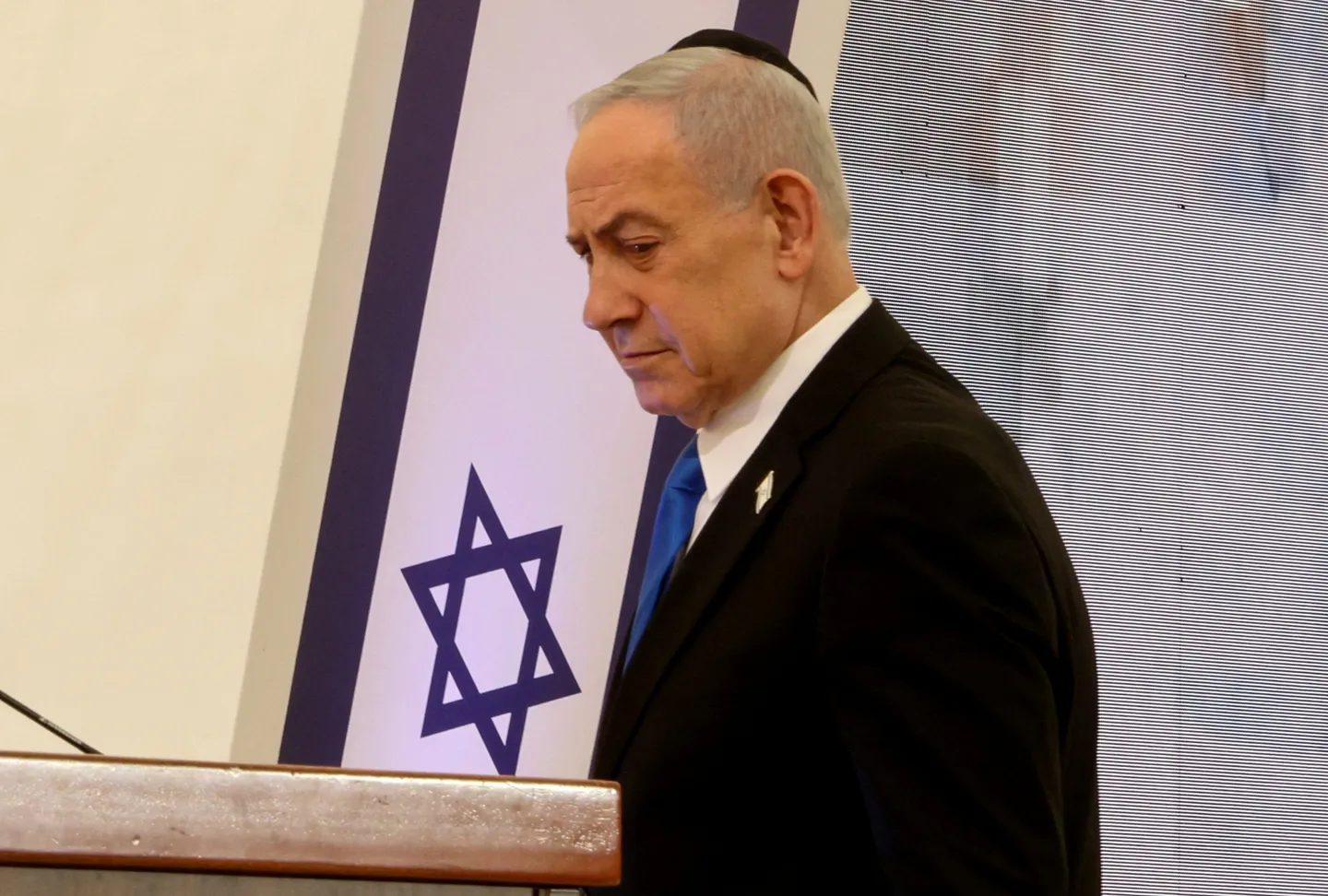








As Israel approaches a pivotal general election, the nation’s political landscape remains deeply fractured, with public polling indicating that neither major bloc is on track to secure the 61-seat majority required to form a government in the 120-member Knesset.
Current projections from a Channel 12 survey suggest that Prime Minister Benjamin Netanyahu’s ultra-right coalition is set to win 52 seats, while the anti-Netanyahu opposition—spearheaded by former premier Naftali Bennett and ex-military chief Gadi Eisenkot—is expected to capture 57 seats. With these figures, the 11 seats projected for Arab parties have become a focal point of the political arithmetic.
The Israeli electoral system operates on nationwide proportional representation, where citizens cast ballots for a party’s official “list” of candidates rather than individual representatives. To enter the Knesset, a party must clear a 3.25 percent vote threshold. To mitigate the risk of falling short, smaller factions often form alliances, known as a “joint list,” to consolidate their electoral standing.
Two primary Arab-majority lists are competing in the October vote. The first is a joint list comprising the Hadash, Ta’al, and Balad parties, which merged to ensure they surpass the threshold. The second is the United Arab List, or Ra’am, led by Mansour Abbas. Analysts anticipate both groups will comfortably clear the 3.25 percent requirement, collectively securing between 10 and 12 seats.
Despite their potential influence, experts suggest that Arab parties are unlikely to formally join a cabinet. Gokhan Batu, a Levant studies analyst at the Centre for Middle Eastern Studies in Ankara, notes that while these parties are essential to the math of government formation, there is almost no prospect of them becoming official coalition partners.
The political climate remains hostile toward such an arrangement. Since the October 7, 2023, attacks, the appetite among the Israeli Jewish public for including Arab parties in a government has diminished significantly. Zionist parties frequently use the prospect of Arab participation as a political weapon to delegitimize their opponents, framing it as a threat to national security.
Nimrod Goren, founder of the Israeli Institute for Regional Foreign Policies (Mitvim), observes that while Arab parties are “of importance” due to their seat count, they are not currently in a position to choose between Netanyahu and the opposition. Supporting Netanyahu is not an option they are considering, yet the Jewish opposition remains deeply divided on whether to accept their support or even their abstention to sustain a minority government.
The historical context complicates the situation. Ra’am made history by joining the 2021-22 Bennett-Lapid government, a move Mansour Abbas justified as a way to secure social, economic, and infrastructure benefits for Palestinian citizens of Israel, who make up one-fifth of the country’s 10.3 million residents. However, that participation became a major political vulnerability for the coalition.
Batu points out that even Netanyahu has previously sought Ra’am’s support, demonstrating that the refusal to cooperate is often more about electoral optics than ideological rigidity. Nevertheless, prominent opposition figures like Naftali Bennett have pledged that any future government they lead will consist solely of Zionist parties, and Yisrael Beitein leader Avigdor Lieberman has explicitly ruled out a minority government dependent on Arab votes.
There is a common assumption that Arab parties might leverage their position to demand concessions regarding Gaza or the occupied West Bank. However, analysts remain skeptical. Goren notes that Arab politicians are primarily motivated by the desire to remove Netanyahu and his ultra-nationalist allies, rather than engaging in policy bargaining.
Batu adds that a coalition supported by Ra’am would likely yield few meaningful gains for Palestinians in Gaza or the West Bank, as those issues are not the central purpose of the party’s participation. For many, the goal remains the establishment of an independent Palestinian state alongside Israel, based on 1967 borders with East Jerusalem as its capital, yet the path to such a reality remains obstructed by the current parliamentary deadlock.
Ultimately, Goren argues that the situation is far more complex than simple arithmetic. He suggests that the ideal path would be Jewish-Arab cooperation within the opposition to foster a better government, though the current political reality suggests that the road to a stable coalition remains fraught with deep-seated divisions. The report also notes that basic arithmetic shows either political bloc will need support from Arab parties – which are typically backed by Palestinian citizens of Israel comprising one-fifth of the country’s population of 10.3 mil, in other words. The report also notes that sometimes, several parties make an alliance and contest polls under a “joint list”. The report also notes that seen as one of the most consequential in the country’s history, the numbers game has intensified in the run-up to next month’s general election in Israel. The report also notes that this shows the Arab parties – long treated by Zionist parties as radioactive – may hold the key to government formation after the October elections. The report also notes that the opposition is split on the issue,” Goren says, at the moment. The report also notes that “Arab support may be strategically valuable when forming a coalition, but it can also carry a considerable political cost,” he says. The report also notes that “The main obstacle lies in the attitudes of the wider public and the parties’ electoral bases,” he notes.