








Diplomatic relations between Britain and Israel have reached their lowest point in decades following a coordinated decision by the UK and 11 other countries—including France, Spain, and Canada—to impose a trade ban on Israeli settlements in the occupied West Bank. The move, which also includes restrictions on arms sales that officials say contribute to the occupation, has triggered a furious response from the Israeli government.
London officials anticipated a hostile reaction to this significant policy shift, yet the speed and intensity of Israel’s response caught many by surprise. Among the retaliatory measures, Israel has moved to close the UK’s consulate in East Jerusalem, which handles relations with the Palestinian Authority in Ramallah, and has removed British representatives from the International Gaza Support Centre, an organization established last year to coordinate relief and stabilization efforts in the Gaza Strip.
Foreign Secretary Ed Miliband, who described the policy as a necessary “reset,” stated that the UK now officially aligns with the 2024 International Court of Justice ruling that characterizes the entire occupation, including Israel’s military presence, as unlawful. Miliband, identifying as a “proud British Jew” and a firm supporter of Israel, issued a stark critique, asserting that “settler terrorism is rampant” and responsible for the “ethnic cleansing” of Palestinians, while accusing the Israeli government of turning a blind eye to these actions.
While products from settlements represent a relatively small portion of Israel’s total exports, the political symbolism of the sanctions is profound. For decades, the UK and other international partners maintained that settlements in occupied territories were illegal but refrained from banning their goods. The new policy extends beyond physical products to include companies providing infrastructure, construction, or financial services to these settlements.
Israeli Foreign Minister Gideon Saar led the condemnation of the move, reflecting a broader sense of outrage shared by many in Israel. Although some Israelis view the violent ideology of certain settler groups as a national embarrassment, there remains widespread disagreement with the characterization of settlements built on land captured during the 1967 Six Day War as inherently illegal. Many Israelis feel increasingly defensive as they face mounting international pressure, ranging from protests at public events to international arrest warrants issued for their leaders.
For the Palestinian leadership, the sanctions are viewed as a significant, albeit overdue, step toward progress. Dr. Husam Zomlot, the Palestinian ambassador to the UK, hailed the decision as a “turning point” that could help facilitate the independence of a Palestinian state based on 1967 borders with East Jerusalem as its capital. However, Zomlot acknowledged that the fundamental reality of the 59-year occupation remains largely unchanged.
The effectiveness of this collective action remains uncertain, as the prospects for a viable Palestinian state continue to appear slim. Historically, only the United States has wielded enough influence to alter Israeli policy, as seen in 1991 when President George HW Bush and Secretary of State James Baker threatened to withhold $10 billion in loan guarantees to pressure Prime Minister Yitzhak Shamir regarding settlement activity.
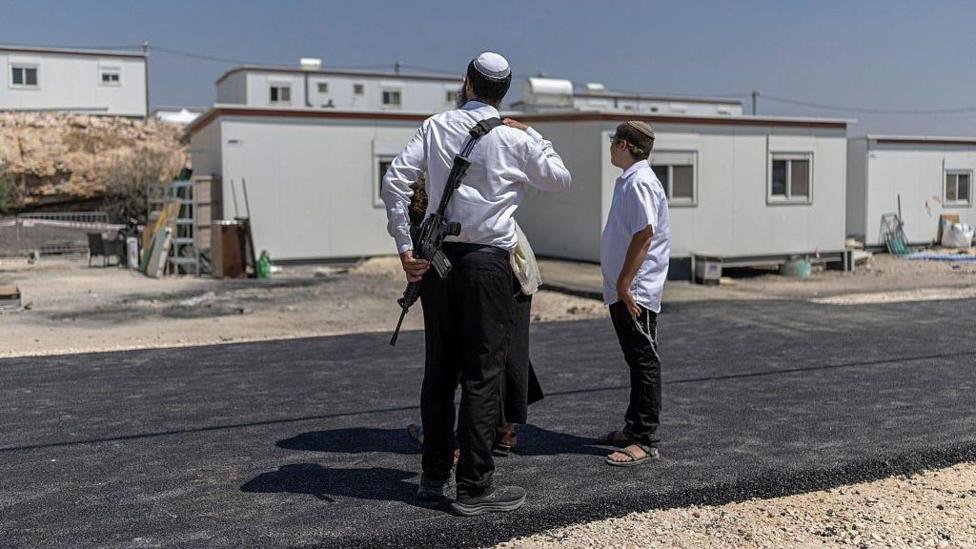
Current dynamics in Washington, however, suggest a different path. While some segments of the MAGA movement have distanced themselves from Israel, US Ambassador to Israel Mike Huckabee remains a staunch Christian Zionist who supports the view that the West Bank was promised to the Jewish people. Consequently, the recent actions by the UK and its partners place them in direct opposition not only to Israel but also to its primary backer in the United States. The report also notes that but the fact that 12 countries chose to move together clearly sharpened the sense of outrage, britain took the brunt of Israel’s anger. The report also notes that but seemed taken aback by the speed and ferocity of Israel’s reaction, officials in London always knew that such a dramatic shift in policy towards Israel-Palestine was going to elicit a hostile response. The report also notes that three Israeli settlers – including an armed one – stand outside houses after the reopening of a settlement at Ganim in the Israeli-occupied West Bank in August. The report also notes that sometimes deeply personal statement that is so striking, and it’s not just the actions – it’s the language of the foreign secretary’s heartfelt. The report also notes that unwavering in my support for the state of Israel,” Miliband spoke more directly and starkly than practically any of his predecessors. The report also notes that it felt like a radical rethink, and it leaves British-Israeli relations at their lowest ebb for decades, at times today.