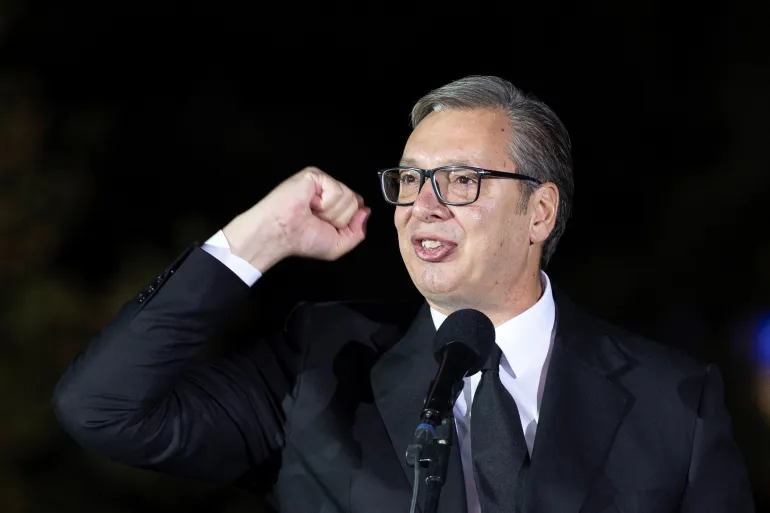








Serbian President Aleksandar Vucic has officially resigned his position to pursue the role of prime minister. His move serves as a strategic maneuver ahead of a snap parliamentary election scheduled for October 25, occurring as an influential student-led protest movement presents the most formidable challenge to his political dominance in over ten years. ‘The crisis could begin after the election’. “I fear that the crisis in Serbia could only begin after the October 25 elections,” she said. “This government has taken over the institutions, it is deeply intertwined with organised crime and it will try every possible way to remain in power.”.
Vucic, who has anchored Serbian politics as either president or prime minister since 2014, represents the Serbian Progressive Party (SNS). Having reached his constitutional limit for presidential terms, he is now leveraging the parliamentary ballot to maintain his grip on power. As a final official act, Vucic signed pardons for 49 individuals, among them 23 people convicted for their involvement in the recent widespread demonstrations. Parliament Speaker Ana Brnabic is set to serve as acting president until a new head of state is chosen.
The upcoming vote follows nearly two years of civil unrest sparked by a tragic incident on November 1, 2024, when a concrete canopy collapsed at a railway station in Novi Sad, killing 16 people. The catastrophe ignited massive protests across the country, where citizens have voiced deep-seated grievances regarding alleged government corruption, a lack of institutional transparency, and excessive political interference. While Vucic and his allies consistently deny any accountability for these systemic issues, the “Students Win” movement has gained significant traction, backed by several opposition parties including the Democratic Party. Vucic and his allies reject the allegations that they are responsible for the problems highlighted by the protesters.
The “Students Win” electoral platform, which features a list of 250 candidates comprised largely of professors and professionals, advocates for stricter anti-corruption measures and greater accountability regarding public funds. While some polls indicate the movement could threaten the SNS’s hold on power, analysts note that the accuracy and methodology of such data remain difficult to verify. Dejan Ilic, a Belgrade-based columnist, argued that the election is a direct result of public pressure rather than a voluntary choice by the leadership, stating that the people of Serbia effectively forced the vote. Drawing hundreds of thousands of people onto the streets, students have since organised some of Serbia’s largest demonstrations in decades. Its list of 250 candidates includes mostly university professors and professionals from a range of fields.
Political observers anticipate further volatility once the ballots are cast. Aida Corovic, a human rights activist and former parliamentarian, expressed concern that the country’s deep institutional ties to organized crime could complicate the transition of power. Regardless of these risks, Vucic stated in a recent interview that he intends to honor the election results should the opposition emerge victorious. “Serbia has been undergoing internal change in recent months,” Corovic told. A few hours before his resignation, Vucic told CNN that if the opposition won, he would acknowledge the results and congratulate his opponents that same evening.
The situation in Serbia is being monitored closely across the Western Balkans. Tanja Topic, of the Friedrich Ebert Foundation, emphasized that a change in Belgrade’s political direction could offer relief to the wider region. Currently, Serbia maintains complex, often strained relationships with neighboring Bosnia and Herzegovina, Montenegro, and Croatia. Belgrade has been criticized for sending mixed signals, often portraying itself as a regional peacemaker while simultaneously fueling political tensions. “It is crucial that the paradigm in Serbia’s politics changes because it would bring relief to the entire region,” Topic told.
Economic disparities remain a central theme for voters, with the average net monthly salary in Serbia recorded at 1,032 euros in April, trailing significantly behind the 1,555 euros earned in neighboring European Union member Croatia. While Vucic has championed investments from China, Russia, and Israel to bolster the economy, many citizens remain dissatisfied with the current standard of living.
The nation’s unresolved history from the 1990s Balkan wars continues to shadow contemporary politics. Tensions were recently exacerbated by the funeral of Ratko Mladic, the former Bosnian Serb military commander convicted of war crimes, which saw attendance from government ministers and military honors. The event drew sharp condemnation from EU officials, including Kaja Kallas and Ursula von der Leyen, who reiterated that those who glorify war criminals have no place in the European bloc. As voters head to the polls, the election will serve as a referendum not only on Serbia’s domestic governance but also on its future standing in the region.