
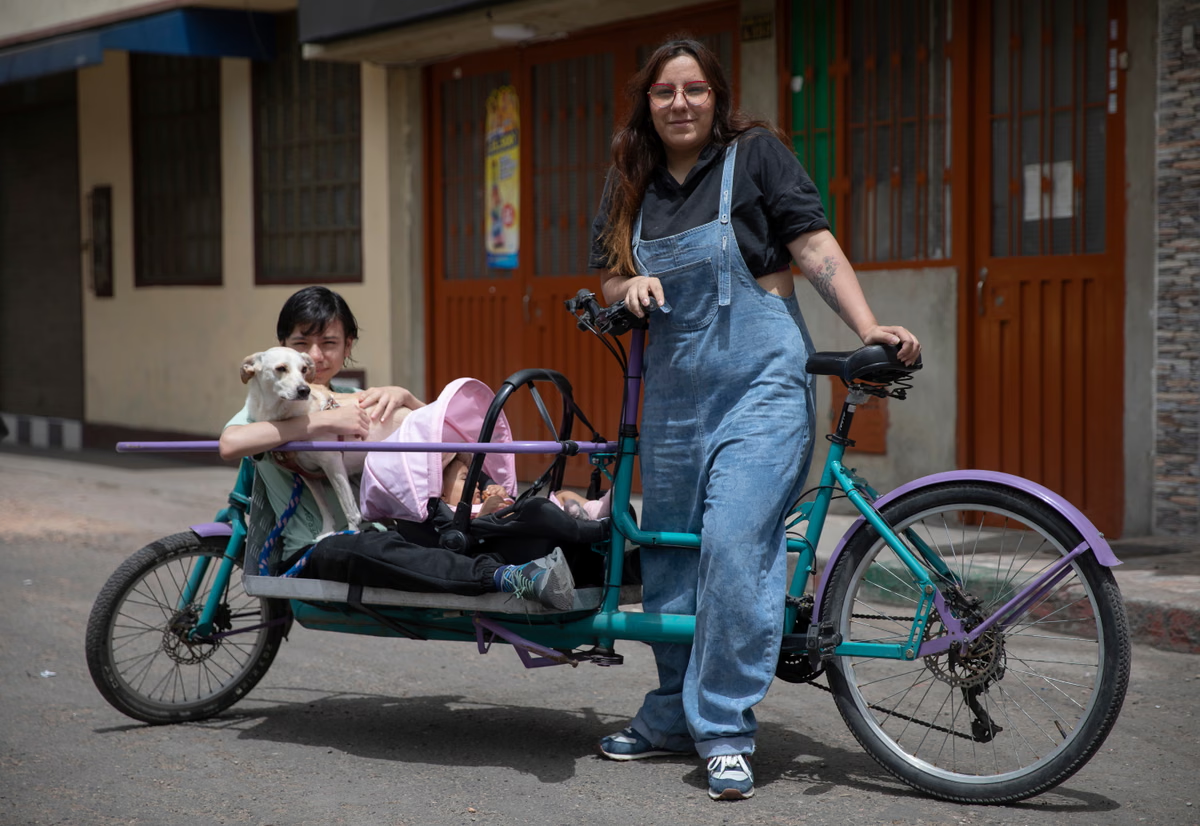








Eliana González navigates the bustling streets of Bogotá using a specialized cargo bike, a vehicle she has adapted to transport her two children and groceries safely. For González, this mode of transport is a personal commitment to environmental stewardship. “For me, my cargo bike is a way to carry my children safely and comfortably without polluting the environment,” she says.
Widely regarded as a global cycling success story, the Colombian city of 10 million people records nearly 900,000 bicycle trips each day – more than any other city in Latin America. Despite this high volume, city officials are now working towards another milestone: achieving gender parity in cycling by 2039. According to the city’s latest mobility survey, women accounted for only 28% of Bogotá’s daily bicycle trips in 2023.
“Our goal is to move from a [nearly] 30–70 split to 50–50 parity,” says Claudia Díaz, Bogotá’s secretary of mobility. Addressing this gap is critical for the city’s environmental future. Transportation remains Bogotá’s largest source of greenhouse emissions, and officials believe that increasing female participation in cycling is essential to supporting the capital’s goal of becoming carbon neutral by 2050.
“The challenge we face is how to increase the number of cycling trips,” says Díaz. “The more we increase the number of cycling trips, the more environmental benefits we see for our city.” Experts emphasize that gender equality is a prerequisite for realizing the full benefits of sustainable transport, including cleaner air and reduced congestion. Dana Yanocha, a senior manager at the Institute for Transportation and Development Policy, notes that these positive impacts are limited if only half the population utilizes the system.
In 2021, Bogotá adopted a pioneering cycling public policy that specifically incorporates a gender perspective. Research conducted by the C40 Cities Finance Facility identified significant barriers: approximately 60% of women surveyed cited fears of theft or assault, 40% worried about traffic accidents, and nearly one-third reported never having learned to ride a bicycle. To combat these issues, the city has expanded its network of protected bike lanes—now the largest in Latin America at 425 miles—while improving lighting and increasing police patrols.
“By improving infrastructure, we can help women feel that riding a bike is a viable option for them,” says Díaz. Beyond physical infrastructure, the city is tackling the educational gap through the Bogotá Bike School, which teaches roughly 40,000 residents annually. Sergio Prieto, who oversees the program, notes that about 80% of participants are women. “Many older women come here because they were never allowed to ride a bicycle as girls,” Prieto explains. “They were told bikes were for men, that women shouldn’t be riding them. Here, those barriers and stereotypes are left behind.”
The cultural shift is also being driven by grassroots initiatives. In 2018, Eliana González founded Mamacitas en Bici to encourage mothers to cycle. Her work addresses an often overlooked reality: the leading reason women move across Bogotá is for caregiving trips, such as taking children to school. Despite the practical benefits, caregivers often face social stigma. González recalls being shouted at by strangers who labeled her irresponsible when she first began cycling with her baby.
Rather than retreating, González built a community to help mothers customize their bikes for safe child transport and organize group rides. She remains committed to the cause, noting, “We still have so many green spaces in our city, and I want to do my part to help protect them. If I get around by bicycle, I’m contributing to that environmental effort.”
As Bogotá continues to refine its urban planning, the focus remains on creating an environment where safety and inclusivity are standard. By combining infrastructure investment with targeted educational programs and community-led advocacy, the city aims to dismantle the historical and social barriers that have kept women off the road, ensuring that the future of urban mobility is truly equitable for all residents by 2039. The report also notes that women make up only a small share of cyclists, often accounting for less than 10% of daily bicycle trips, in many of the cities where her organisation works. The report also notes that according to the city council, bogotá’s network of protected bike lanes – the largest in Latin America – now spans 425 miles (683.9km).