
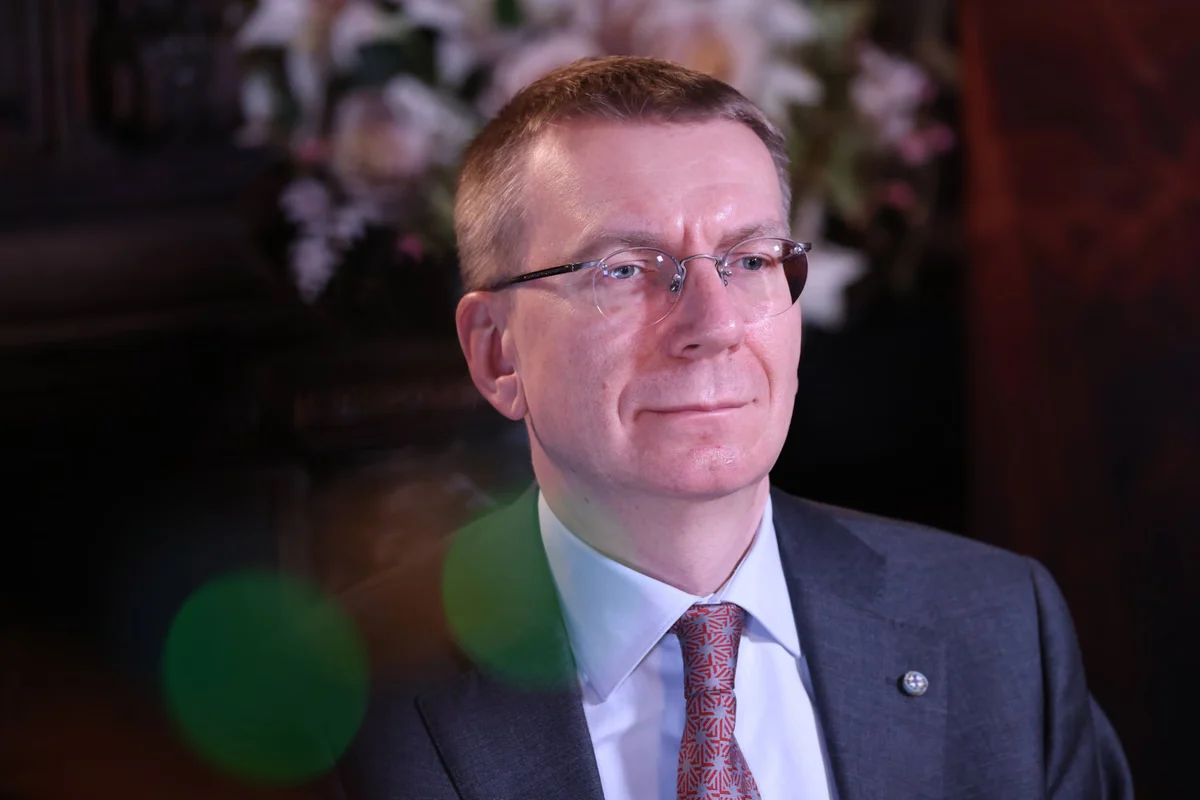







Latvia’s president, Edgars Rinkēvičs, has issued a stark warning that Europe is failing to keep pace with the rapidly evolving nature of aerial and drone warfare observed in Ukraine. During an interview in Washington DC, Rinkēvičs cautioned that current strategic preparations for potential aerial conflicts could be rendered obsolete by the middle of next year due to the sheer speed of technological advancement.
Rinkēvičs emphasized that air defense, drone countermeasures, and anti-ballistic systems across NATO and Europe face systemic challenges. He noted that if Russia were to launch missile strikes against European territories, many nations would struggle to mount an effective defense. The president described the progression of drone warfare as moving at “lightning speed,” leaving current infrastructure lagging behind the threat.
The defensive capability gap is exacerbated by a severe shortage of interceptors. The United States has utilized nearly two-thirds of its critical air-defense stocks in the ongoing conflict in Iran, according to a Congressional Budget Office assessment. Experts suggest that replenishing these supplies could take at least five years. While discussions regarding the potential outsourcing of Patriot missile production to Europe and Ukraine remain ongoing, Rinkēvičs noted that technical licensing hurdles continue to delay a resolution.
Regional tensions are intensifying as Russia appears to be testing NATO’s resolve. Polish Prime Minister Donald Tusk recently warned that Moscow might orchestrate drone or missile strikes against NATO allies in the coming months to challenge the alliance’s commitment to collective defense under article 5. While US President Donald Trump stated he believes such attacks on allies have been occurring for roughly five years, he expressed confidence in the leadership of Polish President Karol Nawrocki.
Despite these mounting threats, Baltic leaders remain skeptical that Moscow currently intends to launch a full-scale conventional military incursion. Instead, Rinkēvičs expects Russia to focus on increasing mobilization following local elections and utilizing the winter period to escalate pressure on Ukraine, while simultaneously attempting to fracture the coalition of nations supporting Kyiv.
Provocations are already visible, ranging from cyber-attacks and sabotage to recent airspace violations. A Russian drone was intercepted by a NATO jet over Lithuania, and Polish authorities were forced to close the Lublin and Rzeszów-Jasionka airports on Thursday following Russian strikes on western Ukraine.
Looking toward long-term defense, Rinkēvičs expressed concern regarding the feasibility of European allies reaching the 5% of GDP defense spending benchmark encouraged by the Trump administration. While he acknowledged that recent dialogues concerning Europe shouldering a greater burden of its own security are becoming more constructive, he cautioned that building actual military capabilities requires significant time.
“Our message is also to do that, we need time,” Rinkēvičs stated, adding that such systemic shifts cannot be accomplished in a matter of months or a single year. The president reiterated that while he would rule out an immediate conventional ground invasion, the alliance must remain vigilant against diverse and unconventional forms of Russian aggression intended to undermine European stability. The report also notes that “What we see is that air defence, drone defence, anti-ballistic defence has serious problems,” he said. “And let’s be frank. The report also notes that “Because if Russia decides to use a couple of missiles in that territory, I think that would be a serious challenge today for many countries to cope with that,” he added. The report also notes that the US has considered outsourcing Patriot production to Ukraine and Europe but so far an agreement has not been made. The report also notes that “It’s up to the United States government, it’s up to the company,” Rinkēvičs said, noting that discussions were continuing and acknowledging the difficulties of some technical issues with licensing. “We have some capacities in Europe, but let’s face it: Patriots are still one of the best, if not the best, to tackle this.”. The report also notes that at next week’s United Nations general assembly in New York City, Donald Trump is expected to hold meetings with senior European leaders, and as Nato allies have stepped up their warnings about the risk of Russia escalating the war in Ukraine. The report also notes that adding that Russia would seek to play off the incidents as accidents, tusk said that Russia would seek to “weaken Nato’s integrity” and show that “article 5 is more theoretical than practical”. The report also notes that they’ve been attacking Ukrainian allies for approximately five years.”.