








Saudi Arabia is increasingly relying on ship-to-ship (STS) transfers off the coast of Oman to bypass significant maritime blockades. The strategy follows damage to the kingdom’s vital 1,200km (746-mile) East-West pipeline, which previously allowed Riyadh to move oil from its eastern fields to the Red Sea port of Yanbu, circumventing the Strait of Hormuz.
The Strait of Hormuz, a critical global energy corridor that accounted for nearly a fifth of pre-war global energy supplies, remains effectively closed. Iran has utilized control of the waterway as leverage in ongoing diplomatic tensions related to the United States-Israeli war. With the Bab al-Mandeb also facing Houthi control, Riyadh has turned to Sohar, Oman, as an essential hub for transferring crude oil between tankers.
Rishi Rajanala, a research specialist in Oil Americas at LSEG Data & Analytics, noted that shipping more crude through Gulf terminals, including STS operations outside the strait, has become Riyadh’s primary alternative. However, he cautioned that while exports are moving through these channels, overall volumes remain constrained by tanker availability, insurance premiums, and fluctuating freight costs.
Data from Rystad Energy indicates that exports via this route have seen a recent surge. Rahul Choudhary, VP of Upstream Research at Rystad, reported that in the first two weeks of the current month, exports edged higher to over 2 million barrels per day (mb/d), which is approximately 1 mb/d above the levels recorded in August. This upward trend is expected to continue, particularly as Aramco has begun offering additional loadings for Asian refiners out of Sohar.
Choudhary added that Saudi Arabia is likely to lean further into the use of so-called dark tanker activity to compensate for the loss of Red Sea access. Independent monitors and media outlets suggest that Kuwait and Qatar are also utilizing similar tactics to move cargoes past the closed strait.
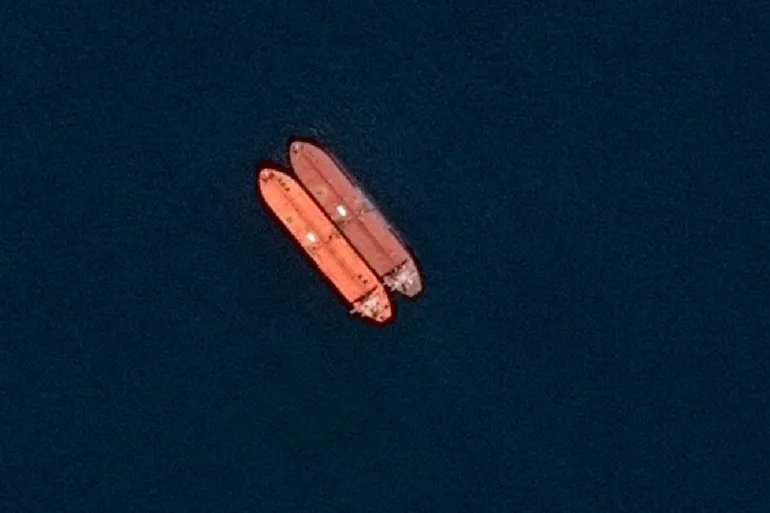
These STS transfers, which involve moving oil directly between two vessels at sea, are essential when direct port access is restricted but present significant operational risks. The process requires precise coordination between a maneuvering ship and a stationary vessel, utilizing pneumatic rubber fenders to mitigate the impact of hulls colliding. During these operations, trackers are often disabled to maintain secrecy, while pumps move the cargo under strictly monitored pressure and weather conditions.
The logistical reliance on these transfers has grown substantially. The monitoring platform TankerTrackers reported that 7.15 million barrels per day were exchanged via STS methods over a 14-day period last week, representing a 56 percent increase compared to the previous month.
The safety of these operations remains a point of concern for the insurance industry. Oscar Seikaly, CEO of the NSI Insurance Group, explained that STS transfers are inherently complicated for traditional insurers. Any incident could trigger complex liabilities involving pollution, collisions, war-risk coverage, and cargo protection. During high-risk periods like the current conflict, many insurers are unwilling to provide broad coverage, potentially leaving the burden of risk with the producing nations themselves.
According to Seikaly, while many oil shipments belong to national oil companies, they often rely on sovereign-backed self-insurance or specific private market arrangements. He noted that underwriters may impose security conditions or navigational warranties that make obtaining comprehensive insurance difficult.
Geopolitically, the situation is further strained by the presence of the Persian Gulf Strait Authority, an Iranian body established to manage the waterway. Iranian authorities have targeted vessels they claim are using unauthorized routes near Omani waters. Despite these risks, the United States military has reportedly assisted in facilitating numerous secretive transfers since early May to ensure energy supplies continue to reach global markets.
The ports of Sohar in Oman and Fujairah in the United Arab Emirates have become critical to this shadow logistics network. Sohar serves as a deepwater industrial hub with extensive container traffic, while Fujairah acts as a major global bunkering and storage center. Both locations provide the necessary open-ocean anchorage required to stage these transfers away from the restrictive narrowness of the Persian Gulf. The report also notes that much like what Iran has been doing for years to export its own crude, media reports suggest that the Hormuz closure and rising oil prices have pushed the US and its allies in the region to adopt shadow tactics. The report also notes that its strategic position has allowed international shipping lines to bypass the narrow Gulf bottleneck while maintaining direct overland connectivity to Arabian Peninsula markets. The report also notes that the companies need to undertake meticulous coordination amid favourable sea conditions to prevent spills and collisions. The report also notes that one vessel, often the larger ship, maintains a steady course or anchors. The report also notes that followed by hulls brought parallel, protected by pneumatic rubber fenders deployed along the ship sides to absorb impacts, the manoeuvring ship approaches slowly. The report also notes that who is engaging in ship-to-ship transfers and why. The report also notes that especially when being taken up in shadows — and also inefficient compared with standard shipping by vessels, ship-to-ship transfers are relatively dangerous. The report also notes that uninspected hoses, and turned-off AIS tracking without insurance coverage, experts note that unregulated STS transfers often rely on ageing vessels with poor hull maintenance.