








Gasoline and diesel costs continued to climb on Thursday, with energy analysts warning that further increases are likely as overseas conflicts disrupt global refining capacity. Drivers should prepare for sustained higher pricing, according to Patrick De Haan, a petroleum expert at GasBuddy.
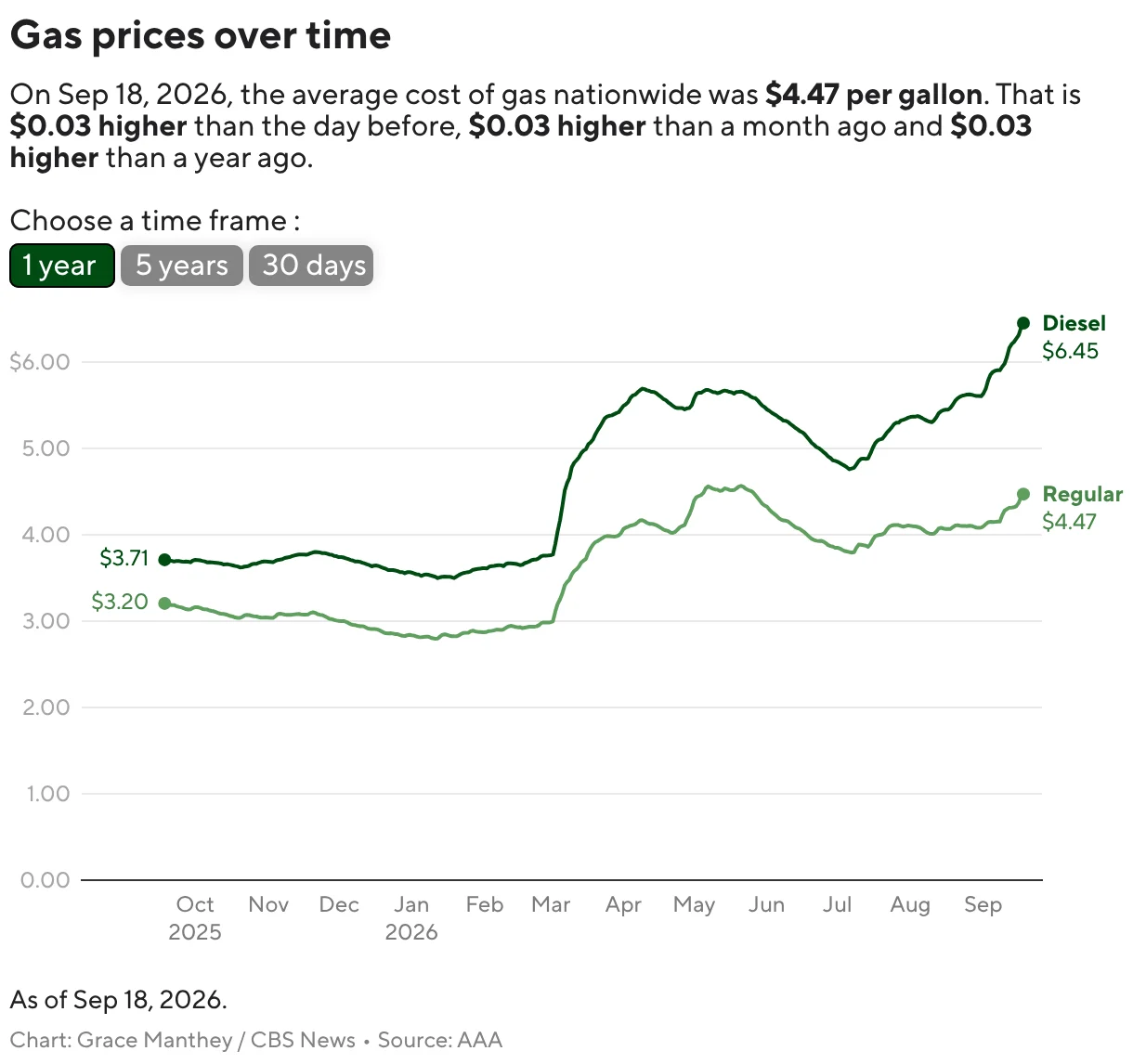
Data from AAA indicates the national average for gasoline rose by 7 cents overnight to reach $4.44 a gallon, a figure nearly 50% higher than before the conflict in Iran began in February. GasBuddy estimates, meanwhile, place the national average at $4.46, with projections suggesting prices could climb to $4.50 per gallon before the week concludes.
Diesel fuel, which is critical for the nation’s supply chain and the transport of food and goods, reached a record $6.40 per gallon, marking a 77-cent increase since the start of September. Experts warn that diesel could hit $6.60 as early as this weekend, with some regions already far exceeding that level; for instance, California’s average for diesel has reached $8.35 per gallon.
Tom Kloza, chief energy adviser for Gulf Oil, emphasized that while motorists might reduce gasoline consumption, diesel usage is harder to curb due to its central role in trucking, construction, and rail operations. He noted that elevated diesel costs are likely to contribute to broader inflation, impacting not only goods but also utility bills. With approximately 4 million U.S. households relying on heating oil—a product derived from diesel—many could face winter heating costs near the $6,000 mark.
The current upward pressure on fuel is largely tied to a trio of conflicts: the Russia-Ukraine war and hostilities involving Iran and Houthi rebels. These geopolitical tensions have crimped global oil supplies and hindered refining output. Specifically, Ukrainian drone strikes on Russian energy infrastructure have incapacitated an estimated 3 million barrels of daily refining capacity, further straining a global market that typically processes roughly 100 million barrels per day.
Logistical disruptions in the Middle East are also compounding the crisis. Attacks by Houthi rebels have impacted the Red Sea tanker traffic and resulted in a strike on a critical Saudi Arabian pipeline. The damage to the East-West pipeline, which accounted for a loss of 4 million barrels per day according to the Eurasia Group, could keep the route out of commission for several weeks.
Reduced refining capacity is a localized issue as well. In the Midwest, an ExxonMobil refinery near Chicago experienced a power outage that halted production for several hours, contributing to regional price spikes. Illinois drivers saw gas prices average $4.78 on Thursday, significantly higher than the national norm.
Regional disparities remain prominent in the U.S. market. Kloza noted that the West Coast suffers from limited refining infrastructure, keeping California prices above the $6 per gallon threshold for gasoline. Generally, fuel remains more expensive in blue states compared to red states, a divergence often tied to the geographical proximity of refining facilities and energy sources.
As Brent crude continues to trade around $103 per barrel, the market remains volatile. While gasoline is expected to hover between $4.25 and $4.50 a gallon, the combination of ongoing warfare and constrained global refining capacity suggests that consumers will face sustained financial pressure at the pump for the foreseeable future. The report also notes that which is diesel fuel,” he told. “Everything that moves around the country and all crops are dependent on spending money on that fuel, buckle up and recognize that inflation is likely to get turbocharged by these high prices for a product you probably don’t care much about. The report also notes that given that around 4 million households rely on heating oil, made from diesel, to keep their homes warm, he said, northeast residents in particular could also be in for an expensive winter. The report also notes that they’re looking at prices in the $6 range,” he said. “If you use 1,000 gallons in a winter, that’s $6,000. The report also notes that two regional officials told The Associated Press news agency earlier this week, the attack could leave the pipeline out of service for weeks. The report also notes that more than 30 cents above the national average, gas prices in Illinois averaged $4.78 a gallon on Thursday. The report also notes that the Federal Reserve just raised interest rates for the first time since 2023.