
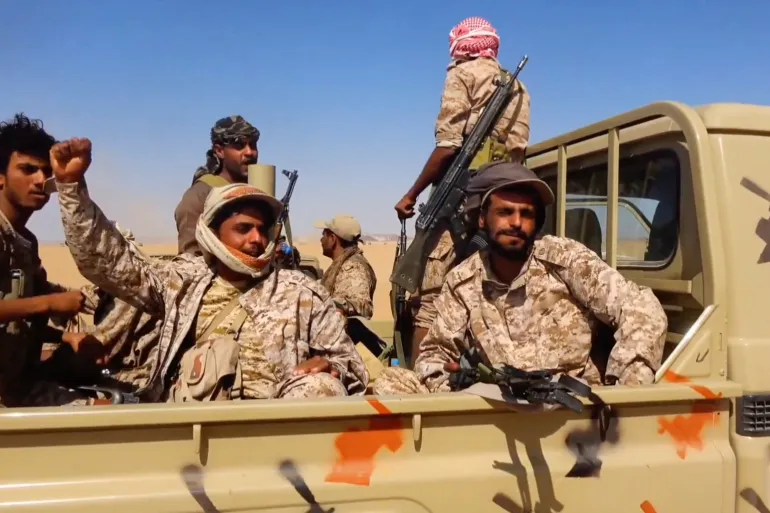







Yemen is currently experiencing a surge in military activity, with the UN-recognised government and Houthi forces engaging in fierce combat across the country’s northern, western, and central territories. The escalation has involved the deployment of warplanes, drones, missiles, and various other armaments, significantly intensifying the long-standing conflict.
Aid agencies have reported a heavy toll from the past two weeks of hostilities, documenting at least 194 deaths and 880 injuries across several key areas, including Taiz, the western coast, al-Jawf, Marib, and Dhalea. These regions have become focal points for both sides as they attempt to consolidate power and secure vital supply lines.
A significant development occurred on Thursday when the Iran-backed Houthis, also known as Ansar Allah, reportedly seized control of Mocha. This coastal city is situated approximately 60km (37 miles) from the Bab al-Mandeb strait, a critical maritime chokepoint linking the Red Sea to the Gulf of Aden. By securing this position, the Houthis have gained a foothold on a vital international shipping lane.
Yazeed al-Jeddawy, research manager at the Sanaa Center for Strategic Studies, noted that the Houthis have long targeted the mountainous terrain of Taiz and the western coast. He explained that the group’s tactical objective is to seize commanding heights and sever supply routes between Mocha and Taiz, thereby preventing government forces from linking up with the Taiz Military Axis.
The strategic importance of these fronts was further emphasized by political analyst Fuad Mussed, who pointed out that the proximity to Bab al-Mandeb allows the Houthis to exert pressure on global maritime traffic. According to Mussed, this aligns with a broader strategy pursued by Tehran to maintain influence over key waterways like the Strait of Hormuz and the Bab al-Mandeb, using them as leverage against international and regional powers.
The regional dimension of the conflict remains prominent. Iran has previously utilized its influence to threaten shipping through the Strait of Hormuz and has warned of potential closures at Bab al-Mandeb. Furthermore, in July, the Houthis declared a blockade against Saudi vessels transiting the Red Sea, adding another layer of complexity to the maritime security situation.
In the north, the focus remains on the oil-rich governorate of Marib. Political commentator Saddam al-Huraibi described the Marib front as a decisive battleground. For the government, holding Marib is essential to maintaining its presence and leverage in northern Yemen. Conversely, the Houthis view the capture of the region as a way to deepen their authority and gain control over critical oil and gas infrastructure, a goal they have pursued for over a decade.
Fighting also persists in the al-Jawf governorate, which borders Saudi Arabia. Government forces have concentrated their recent offensive efforts there, hoping that a breakthrough would alleviate pressure on Marib and force the Houthis to defend a wider, more vulnerable area. Meanwhile, the Houthis have continued to launch attacks on energy facilities in southern Saudi Arabia, while accusing the kingdom of providing air support to government forces in provinces such as al-Bayda and Taiz.
Despite the intensity of the current fighting, pro-Houthi general Khaled Ghorab stated that the group was prepared for this escalation. He asserted that their military capabilities were developed to counter sustained, comprehensive attacks, allowing them to respond directly to threats whether at sea or deep within enemy territory, including targeting military bases or aircraft carriers as far away as the Horn of Africa.
Ultimately, experts suggest that while the fighting is driven by domestic military and political objectives, it is inextricably linked to the wider regional war. As al-Jeddawy observed, Iran maintains an interest in keeping the Red Sea active as a source of leverage, while the government camp views the current strain on Houthi resources as a potential opportunity to weaken the group’s position. The report also notes that experts say gains or losses on any of these strategically important fronts could have significant consequences for either side. The report also notes that causing massive damage to its port facilities and killing and injuring several civilians, the Houthis launched missile and drone attacks on the city last month. The report also notes that “The Houthis seem intent on tightening their hold around Mocha and moving closer to the Dhubab–Bab al-Mandeb area. The report also notes that that is why pro-government troops are ready to fight tooth and nail on this front line,” al-Huraibi told. The report also notes that including the capital, Sanaa, in 2014, but Marib has remained in government hands since, the Iran-backed group captured vast swaths of northern Yemen. The report also notes that they would keep fighting to achieve that goal,” al-Huraibi said, without facing a crushing defeat in Marib. The report also notes that while a strong Houthi defence could undermine government forces’ morale and prompt them to retreat, a government gain there would lay the groundwork for further advances. The report also notes that which began in April 2022 following the UN-brokered ceasefire, fighting there did not fully stop during the relative calm.