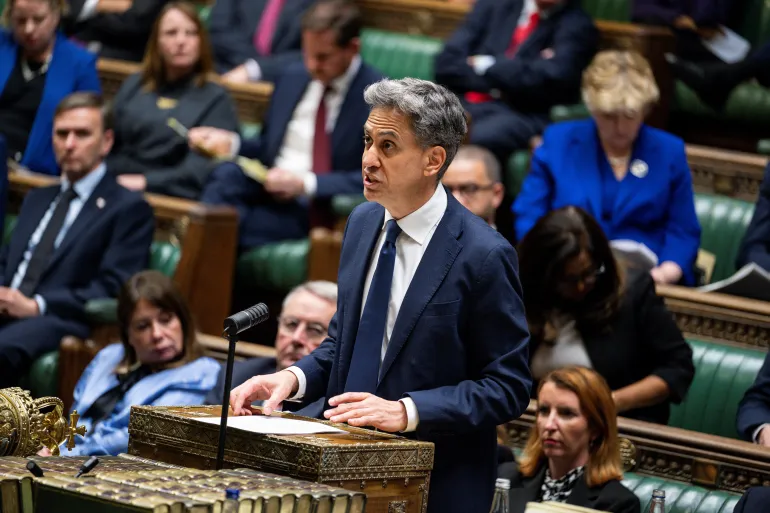








The British government has unveiled a new policy to prohibit the import of goods produced in illegal Israeli settlements across the occupied West Bank. This move, part of a broader set of measures, follows a notable shift in rhetoric from UK Foreign Secretary Ed Miliband. In a recent address to Parliament, Miliband accused Israel of engaging in “ethnic cleansing” within Palestine and reaffirmed the long-standing British position that such settlements are unlawful.
Despite the strong language, analysts and observers are questioning the practical implications of these measures. The core of the policy is a ban on settlement-produced goods, alongside new designation powers intended to target services. However, the government has not yet clarified how it will distinguish between goods manufactured within Israel, those originating from settlements, and products sourced from Palestinian territories. Furthermore, while the government has committed to taking action on services, the initial ban does not explicitly include them.
The scale of the potential impact remains a point of contention. Trade between the UK and Israel reached approximately £6 billion ($8.1 billion) in 2025. In contrast, total trade between the UK and Palestine for the four quarters ending in March 2026 was recorded at £40 million, up from £38 million the previous year. Of that figure, only £6 million ($8.1 million) was attributed to goods imported from Palestine. Even if every single item in that £6 million category originated from an Israeli settlement, the ban would affect no more than 0.1 percent of the annual trade volume between the UK and Israel.
Quantifying the exact value of settlement goods is inherently difficult, as the government itself has acknowledged. Official trade statistics differentiate between Israel and Palestine but do not isolate goods produced by settlers. This creates a significant gap in enforcement, as settlement products could potentially be labeled as Israeli to bypass the new restrictions. A June 2026 report by the Global Echo Litigation Center, titled “Importing Occupation,” found that roughly one in six shipments of fresh produce from Israel to Europe contained products originating in settlements, suggesting that these goods are already being integrated into Israeli supply chains.
The enforcement mechanism for the new ban remains largely undefined. Currently, the UK operates a system where importers must provide proof of origin to claim preferential tariffs under the existing UK-Israel free-trade agreement. This documentation requires specific details, including the city and postcode of production. Since September 2025, importers have also been required to use customs code Y864 to declare that goods are not from settlements. While this provides a framework for identifying product origins, current rules only prevent settlement goods from receiving preferential tariff treatment rather than barring them from entry entirely.
Jess Stober, Legal Director of the Global Echo Litigation Center, suggests that the new ban could shift incentives for companies, provided the government maintains consistency. Stober noted that because the UK has formally accepted that Israel’s occupation of Palestinian territory is unlawful, it should align its trade and sanctions policies with the International Court of Justice’s July 2024 Advisory Opinion. This, she argues, should extend to examining the government’s own procurement and contracting relationships.
The scale of these public-sector contracts is substantial. An investigation recently identified over £2.1 billion ($2.8 billion) in UK public-sector contracts awarded to 17 entities linked to illegal Israeli settlements. The majority of this total—approximately £1.7 billion ($2.3 billion)—is tied to companies owned by the US technology giant Motorola Solutions, primarily through its British subsidiary, Airwave Solutions. This subsidiary provides secure communications networks for police, fire, and ambulance services across England, Scotland, and Wales, including a Home Office contract valued at £1.562 billion ($2.13 billion). Whether such commercial relationships will be reconciled with the government’s new stance on settlement trade remains an open question. The report also notes that britain has announced a ban on imports of goods produced in illegal settlements in the occupied West Bank as part of a wider package of measures targeting expanding Israeli settlements and intensifying settler pogroms against the Palestinians. The report also notes that what will the measures materially change, but beyond the language of the announcement. The report also notes that for serious violations of international humanitarian law, including in Palestine; using that regime to sanction several extremist settlers who have supported or incited pogroms against Palestinian communities. The report also notes that the first measure is straightforward, and it outlines that goods produced in Israeli settlements will no longer be allowed into Britain, on the surface. The report also notes that according to UK government figures, trade in goods and services between the two countries totalled about £6bn ($8.1bn) in 2025. The report also notes that but did not receive a response by the time of publication of this article, asked the British government how much the UK imports specifically from Israeli settlements.