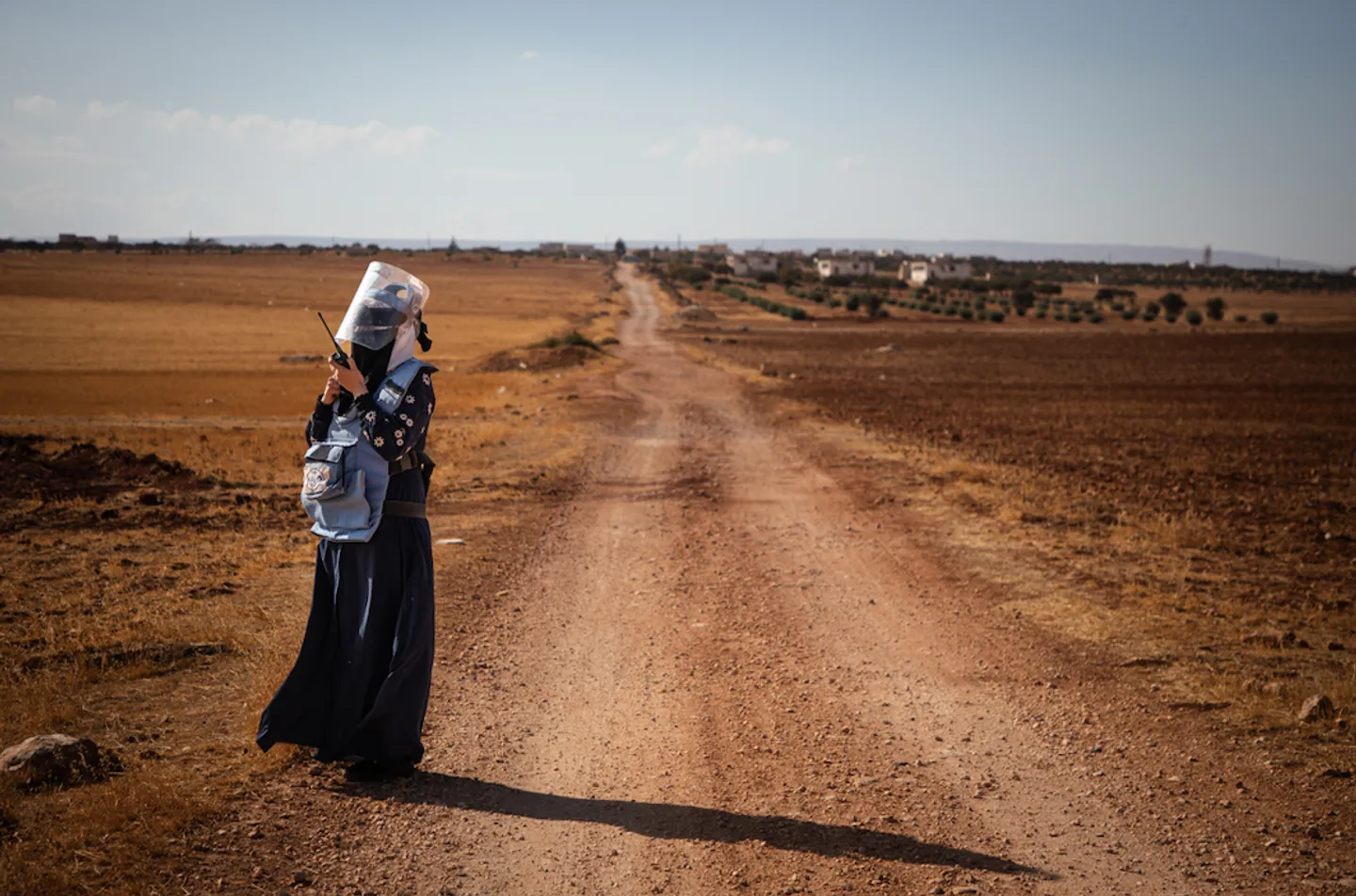








In the Idlib countryside, Lama Haj Kaddour stands in a field, holding a detonator with steady, practiced hands. She and her all-female team have spent hours locating a buried landmine, a task that culminates in a controlled blast, sending a column of smoke into the air. Like her colleagues, Kaddour wears a protective vest and dresses in black, leaving only her eyes visible as she works to clear the remnants of a 14-year civil war.
Kaddour, a 33-year-old mother of three who moved to Idlib from the Hama countryside in 2019, is one of 31 women currently working in operational roles for The HALO Trust in the region. Her motivation is deeply personal: “I could never live with the idea that a single wrong step by my children could set off a landmine that ends their lives, or takes one of their limbs,” she explains.
The threat of explosive remnants of war (ERW) remains a persistent danger for millions of Syrians. According to the Syrian Network for Human Rights (SNHR), at least 3,799 civilians—including 1,000 children and 377 women—have been killed by landmines across the country. The highest death tolls have been recorded in Aleppo, Raqqa, and Deir Ezzor. Raed al-Hassoun, director of clearance operations at Syria’s National Mine Action Centre, reports that 49 landmine incidents occurred between January and August 2026 alone, resulting in 24 deaths and 61 injuries.
The landscape itself is shifting, making the work more unpredictable. Siba Abdul Karim, who leads the non-technical survey department at The HALO Trust, notes that the danger is not static. “Floodwater, like what we saw in late August, can reshape the land and carry buried explosive objects with it,” she says. This was evidenced on August 31, when an unexploded object detonated in the village of Faydat Ibn Muwaina in Deir Ezzor.
In conservative communities, female deminers hold a unique advantage. “A woman working in this field can enter local households and speak directly with women and children in ways her male colleagues often cannot,” Kaddour notes. While women remain a minority in the global mine action sector—a 2019 survey indicated they made up only about 20 percent of staff—the situation in Syria is evolving. The fall of the Assad regime in December 2024 removed significant operational restrictions, allowing organizations like HALO to expand recruitment and training.
According to HALO, women now account for approximately 20 percent of new trainees in hubs like Daraa. As the organization grows its staff beyond 250 across the country, women are taking on diverse roles, including manual demining, team supervision, and community education. Some recruits are widows seeking to support their families, while others, like Kaddour, transitioned into the field after working in relief and supporting landmine survivors.
The work is often emotionally taxing. Mariam al Asaad, 26, a mother of an eight-year-old daughter who has volunteered with the White Helmets for four years, admits to the constant internal struggle. “I worry all the time about the balance between my daughter and this job,” she says. Her commitment is rooted in a family tragedy; in 2017, her younger brother was severely injured when he threw a stone at the ground in the family’s olive grove, triggering a hidden mine. The incident forced the family to abandon their land entirely.
National efforts to address the crisis are also underway. Al-Hassoun notes that the National Mine Action Centre is developing standards to govern organizational work and building a national information management system to better track risks. The centre is also coordinating with groups like the Red Cross and the Red Crescent to clear key areas, such as the Jobar district of Damascus. “The reconstruction of Syria’s battered infrastructure depends first and foremost on resolving the mine issue,” al-Hassoun emphasizes.
Despite the risks, these women remain committed to their mission. For Kaddour, the daily routine of saying goodbye to her children before heading to the field is a reminder of the stakes. She recalls a moment where she successfully calmed a child who had discovered an explosive device, guiding him away from danger. It is this dedication to protecting the next generation that drives them to continue their work in the face of constant peril. The report also notes that the rest of the team waits, still and silent, a short distance away. The report also notes that even after the end of a conflict that killed hundreds of thousands, displaced millions and devastated the economy, the threat has followed families back to the villages they fled. The report also notes that a 2019 survey of a dozen mine action operators published by the Journal of Conventional Weapons Destruction found that women made up only around 20 percent of mine action staff globally, with clearance roles particularly male-dominated. The report also notes that women now make up about 20 percent of new demining trainees — eight out of a recent class of 40, according to Pomfret, in training hubs such as Daraa. The report also notes that kaddour’s own path into demining began earlier. The report also notes that she started by supporting landmine survivors before training for fieldwork in 2022 and taking on the work of clearing unexploded ordnance herself. The report also notes that more than three million displaced people have returned to areas badly damaged by the conflict. The report also notes that but the roads leading to them contaminated, many find their homes still standing.