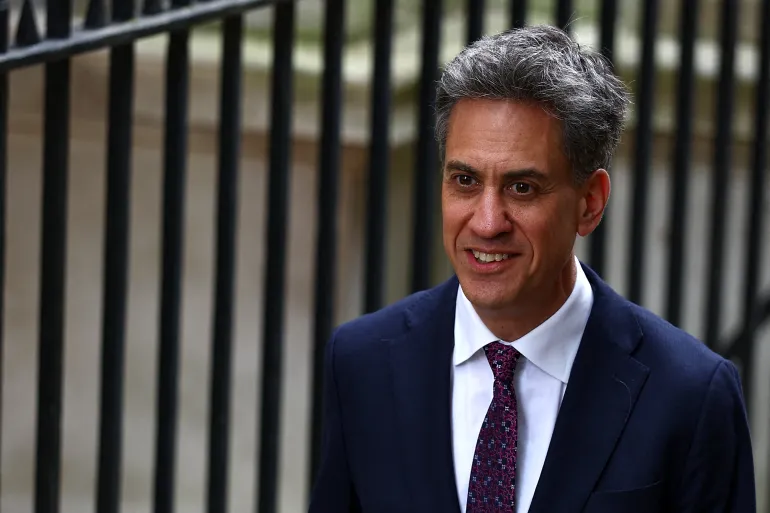








The United Kingdom has officially implemented a ban on the import of all goods produced within illegal Israeli settlements in the West Bank. This move, described by Foreign Secretary Ed Miliband as a “comprehensive reset” of the nation’s policy toward Israel, aims to ensure that the British market does not facilitate the expansion of the occupation. During his address to Parliament, Miliband stated that he did not believe the British public wished to support the occupation through the purchase of settlement-produced products.
Miliband’s announcement included a broad range of restrictive measures. Beyond the import ban on settlement goods, the UK is imposing sanctions on any organizations, businesses, or individuals involved in the construction, infrastructure, or financing of these settlements. Furthermore, the government has instituted a total ban on advertising for the sale of properties located in West Bank settlements and will restrict new export licenses for weapons or other goods that materially contribute to the occupation.
The Foreign Secretary explicitly accused Israel of engaging in “ethnic cleansing” within Palestine and affirmed the official UK stance that the rapid expansion of settlements across the occupied West Bank is unlawful. He also identified settler violence in the region as a form of ethnic cleansing, labeling those responsible as “settler terrorists.” In a move to address specific expansion threats, Miliband announced an extension of the UK’s global human rights regime to enable swifter action against settlement development, specifically targeting the proposed E1 settlement area.
In response to the UK’s policy shift, Israel’s Foreign Minister Gideon Saar announced four immediate counter-measures. These include banning 12 British members of parliament from entering Israel, closing the British Consulate in Jerusalem, removing British representatives from the International Gaza Support Center in Kiryat Gat, and ending the British training of Palestinian Authority forces in the West Bank.
The UK’s decision has garnered international attention, with 12 countries—including France, Canada, Denmark, Spain, Finland, Ireland, Iceland, Norway, Poland, Portugal, and Sweden—issuing a joint statement that supports a two-state solution and signals their own intent to impose similar trade restrictions on illegal settlements. While the ban on settlement products accounts for less than 1 percent of total UK-Israel trade, advocates such as Zena Agha of the British Palestinian Committee have characterized the move as a “bare minimum.” Chris Doyle of the Council for Arab-British Understanding noted that while the ban is a positive step, the UK must be prepared to increase pressure if Israel continues its settlement enterprise.
Despite these sanctions, Miliband emphasized that the UK remains committed to Israel’s security and that the measures are directed at the conduct of the Israeli government rather than the Israeli people. He reaffirmed the UK’s support for a two-state solution and condemned the rhetoric of Israeli officials like Finance Minister Bezalel Smotrich, who have publicly rejected the notion of a Palestinian state. Miliband also reiterated that the UK recognizes Israel’s right to exist and live without fear, while simultaneously calling for Hamas to decommission its weapons and dismantle its infrastructure in Gaza.
To maintain a balanced approach, Miliband announced additional sanctions against Al-Qard al-Hasan, the financing arm of the Lebanese group Hezbollah, and confirmed that the UK will reimpose sanctions on Iran, aligning with measures previously adopted by the European Union and the United States. As a Jewish member of the government, Miliband also pledged a more robust response to rising anti-Semitism within the UK, stressing that targeting Jewish people for the actions of the Israeli government is unacceptable.
The economic context of these changes is significant. In 2025, trade between the UK and Israel reached 6 billion pounds ($8.1bn), encompassing machinery, precious metals, and medical equipment. While the UK has long attempted to distinguish between Israeli and settlement goods through labeling guidelines and customs documentation, the new policy marks a definitive escalation. The government had already suspended approximately 30 arms export licenses between 2024 and 2025 due to the conflict in Gaza and halted negotiations to modernize trade agreements last May. The report also notes that ahead of Tuesday’s announcement, Miliband said new trading bans and sanctions would represent a “comprehensive reset” of the UK’s policy on Israel, amounting to an approach that “not only calls out the injustice [in Palestine], but acts”. The report also notes that he accused the Israeli government of turning a blind eye to the violence and intimidation of Palestinians. The report also notes that a Britain that fights against oppression and suffering wherever it occurs, a Britain that stands up for what is right”, he said, britain is a country “that upholds its values at home and around the world. The report also notes that the UK is an important trading partner for Israel as a whole. The report also notes that however, it is difficult to estimate exactly how much of this is from goods produced by settlements, but an estimated 38 million pounds ($51.4m) worth of goods was imported from the occupied territory in 2025, parliament records show. The report also notes that in return, the UK exports, among other things, defence equipment including drones, helicopters and aircraft components. The report also notes that however, exemptions were made for F-35 combat aircraft components, which Israel can access via other partners like the US.