
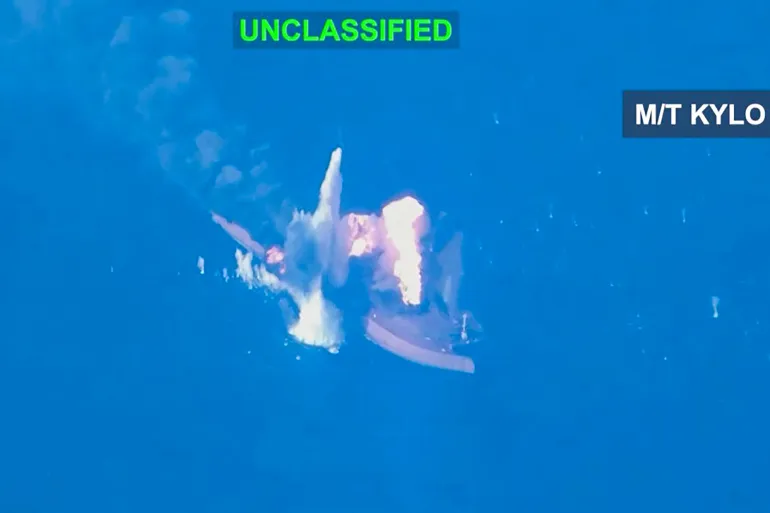






Tensions between Tehran and Washington have intensified as the United States continues its dual strategy of economic sanctions and military force against Iran. The US Central Command (CENTCOM) released footage on Saturday documenting the destruction of three Iranian crude oil tankers near Kharg Island, Jask, and the Gulf of Oman. According to CENTCOM, two vessels were permanently disabled while a third sank following heavy bombardment.
In response, Iran’s Islamic Revolutionary Guard Corps (IRGC) released its own video footage depicting explosives-laden projectiles striking multiple vessels within the Strait of Hormuz. The IRGC claimed to have destroyed a US-built sea drone attempting to enter Iranian waters. Furthermore, the Guard reported firing ballistic missiles at a US aircraft carrier and an accompanying warship involved in the months-long naval blockade of Iran’s southern ports. While the IRGC asserted that both vessels sustained damage and retreated, CENTCOM stated the attacks were evaded, and there is no immediate evidence of successful hits.
The IRGC characterized the US acknowledgment of the missile launches as proof of the enemy’s strategic defeat and evidence of Iran’s offensive capabilities. In a statement on Sunday, the IRGC declared that the aggressor US must leave the region and cease its malignance. Iranian Parliament Speaker Mohammad Bagher Ghalibaf, who serves as the country’s chief negotiator, told lawmakers that Tehran has inflicted significant blows to US regional bases. He warned that the era of proportionate responses has ended and that any further aggression will trigger faster, heavier, and more painful strikes.
The Iranian Ministry of Foreign Affairs has formally condemned the attacks on its shipping fleet as illegal acts and war crimes that violate the United Nations Charter. Meanwhile, the two nations offer conflicting accounts regarding the status of the Strait of Hormuz. The Trump administration claims that, under US guidance, maritime traffic has increased in recent weeks, nearing pre-war levels. Conversely, Iranian authorities maintain that the vital waterway remains effectively closed.
Data from TankerTrackers indicates that Middle Eastern crude oil exports in August fell by 39 percent compared to the January-February baseline of 18.5 million barrels per day (mbpd), with a current deficit of 7.2mbpd. While Iranian officials admit they cannot currently move crude past the blockade, they note that exports have not ceased entirely. President Masoud Pezeshkian recently stated that 90 million barrels were exported during the brief window when a June memorandum of understanding with the US was active.
Washington is currently focused on depleting Iran’s remaining reserves. Treasury Secretary Scott Bessent stated on Fox News that only about 30 million barrels of Iranian crude remain available for purchase by China, suggesting that supply will soon be exhausted. This blockade and sanction regime, branded as Operation Economic Outcast, aims to isolate the nation of 90 million people by severing trade ties with neighbors.
While some analysts suggest that overland and rail routes could transport limited amounts of refined products, fuel oil, and liquefied petroleum gas to markets in Iraq, Afghanistan, and Central Asia, these methods cannot replace the high-volume capacity of very large crude carriers. To manage the ongoing crisis, Iran’s Economy Ministry established an economic war headquarters on Sunday to address severe challenges, including high inflation, unemployment, and energy imbalances.
Despite the pressure, IRGC spokesman Hossein Mohebbi argued that the United States is suffering greater economic damage than Iran. He asserted that for every dollar of damage the US inflicts on Iran, it incurs several dollars in costs itself, citing the depletion of US strategic energy reserves and a decline in regional aluminum exports as evidence of the blockade’s self-inflicted toll. The report also notes that uS and Iranian officials provide different readings of what is transpiring after months of disruptions in the Strait of Hormuz and the naval blockade imposed since mid-July. The report also notes that down from 12.4mbpd in May, it said the current deficit is now 7.2mbpd. The report also notes that “Although most may recover in the coming months, Iran’s exports of 1.68mbpd (baseline number) may likely remain at zero for the foreseeable future; depending on any agreement,” the maritime intelligence company posted online on Sunday. The report also notes that with President Masoud Pezeshkian saying late last month that up to 90 million barrels of oil were exported during the brief period that the memorandum of understanding signed with the US in June was in effect, but they pointed out it does not equal a total halt to exports. The report also notes that allowing Iran to gradually sell it at a discount to its main oil customer, China, despite US sanctions, some of the oil is kept in floating storage outside the blockade. The report also notes that aimed at reducing Iran’s trade with neighbours and further isolating 90 million Iranians, bessent again hailed the “one-two punch” of the blockade and sanctions as part of what the Trump administration has branded Operation Economic Outcast.