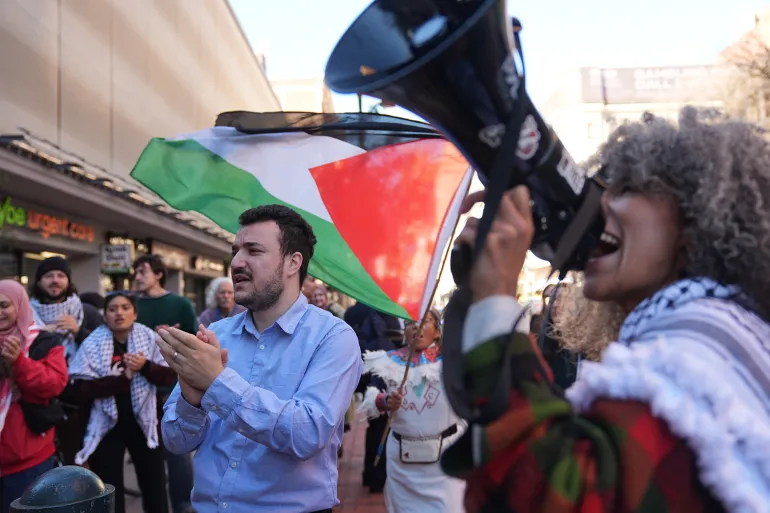

A United States federal judge has issued a significant ruling against the Trump administration, declaring that its efforts to punish international students for criticizing the war in Gaza violated their constitutional rights. District Judge Noel Wise, presiding in California, delivered a sharp rebuke to the Department of State and the Department of Homeland Security for attempting to use visa revocations as a tool to suppress protected speech.
In her 90-page decision, Judge Wise emphasized the fundamental nature of American free speech protections. “Stated plainly, in the United States, freedom of speech belongs to the people,” she wrote. “It is not the government’s to take.” Wise, an appointee of former President Joe Biden, argued that the strength of the nation’s democracy relies on the ability of all residents—citizens and noncitizens alike—to speak freely without fear of state-sponsored retaliation or the need to self-censor.
The legal challenge stemmed from a series of visa revocations and detentions that began in March 2025, starting with the case of Columbia University graduate Mahmoud Khalil. As a key negotiator for student groups at an epicenter of the protest movement, Khalil became a focal point for the administration’s crackdown. While he continues to contest his deportation in separate proceedings, Khalil welcomed the court’s decision, stating on social media that no individual should fear speaking out for Palestine.
The lawsuit, brought by the Foundation for Individual Rights and Free Expression (FIRE), also highlighted the broader chilling effect on academic discourse. In August 2025, the Stanford Daily filed a complaint noting that noncitizen writers had refrained from covering protests due to concerns over visa status. Two additional anonymous plaintiffs, both foreign nationals with clean records, joined the suit, citing similar pressures to remain silent to avoid deportation.
The Trump administration had defended its actions by citing the Immigration and Nationality Act, which allows the secretary of state to exclude foreign nationals whose presence might cause “potentially serious adverse foreign policy consequences.” However, critics and legal experts have argued that this standard is vague and cannot override First Amendment protections.
Judge Wise specifically criticized Secretary of State Marco Rubio for what she termed a “standardless” enforcement policy. “The record does reveal one clear pattern in the enforcement actions the government has taken to revoke noncitizens’ visas since March of 2025,” the judge noted. She concluded that the secretary consistently targeted those critical of the government or its favored causes, labeling the practice as “seriously discriminatory enforcement.”
Conor Fitzpatrick, a lawyer for FIRE, praised the ruling as a victory for civil liberties. “Today’s ruling proves that free speech isn’t a privilege, but the inalienable right of every man, woman, and child,” he said.
This decision follows a similar legal setback for the administration in September 2025, when a federal judge in Massachusetts ruled that officials had violated the First Amendment by targeting noncitizen students and academics for their advocacy. That case, brought by a coalition of education groups, similarly argued that the government’s policies had fostered a climate of fear and repression on university campuses. The State Department and the Department of Homeland Security have not yet provided comment on the latest ruling. The report also notes that the ruling centred on how the second Trump administration revoked visas and detained international students studying in the US after they engaged in pro-Palestinian advocacy.