
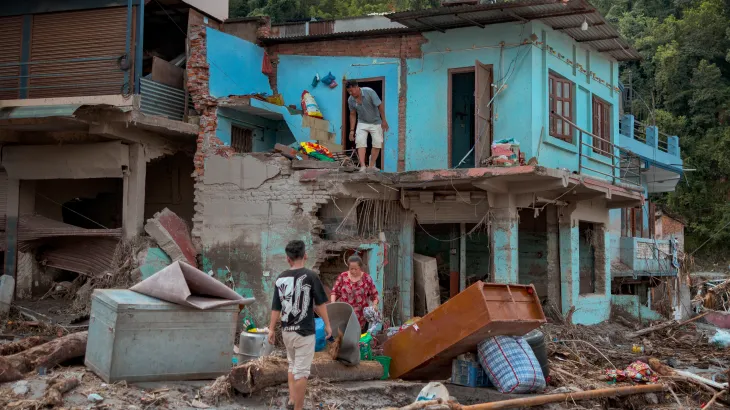









Two days after a catastrophic glacial collapse triggered widespread flash floods and mudslides across Nepal and Tibet, authorities are grappling with a new, secondary threat: the formation of unstable barrier lakes. The disaster, which has already claimed 469 lives with more than 1,000 people still reported missing, saw rescue operations halted on Friday after a river breach occurred at the site of the collapse.
The current crisis stems from the deposition of massive volumes of rock, ice, and debris into the river valley, which has effectively dammed the water flow. Scientists have identified two distinct lakes formed by this event. One is located at a high altitude near the glacier, formed by trapped meltwater, while the second, larger, and more hazardous lake has formed on the Lehende river system in Nepal, where a landslide blocked the valley.
Officials in Nepal’s Rasuwa district reported on Friday that the barrier lake has begun to overflow. Narendra Pariyar, the district’s most senior official, noted that while water levels in the river are visibly rising, the exact dimensions and depth of the lake remain difficult to determine. The lake is situated near the confluence of the Chhochen Khola and Purepu Tsangpo rivers, upstream from the Bhotekoshi and Trishuli rivers that flow toward Kathmandu.
China’s Ministry of Water Resources has estimated that the barrier lake currently holds between 1.5 and 2 million cubic metres of water, with the potential for an additional 3 million cubic metres to accumulate over the next three days. To put this volume in perspective, it is equivalent to approximately 1,200 Olympic-sized swimming pools. The National Disaster Risk Reduction and Management Authority (NDRRMA) of Nepal has warned that the rising water levels pose a significant risk of a sudden dam failure.
In response, Chinese authorities have deployed an eight-member engineering team to conduct aerial surveys and 3D modelling of the site. However, access remains a major hurdle. Engineer Chen Hanxiao reported that the collapse has left the surrounding area characterized by steep, isolated cliffs, making it extremely challenging for personnel to reach the site safely.
Pawan Bhattarai, an assistant professor at Tribhuvan University’s civil engineering department, explained that the avalanche and the subsequent formation of the natural dam were likely unavoidable. He noted that in such steep terrain, even a minor breach could trigger a fast-moving, debris-laden flood with minimal warning for downstream communities. Bhattarai suggested that while the initial event was unpreventable, the consequences might have been mitigated through more robust satellite monitoring and real-time river flow detection systems.
Nitesh Khadka, a physical geographer specializing in glacial floods, confirmed that satellite imagery and drone footage clearly show the two lakes. He noted that while controlled breaching is a theoretical option to mitigate danger, the complex and remote terrain makes such an operation largely infeasible. Khadka warned that if the lake breaches, it would likely mobilize significant amounts of sediment, which would not only cause further flooding but also severely hinder ongoing search and rescue efforts for the missing.
The threat extends to critical infrastructure, including hydropower tunnels located downstream, as well as to survivors who have already been displaced. The current disaster is part of a broader, concerning trend of glacial instability in the region. Similar events have occurred in recent years, including a 2016 incident in Tibet’s Aru Range that released 68 million cubic metres of ice, and a 2022 collapse in China’s Qinghai province that generated a 13-meter wave after an ice avalanche struck a lake.
As the situation develops, experts emphasize that while the natural process of lake formation cannot be stopped, continuous monitoring is essential to reduce the risk to downstream populations. For now, the combination of rising water levels and the structural instability of the natural debris dam remains a primary concern for both Nepali and Chinese disaster management teams. The report also notes that he added that it is currently unclear how high the water level is. The report also notes that however, there are challenges when it comes to accessing the site. The report also notes that creating a natural dam and hence causing this lake to form, these immense piles of debris blocked river channels. The report also notes that additionally, when a barrier lake is held behind only by loosely packed rocks and mud, even moderate overflow can erode the barrier and trigger a sudden, destructive outburst flood downstream. The report also notes that they were paused on Friday since the barrier lake broke its banks, in the hard-hit Rasuwa district. The report also notes that china’s state broadcaster CCTV said on Friday that the risks from the overflowing barrier lake were “manageable”.