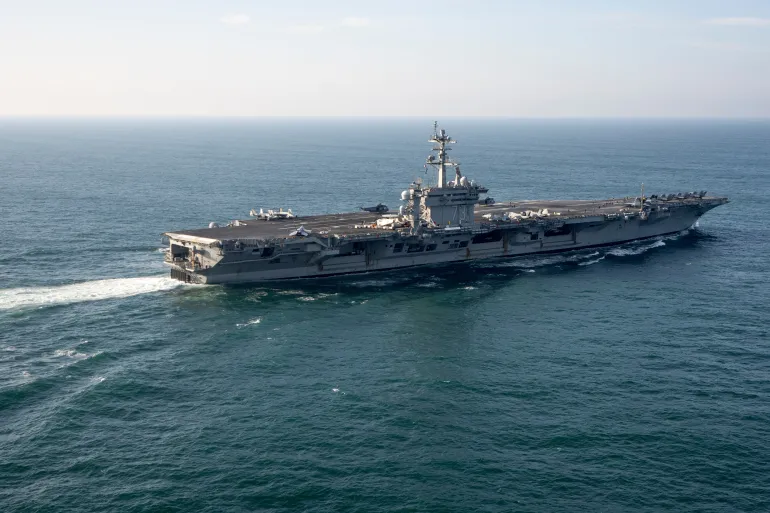







United States allies across the Asia-Pacific are growing increasingly uneasy as the Trump administration redirects critical military assets to the Middle East. The ongoing conflict between the US and Iran, now entering its sixth month, has necessitated a strategic pivot that has seen the USS George Washington—the last remaining US aircraft carrier in the region—ordered to depart Japan for the Middle East.
This redeployment is intended to relieve the USS Abraham Lincoln, which has been stationed in the region for nine months. Recent reports indicated that the crew of the USS Abraham Lincoln faced significant hardships, including food shortages, unsanitary living conditions due to broken plumbing, and at least one reported attempt by a sailor to jump overboard.
The shift of the USS George Washington follows earlier concerns regarding the depletion of regional defense capabilities. Earlier this year, the US relocated components of its Terminal High Altitude Area Defence (THAAD) system from South Korea to the Middle East, while also drawing down missile and munitions stockpiles to sustain the war effort.
William Yang, a senior analyst for Northeast Asia at the International Crisis Group, warned that these combined actions weaken US power projection and its ability to counter Chinese influence. Regarding the carrier’s departure, Yang noted that the move impacts the overall effectiveness of US-led regional deterrence, stating, “If we look at this as part of a larger trend … it certainly is creating an impact.”
While the US presence fluctuates, China has become more assertive, with its fleet increasingly operating beyond the First Island Chain. This defensive perimeter, which stretches from Japan through Taiwan and the Philippines, has failed to prevent Chinese carriers like the Liaoning and Shandong from entering the Western Pacific. Furthermore, Chinese coastguard activity near Taiwan has intensified since June, encroaching on the exclusive economic zones of Japan and the Philippines. Yang described these maritime operations as being “aimed at Taipei, aimed at Manila, aimed at Tokyo,” adding that Beijing is actively testing the US capacity and willingness to respond.
Ja Ian Chong, a security expert at the National University of Singapore, suggested that the redeployment might embolden Beijing. “I think US allies and partners may wonder if the move gives [China] more confidence to test and push,” Chong said, noting that while the bulk of the 375,000 US military and civilian personnel in the region remain, the loss of the carrier reduces operational flexibility.
This strategic shift aligns with the 2026 National Defense Strategy, which emphasizes burden-sharing. The policy mandates that allies in Europe and Asia increase military spending to 3.5 percent of their GDP and security-related spending to 1.5 percent by the 2030s. In response, Taiwan has announced plans to boost its 2027 defense budget by 18 percent, while the Philippines is pushing for spending to reach 4 percent of GDP.
Despite the current anxiety, some experts remain measured. Kei Koga of Nanyang Technological University characterized the move as a short-term concern rather than evidence of a long-term strategic withdrawal. Similarly, K Tristan Tang of the National Bureau of Asian Research pointed out that US Amphibious Ready Groups, capable of hosting F-35B stealth fighters, remain in the region.
Tang also emphasized that President Trump remains focused on the global balance of power. “Deep down in President Trump’s mind, the most important thing will still be US economic interests and the economic issue with China,” Tang said. “China is still the most important thing.” The report also notes that but it has recently done little to keep China’s Liaoning and Shandong aircraft carriers from moving into the Western Pacific, the Cold War defensive line was originally designed to contain Beijing. The report also notes that that could in turn put more pressure on them,” he told. The report also notes that which under Trump sees regional allies as taking the leading role in their own defence, albeit with US support, chong saw the redeployment as more symbolic of shifts in the US strategy towards Asia. The report also notes that he expected to see this trend deepen as Asia navigates its way forward, chong said that going forward. The report also notes that in addition to building their organic capabilities,” he said, uS allies and partners are also looking for ways to work with each other more. The report also notes that he did not think Trump would forget about the world’s second-largest superpower, tang also said that even with the Iran war dragging on.