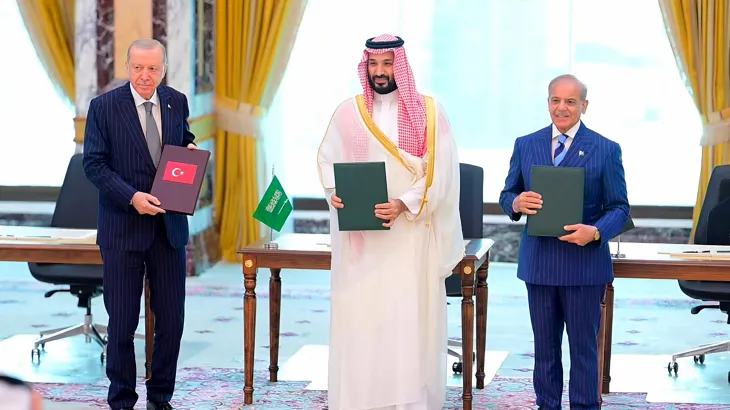







A new trilateral defense pact between Saudi Arabia, Pakistan, and Turkiye has sparked debate regarding the future of regional security, particularly as the ongoing conflict between the United States and Iran continues to reshape the Middle East. Under the terms signed in Mecca this past Friday, the three nations have committed to a mutual defense framework where an armed attack on one member will be treated as an attack on all.
The announcement follows five months of intense hostilities, initiated by a US-Israel bombing campaign against Iran. This conflict has significantly impacted the Gulf region and disrupted critical maritime transit through the Strait of Hormuz. Despite the geopolitical weight of the new alliance, the signatory nations have emphasized that the pact is not directed at any specific country and does not void existing international agreements.
In Tehran, the official response has been measured. Iranian Foreign Minister Abbas Araghchi addressed the development on X, suggesting that regional unity allows Muslim nations to confront challenges from “malicious outsiders head-on.” He advocated for self-reliance and brotherhood, though he stopped short of explicitly naming the new trilateral agreement.
Analysts suggest that while Tehran is not currently facing an immediate existential threat from the pact, there are long-term concerns. Hamidreza Azizi, a researcher at the Clingendael Institute, noted that the timing is significant given the persistent attacks on Saudi Arabia by Iran-aligned Houthi forces in Yemen and various armed groups in Iraq. Azizi warned that if the pact is perceived as a shield against Iranian influence, it could complicate Tehran’s diplomatic efforts to maintain individual relations with Riyadh, Islamabad, and Ankara.
The security landscape remains volatile. On Sunday, the Houthis claimed a drone strike on a Saudi Aramco refinery in Jizan, which Saudi officials confirmed caused a fire but resulted in no casualties. Simultaneously, a separate Houthi attack on the Red Sea port of al-Makha reportedly killed seven people and wounded 15, causing substantial damage to infrastructure. The group claimed the strike targeted weapons depots belonging to the Saudi-backed Yemeni government.
Tehran’s diplomatic perspective was further emphasizes the perceived decline of American hegemony. Hosseinfluence. Hossein Noushabadi, a director general for parliamentary and legal affairs, described the pact as a potential indicator of the collapse of US security hegemony in West Asia. He suggested that the agreement signals a shift toward a regional order managed by local states rather than external powers, effectively moving the region away from the sphere of US interests.
Academic experts largely concur that the pact is currently more symbolic than operational. Vali Nasr, a professor at Johns Hopkins University, characterized the agreement as a component of a post-American security architecture, noting that it serves as a counterweight to the US-backed Abraham Accords. Similarly, Mehran Kamrava of Georgetown University in Qatar argued that there is little substance to suggest that Pakistan or Turkiye would commit to direct military intervention in the Saudi-led war in Yemen.
However, the agreement has faced criticism from some Iranian hardliners. Certain lawmakers and media outlets have expressed concern that the pact could be weaponized against the “resistance front” and might undermine Pakistan’s role as a neutral mediator between Iran and the West. Ebrahim Azizi, a member of the Iranian parliament’s National Security and Foreign Policy Commission, acknowledged the necessity of regional security cooperation but argued that the current roadmap remains insufficient.
The long-term viability of the pact may depend on whether Iran seeks its own path toward membership, a prospect that analysts say would require a sustainable resolution to regional maritime and border conflicts. For now, Tehran appears focused on framing the alliance as a rejection of external interference, even as it remains wary of the potential for coordinated pressure from its neighbors.
Ultimately, the trilateral agreement reflects the complex security calculations of Riyadh, Islamabad, and Ankara. As noted by Sanam Vakil of Chatham House, these nations are navigating a landscape defined by concerns over US unreliability, Israeli revisionism, and the ongoing repercussions of Iranian retaliation.
The situation remains fluid, with Iran continuing to monitor whether the pact evolves into an explicitly anti-Iranian coalition. Tehran’s priority, according to regional experts, is to prevent such an outcome while continuing to advocate for a security model organized by regional states rather than extra-regional actors.
As the region adjusts to this new diplomatic configuration, the focus remains on whether these three powers can maintain their delicate balance of interests without further escalating tensions with Tehran or relying on the traditional security umbrella provided by the United States.
In Tehran, the reaction has largely been subdued, with officials mostly focusing on aspects of regional and Muslim cooperation and what they perceive as a declining role for the US.
“Time to rely only on ourselves and embrace true brotherhood,” he wrote on X, without directly mentioning the trilateral agreement signed hours earlier.
Separately in Yemen, Houthi missiles and drones struck the Saudi-backed and internationally recognised government’s Red Sea port of al-Makha, with officials reporting at least seven people killed, 15 wounded and severe i
Hossein Noushabadi, a director general for parliamentary and legal affairs, told the state-linked ISNA news service that the ministry predominantly regards the agreement within the context of a diminishing direct US presence in the region.
“This is also as much a balance to the Abraham Accords as a direct challenge to Tehran,” he added, in reference to the US-pushed regional normalisation effort with Israel, which US President Donald Trump last month tied with a civil nuclear deal sought by Saudi Arabia.
“Ultimately, this pact is not that new, nor is it something that, at present at least, has a great deal of substance beyond its symbolic significance.
“It’s clear that Arab states finally understand security cannot be imported; it must be built within the region.
“Warning: Miscalculation is a historical mistake.
Iran has proven that every error comes at a cost.
Balance is the only way forward,” he wrote on X.
Ebrahim Rezaei, another member of the commission, also wrote on X that “a paper agreement with Turkiye and Pakistan” will not bring Saudi Arabia security, “just as years of one-sided dependence on the Americans did not bring them security”.
Egypt has already been floated as a candidate, but that could be a complex decision for Cairo to make.
“They are driven together to forge greater diplomatic and defence cooperation in reaction to US unreliability, Israeli revisionism and Iranian retaliation,” she told Al Jazeera.