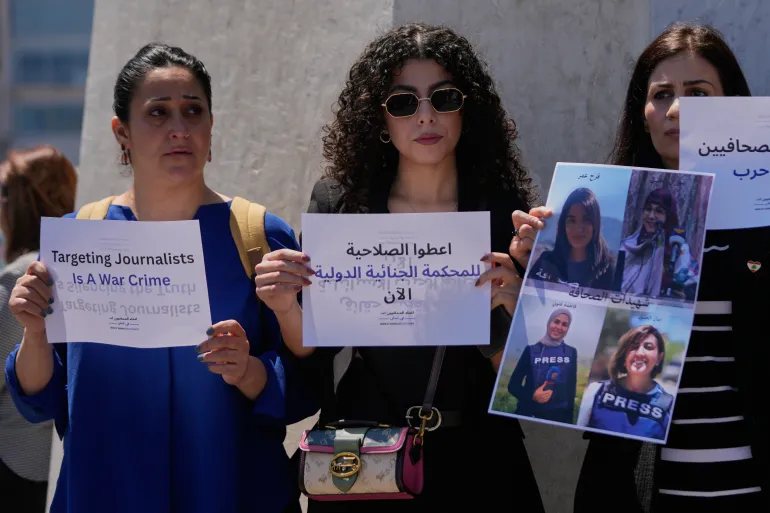





International and Lebanese human rights organizations have formally accused Israel of intentionally targeting a journalist and preventing medical personnel from reaching her after she was critically wounded. The incident occurred on April 22 in the southern Lebanese town of al-Tiri, resulting in the death of Amal Khalil, a veteran reporter for the newspaper al-Akhbar, and leaving photojournalist Zainab Faraj with severe injuries.
Following separate investigations, Human Rights Watch (HRW), Amnesty International, and the Lebanese group The Legal Agenda released findings challenging the Israeli military’s conduct. HRW characterized the strikes as “apparently deliberate attacks on civilians and civilian objects,” while Amnesty described the event as a “direct attack on civilians which should be investigated as a war crime.” The Legal Agenda further concluded that the military’s actions constituted “war crimes and grave violations of international humanitarian law.”
According to the HRW report, the journalists had sought shelter in a building after being forced to abandon their vehicle due to earlier strikes. Despite the Lebanese Red Cross relaying an evacuation request through the United Nations Interim Force in Lebanon (UNIFIL), the military proceeded to target the structure. Investigators noted that Israeli drones were present at the site, suggesting the military knew or should have known the occupants were civilians.
The reports also allege that Israeli forces actively impeded rescue operations. HRW documented that paramedics were forced to retreat after a stun grenade was fired in their direction. Furthermore, witness accounts and photographic evidence indicate that a Lebanese Red Crescent ambulance was struck by small arms fire while attempting to reach the scene.
In response to the allegations, the Israeli military claimed at the time that it had struck a vehicle departing from a structure used by Hezbollah and subsequently targeted the building itself. The military denied preventing rescue teams from accessing the area. Amnesty International noted that the Israeli army stated the incident underwent a “preliminary review” and that it “regrets any harm caused to journalists.”
Lebanese President Joseph Aoun previously condemned the killing, asserting that the targeting of journalists was part of a broader effort to “conceal the truth of its aggressive acts against Lebanon.” This incident is part of a wider pattern of violence against media workers in the region.
Data from the Committee to Protect Journalists (CPJ) highlights the scale of the crisis, noting that in 2025, Israel was responsible for 84 of the 129 journalist deaths recorded globally. The CPJ also classified 38 of 47 targeted killings that year as “murder” attributed to Israeli forces. This year, the trend has persisted, with at least eight Palestinian journalists and nine journalists in Lebanon killed according to respective tallies.
Ramzi Kaiss, a Lebanon researcher at HRW, criticized the lack of accountability, stating that the military’s actions demonstrate a “brazen willingness to commit atrocities without any fear of consequences.” He urged international actors to exert leverage over Israeli authorities to prevent further incidents.
Amnesty International’s Heba Morayef echoed these concerns, noting that the impunity enjoyed by Israeli forces over the past three years has enabled the continued use of unlawful air strikes. Both organizations have called for urgent international pressure to ensure accountability for the deaths of Khalil and other civilians.
In 2025, Israel was responsible for more than two-thirds of journalists killed globally – 84 out of 129 – according to cases tracked by the Committee to Protect Journalists (CPJ).
“The Israeli military says it does not target journalists, but the facts and evidence show that it has repeatedly done so.