
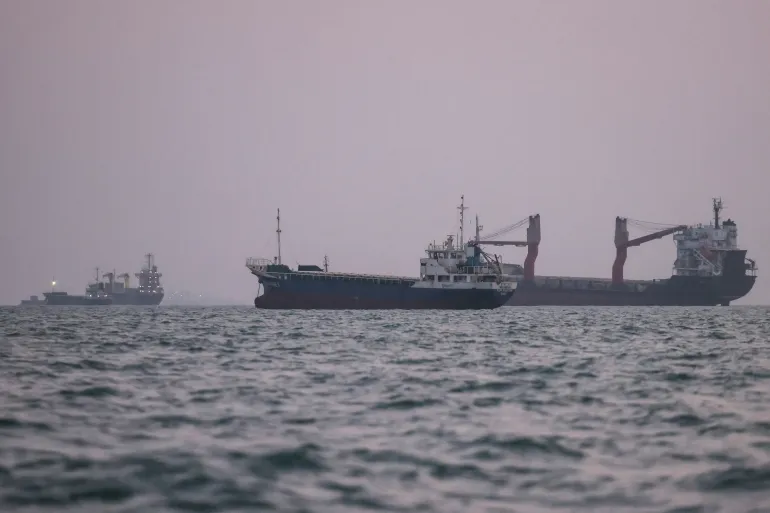






The United States and Iran have significantly intensified their maritime confrontation over the past 24 hours, engaging in a series of retaliatory strikes that have left tankers damaged and raised fears of a broader conflict. Washington reported that its forces successfully targeted three Iranian oil vessels, including one near Kharg Island—a facility that handled 90 percent of Iran’s crude exports prior to the ongoing war. Additional strikes were recorded near Jask and in the Gulf of Oman, where an unladen vessel was hit after its crew was ordered to abandon the ship.
These operations followed Iranian ballistic missile launches directed at a US aircraft carrier and a navy destroyer. US Central Command (CENTCOM) stated that the warships evaded the incoming fire, and no American personnel were injured. CENTCOM commander Admiral Brad Cooper framed the response as a direct deterrent, stating, “If you shoot at two of our ships, we will impose an even higher economic cost — taking out three of yours.”
Tehran’s Islamic Revolutionary Guard Corps (IRGC) justified its missile strikes by accusing the US vessels of harassing Iranian ships and enforcing an illegal naval blockade. Defense analyst Wolfgang Pusztai described the targeting of an aircraft carrier as a “very, very significant development,” noting that it represents the backbone of the American military campaign in the region. Beyond the missile launches, Iranian forces claimed to have targeted three oil tankers navigating what they labeled an “unauthorised route” in the Strait of Hormuz, alongside three other US-linked vessels.
The IRGC navy has issued a stern warning to all maritime traffic in the Gulf and the Strait of Hormuz, urging vessels not to be “deceived” by the US military or engage in suspicious movements, threatening that those who fail to comply will be targeted. Iran also claimed to have struck an unmanned US vessel attempting to enter the strait on Sunday.
This “calculated escalation” occurs as both nations attempt to leverage control over the Strait of Hormuz, a critical global chokepoint. While the US asserts that the waterway remains open and that millions of barrels of oil are transiting daily, marine analytics firm Kpler reported a 10-day average of only 13 vessels per day. US Treasury Secretary Scott Bessent recently announced new economic measures aimed at dismantling Iran’s revenue streams, including its “shadow fleet” used to bypass sanctions. Washington maintains that the tankers it struck were integral to a multibillion-dollar network financing the IRGC and its regional allies.
Iranian officials remain defiant, with Hassan Ghashghavi of the National Security Commission describing the confrontation as an “existential war.” Tehran has signaled that it has plans to counter the US blockade, with analysts suggesting that Iran may attempt to drive global oil prices above $100 per barrel. Ali Akbar Dareini, an analyst in Tehran, noted that the US attacks on oil tankers are a major provocation that Iran cannot ignore, warning that such actions only incentivize harsher retaliation.
The economic fallout is becoming increasingly apparent. Brent crude futures closed at $96.28 per barrel on Friday, marking their highest level since late July. In the United States, diesel prices reached a record average of $5.85 per gallon. These rising costs are creating political pressure for President Donald Trump ahead of the November midterm elections. Recent polling from Reuters/Ipsos indicates that only 31 percent of Americans support the war, while Trump’s approval rating has slipped to 33 percent since the conflict began.
As the naval blockade of Iranian ports continues, the prospect of a diplomatic de-escalation appears increasingly remote. The ongoing disruption to energy supplies has slowed global economic growth, and with both sides seemingly committed to a strategy of imposing maximum costs on the other, the conflict shows few signs of abating. The report also notes that though the exact figures are still debatable, while the naval blockade of Iranian ports continues, the attacks on tankers come as the US claims that an increasing volume of oil has started to flow through the strait. The report also notes that the latest exchanges further dim hopes for a de-escalation through diplomacy as the US-Israel war on Iran has disrupted energy supplies and slowed economic growth around the world. The report also notes that so, what do we know about the latest tanker wars, and where is the conflict headed. The report also notes that a source of revenue that has become more important since the US began blockading Iranian ports in April, iran has long relied partly on a shadow fleet to circumvent sanctions and sell oil. The report also notes that through which 20 percent of the world’s oil supplies flowed, in retaliation for the US-Israeli attacks that began on February 28, iran effectively shut the Strait of Hormuz. The report also notes that “Naturally, they have acted militarily in violation of all international laws,” he told, adding that “because America is far from us, it does not see this war as existential”.