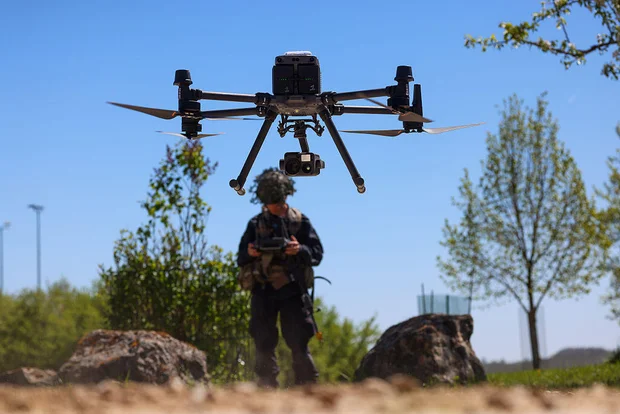









The U.S. Army is moving to disband a drone battalion established just last year to analyze and implement tactical lessons from the ongoing war in Ukraine. An Army official confirmed the decision on Thursday, noting that the unit will be phased out following the conclusion of a current training exercise.
The unit, known as the Unmanned Assault Battalion, was formed as part of the 173rd Airborne Brigade. According to an Army official, once the current exercise concludes in September, the soldiers will return to their primary duties as an airborne infantry battalion, focusing on traditional parachute and deployment operations.
Multiple current and former officials indicated that the decision to terminate the unit stems from long-standing friction between the senior officers who advocated for its creation and Gen. Christopher LaNeve, the acting chief of staff of the Army. The battalion was a key project for former Army Chief of Staff Gen. Randy George and the former commander of U.S. Army Europe and Africa, Gen. Christopher Donahue. Both men have since been fired or forced into early retirement, facilitating LaNeve’s rise to his current position.
Sources familiar with the situation described a history of tension between LaNeve and Donahue, specifically citing an incident where LaNeve’s tenure as commander of the 82nd Airborne Division was cut short. This “soft relief” and the subsequent pressure for LaNeve to vacate his residence at Fort Bragg, North Carolina, reportedly created significant ill will.
Last year, Gen. George and Army Secretary Dan Driscoll introduced the Army Transformation Initiative, which prioritized the development of unmanned systems. At the time, Driscoll told “Face the Nation” that there was universal consensus on the necessity of learning from the conflict in Ukraine. However, a spokesperson for the Army secretary stated that Driscoll had no comment regarding the current decision to nix the drone unit.
In his recently published vision document, “The Army Azimuth,” LaNeve emphasized that the force must prioritize fundamental soldiering skills while integrating new capabilities, such as defense against unmanned systems. “Every Soldier deserves to know where this Army is headed and what’s expected of them,” LaNeve stated. “My focus is simple and it hasn’t changed: this Army must fight and win today.”
The strategic value of drones has been a subject of intense debate. Retired Gen. David Petraeus argued in April that the U.S. military must aggressively pivot toward drone-centric warfare, suggesting that armored battalions should be replaced by drone-focused units. Similarly, Capt. Ronan Sefton, who served with the 2nd Cavalry Regiment in Germany, has been a vocal proponent of integrating drone technology into every aspect of training.
Sefton, who later joined the Army’s Ukraine Lessons Learned Task Force, previously told “60 Minutes” that he urged senior commanders to recognize that drones are fundamentally altering the nature of combat. While he maintains that traditional firepower remains relevant, he argues that the military must urgently adapt to counter the advanced drone capabilities demonstrated by adversaries.
The Unmanned Assault Battalion is currently utilizing its final exercise to document the knowledge gained over the past year, aiming to inform the future of Army warfare. A spokesperson for LaNeve referred all inquiries to the broader Army, which declined to provide further comment beyond confirming the plan to shut down the unit. The report also notes that the war in Ukraine has highlighted the key role drones now play in warfare for several years. The report also notes that and Israel against Iran, that message was driven home further as Iran launched one-way attack drones at U.S. The report also notes that military installations across the Middle East. The report also notes that the Wall Street Journal first reported that the drone unit would be phased out. The report also notes that strategic moves based on personal disagreements. The report also notes that they think that innovativeness is giving 50 drones to an armored battalion,” Petraeus said, in some Western countries right now. The report also notes that ronan Sefton was first deployed to Germany with the Army’s 2nd Cavalry Regiment not long after Russia launched its invasion in 2022.