
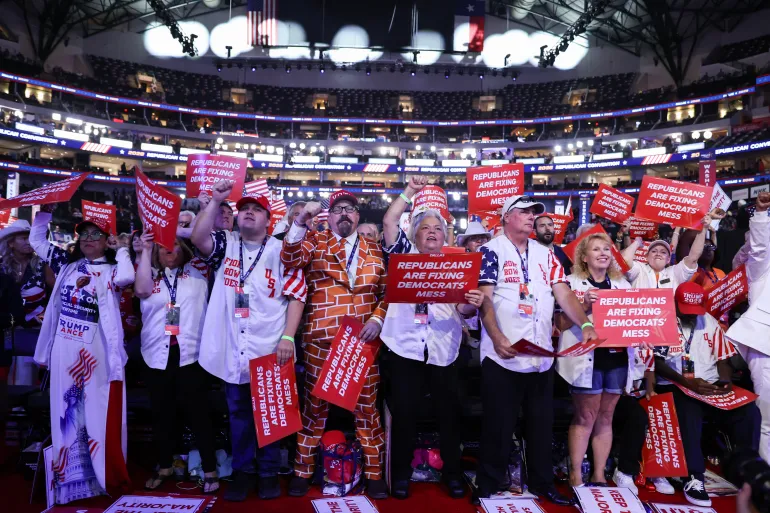







The Republican midterm convention in Dallas has served as a high-stakes platform for President Donald Trump, placing him at the center of the party’s strategy as it fights to maintain control of both the House of Representatives and the Senate. However, the event occurs under the shadow of the war in Iran, which Trump and Israel initiated on February 28, and the subsequent economic strain on American voters.
Market volatility remains a persistent concern. As Trump prepared for his Wednesday keynote, Brent Crude prices climbed above $100 per barrel for the first time since July, highlighting the global economic fallout of the ongoing conflict. This economic pressure is a primary issue for the electorate, complicating the party’s messaging in the final stretch of the midterm cycle.
For some attendees, the convention is a display of party unity. Carter Eisinger, a 27-year-old electrician from Fargo, North Dakota, described the event as a “Trump-a-palooza.” While he views the term as a compliment and acknowledges the party is firmly under Trump’s influence, he remains conflicted about the war’s alignment with an “America First” agenda. Eisinger questioned how the conflict benefits domestic interests, stating that while he would support a justified war, he has yet to see that justification clearly linked to American family needs.
Other supporters expressed a mix of loyalty and strategic concern. Bijay Dixit, a 59-year-old photographer from Houston, praised Trump’s immigration policies and economic stewardship but suggested the administration underestimated the Islamic Revolutionary Guard Corps (IRGC). He characterized the war as a necessary response to decades of Iranian actions since the 1979 revolution, despite the tactical miscalculation.
The political stakes are further complicated by public opinion. Recent polling, including data from Reuters/Ipsos, indicates that only one-quarter of Americans view the war as worthwhile. Independent voters, in particular, have shown significant disapproval, often prioritizing affordability over foreign policy objectives.
The Trump administration has maintained its focus on securing shipping routes in the Strait of Hormuz, where Iran continues to exert influence. Addressing reporters before his trip to Dallas, Trump dismissed suggestions that the war would conclude before the November elections. He accused the Iranian government of intentionally prolonging the conflict to influence the outcome of the US vote, claiming they hope for a weaker administration. He expressed confidence that the war would end swiftly once the elections are over, asserting, “They can’t hold out any longer.”
Despite these tensions, some loyalists remain optimistic. John Russell, a 55-year-old from Rockford, Illinois, and a frequent attendee of Trump rallies, dismissed the rising gas prices as a “small bump.” He argued that the war is essential to prevent Iran from acquiring a nuclear weapon, a core justification cited by the administration. While Tehran denies pursuing nuclear arms, military analysts have warned that dismantling their program would likely require a major escalation and significant ground forces.
Helen Vennett, a 65-year-old small business owner and county Republican chair from Maryland, compared the atmosphere to a pep rally, noting that supporters need to feel they are part of a larger movement. She acknowledged the potential for political fallout but remains committed to the administration’s stated goals.
Looking ahead to the polls, Russell predicted that the convention would energize the Republican base and sway enough independent voters to secure victories for Trump-backed candidates. Whether this strategy will overcome the economic and geopolitical pressures remains the central question for the party as the midterm elections approach. The report also notes that which Trump launched alongside Israel on February 28, and the knock-on effects on affordability in the United States, a key issue for many voters, that has been particularly true when it comes to the war on Iran. The report also notes that “I think some people say that in a derogatory way, but I think it’s very much a complimentary phrase,” he added. The report also notes that “In my opinion, I don’t really see the connection of how a war in Iran helps us here in the country,” he said. The report also notes that he felt a similar confusion about the close relationship between the US and Israel. The report also notes that “At the end of the day, I’m going to come right back to whatever is best for families, young people, anyone in America,” he said. The report also notes that even if they saw the war on Iran as a misstep, others were more charitable towards Trump’s approach to the Middle East. The report also notes that he also believed Republicans were the party to steward the economy in the years ahead.