








The Supreme Court has issued a temporary stay, allowing President Donald Trump to proceed with the construction of a massive new ballroom at the White House. The order effectively freezes a lower court ruling that would have mandated a work stoppage at midnight on Friday. This administrative action, issued by Chief Justice John Roberts, does not resolve the underlying legal debate regarding the project’s legitimacy; rather, it provides the justices with additional time to evaluate the administration’s request to indefinitely pause the adverse rulings.
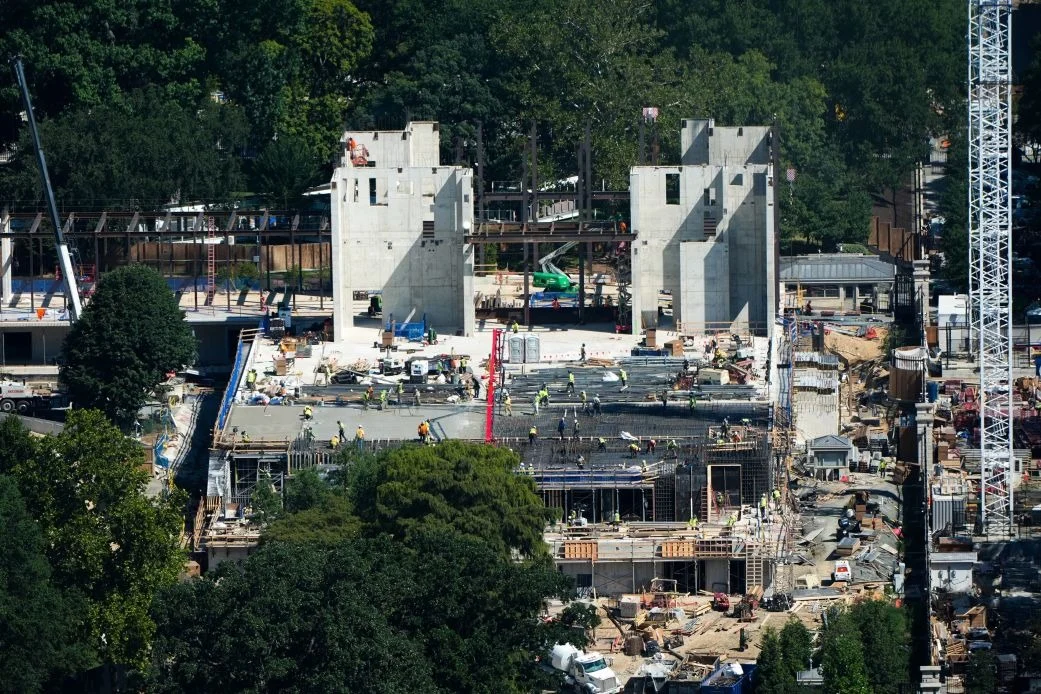
The project, which has faced significant legal challenges, has been deemed unlawful by two lower courts on the grounds that it lacks necessary congressional authorization. Despite these rulings, the administration has maintained a rapid construction pace. Court filings indicate that a 250-person crew has been operating on 20-hour shifts, seven days a week. The government reports that the complex is currently “65% complete in its entirety.” Chief Justice Roberts, who oversees emergency matters originating from the DC Circuit Court of Appeals, did not establish a specific deadline in his order, meaning construction may continue until the Supreme Court issues a further directive.
As this is an administrative stay handled by the Chief Justice, there was no accompanying reasoning, vote count, or dissent. The matter is expected to be referred to the full bench of nine justices. Since beginning his second term, the president has focused on reshaping various aspects of the Washington landscape to reflect his personal preferences. The ballroom project represents the most significant of these efforts, following the demolition of the former East Wing last year—a move that sparked widespread criticism from both political parties.
Regarding the project’s scale, the president remarked in August, “This will be the greatest military complex slash ballroom anywhere in the world. There won’t be anything like it.” Sources familiar with his perspective suggest he views these construction initiatives as a foundational element of his legacy, recently characterizing opponents of the work as “very disloyal to our country.”
The legal battle began in December when the National Trust for Historic Preservation filed suit, eventually securing an injunction from federal judge Richard Leon. While Judge Leon initially allowed work to continue on a sophisticated bunker beneath the site—accepting the administration’s argument that the bunker and the ballroom were distinct entities—the situation evolved. Trump and his officials increasingly emphasized the necessity of the entire structure for national security, citing recent threats against the president’s life. However, the DC Circuit Court of Appeals upheld the injunction in a 2-1 decision, stating that the decision to build such a massive ballroom rests with Congress, not the Executive Branch.
In its ruling, the appeals court emphasized that the National Trust had compellingly demonstrated that Congress has not granted the Executive Branch the authority to fundamentally redesign or reconstruct the White House. Following this, the administration appealed to the Supreme Court. Solicitor General D. John Sauer argued that the project is essential for security and architectural integrity, labeling the lower court’s intervention as “judicial overreach.” He further asserted that the president, as the elected head of the Executive Branch, is authorized to secure and renovate the White House grounds.
A central point of contention remains the legal standing of the National Trust. The administration argues the group lacks the right to sue, while lower courts have pointed to the testimony of architectural historian Alison Hoagland, who claimed her enjoyment of the site is diminished by the project. The president dismissed this concern, stating, “The person said she walked along and she didn’t like the view, even though nothing was built. The woman has absolutely no standing.”
Financial estimates for the project have fluctuated significantly. While the administration initially cited a cost of $200 million, the president later suggested a figure of $300 million in the fall, and recently noted that nearly $400 million had been spent. Internal documents obtained by the media suggest the total cost of these changes, including the Rose Garden and a helipad, could reach approximately $900 million. Lawyers for the National Trust have warned that the use of specialized, near-permanent concrete means the administration is attempting to “outrun judicial review” by making the project irreversible, urging the Supreme Court to deny the request and prevent further irreparable harm to historic preservation efforts. The report also notes that which two other courts have said Trump is pursuing unlawfully because Congress hasn’t approved it, friday afternoon’s order doesn’t address the legality of the project. The report also notes that with a 250-person crew working 20-hour days, 7 days per week, according to a filing submitted by the Trump administration to the Supreme Court, construction has been progressing rapidly. The report also notes that the court agreed with the judge in a divided ruling that required work to cease starting August 21, but in early August. The report also notes that roberts is certain to refer to the case to all nine justices. The report also notes that the administration revealed how much construction had progressed in recent months, in asking the justices to step into the dispute. The report also notes that filings submitted to the court said hundreds of workers were spending “20 hours a day, 7 days a week to keep the project ahead of schedule and under budget,” and that it was already more than halfway done. The report also notes that sauer said that among the building materials being used is a type of concrete that is also used at nuclear power plants and nearly impossible to deconstruct.