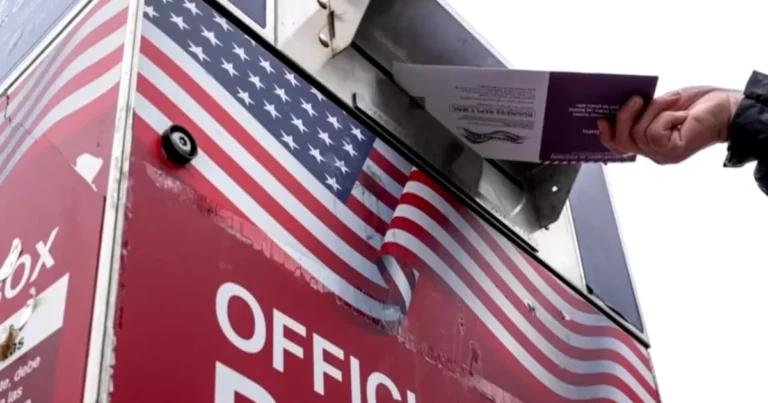






Since 1992, anytime a Democrat has won the White House, South Carolina primary voters have picked the winning candidate. Historically, Bill Clinton, Barack Obama, and Joe Biden were the top vote-getters in the state on their roads to the presidency, establishing the region as a critical proving ground for those seeking the party’s nomination. As Democrats seek a path back to 1600 Pennsylvania Ave. in 2028, South Carolina will again be the first state in the nation to hold a Democratic presidential primary—or at least the state sanctioned by party leaders to vote first. The Democratic National Committee officially confirmed on August 15 that South Carolina is the party’s choice to replace Iowa and New Hampshire, the traditional leadoff states, in two years to better reflect the party’s diverse voters. The primary is scheduled for January 22, 2028.
Many potential presidential candidates are already making pilgrimages to the state, even though the primary is still far off. That includes multiple trips by California Gov. Gavin Newsom for the South Carolina Democratic Party’s “On the Road” series, an initiative designed to connect national and regional Democratic figures to local communities. Arizona Sen. Mark Kelly participated in a SCDP town hall event in 2025, and Kentucky Gov. Andy Beshear served as an SCDP speaker earlier in 2026. Former Vice President Kamala Harris, the Democrats’ unsuccessful 2024 candidate, participated in a private fundraiser this year, while Cory Booker, a 2020 presidential candidate, took part in the “On the Road” series.
“Everybody comes here to test the water,” said Brent Nelsen, a political science professor at Furman University in Greenville, South Carolina. More than 60% of South Carolina’s Democratic primary electorate is African American, which is the party’s most loyal voting bloc. South Carolina voters tend to be conservative and deeply religious, and candidates who can speak to their values often find success. “It is a part of how you have to campaign in the Deep South,” said Christale Spain, chair of the South Carolina Democratic Party. “It’s the Bible belt.”
Spain noted that while faith communities are part of the political landscape, dominated mostly by Baptists and AME churches, the approach must be authentic. “I mean, Joe Biden was a Catholic,” she said, highlighting how candidates often navigate these spaces. Political commentator Bakari Sellers, a former member of the South Carolina House of Representatives, agreed that faith is a cornerstone of the electorate. “Rooted in faith is important. It’s not a religiosity, although, you know, Black Christianity is extremely strong, but it’s having some center of faith,” he said.
Sellers pointed to Pennsylvania Gov. Josh Shapiro, who is Jewish, and Maryland Gov. Wes Moore, who is a Southern Baptist, as examples of leaders who understand this dynamic. “Both come in with the ability to understand the power of faith, the power of prayer, and they can do well,” he said. In a recent interview with Roland Martin, he emphasized that Black voters should not be taken for granted, as their support is essential for any path to the nomination. He also noted that local figures like Anna Andrews could potentially become the next junior senator from South Carolina, signaling the state’s shifting political bench.
Rep. Jim Clyburn, South Carolina’s only Democratic congressman, is seen as a kingmaker in the state party. “The fact of the matter is you want to win in November. So you ought to put people on the field who can win,” Clyburn said. Successful candidates will be able to inspire turnout, he added, noting that only about 59% of eligible voters participated in the last cycle. South Carolina Democrats will gravitate to candidates who are willing to do the work of connecting with voters on the ground, particularly those who help the party break the Republican supermajority in the State House.
The state’s voters also want candidates who can connect with them on issues of affordability. “Someone who can speak to the pain that everybody feels across the country,” said Spain. “The cost of gas, the cost of groceries—that is what people are talking about.” Among candidates with buzz, she mentioned Newsom and Booker. “I don’t know that there’s one name that rises above the others, but you have people like Governor Newsom who are very active,” she said. Booker has “great relationships” from his 2020 run and maintained a significant team on the ground.
While the Democratic Party is facing an ongoing ideological tug-of-war between the moderate establishment and the progressive wing, the decision to put South Carolina first is seen as a strategic move. “It will reward the candidate who can assemble the core Democratic coalition—not simply excite the loudest voices on social media,” said one strategist. Sellers doesn’t think far-left progressive candidates, such as Rep. Alexandria Ocasio-Cortez of New York, will find much traction in the state. “South Carolina is going to cull the herd extremely early,” he said. “This isn’t where a far-left movement is going to find its footing.”
Gibbs Knotts, a professor of political science at Coastal Carolina University and author of the 2020 book “First in the South,” noted that the state is slated to play a different role than it has in previous cycles. “Most progressive candidates, I think, will struggle some in South Carolina, given the Democratic electorate here is more moderate and pragmatic,” he said. Sellers echoed this sentiment, casting the progressive movement in the country as a “suburban, white, upper crust type of movement” that does not mesh with the realities of South Carolina’s diverse, working-class base.
Regarding the 2024 election autopsy, the report noted that “Losing a whopping 6.8 million voters who supported Biden in 2020 proved pivotal in this extremely close election,” and “Harris’s inability to mobilize these pro-Biden voters may have been the campaign’s biggest failure.” While Sellers and Spain suggested Harris has a good chance in the 2028 primary if she chooses to run, Nelsen was less optimistic. “I think there’s very little enthusiasm for her. I’m on a college campus, and no one has emerged as a clear favorite for anybody,” said Nelsen.
With 524 days until the South Carolina Democratic primary, “potential” remains the operative word. Candidates are currently in a “testing the waters” phase, where building relationships with local leaders and understanding the specific cultural and economic needs of the state are paramount. The primary will serve as the first major test of whether a candidate can bridge the gap between national party ambitions and the specific, faith-rooted, and pragmatic needs of the Southern electorate.
Ultimately, the candidate who emerges from South Carolina will likely be the one who demonstrates the most resilience and the ability to speak to the “pain” of the average voter, as Spain noted. Whether it is a seasoned governor like Newsom, a former candidate like Booker, or a new face entirely, the path to the 2028 nomination now runs directly through the Palmetto State, forcing every contender to adapt to its unique political climate.
3 interview with Roland Martin, he said Black voters should not be taken for granted.
“So, we’ll see how that works for him as well.”
“I hear it on the streets that there’s this hunger for something different, something exciting, something that you can really get excited about,” he said.
Another progressive thought to be considering running is Rep.
Jon Ossoff, in no particular order.
He classified Newsom as a “somewhat unknown quantity.”
“So perhaps an AOC or somebody else emerges.”
“But I would not be surprised that a DSA candidate had a very strong showing that might then propel that person to stronger showings in subsequent primaries,” he said.
Bernie Sanders’ 2016 presidential campaign.
Swapna Venugopal Ramaswamy is a White House correspondent for.