
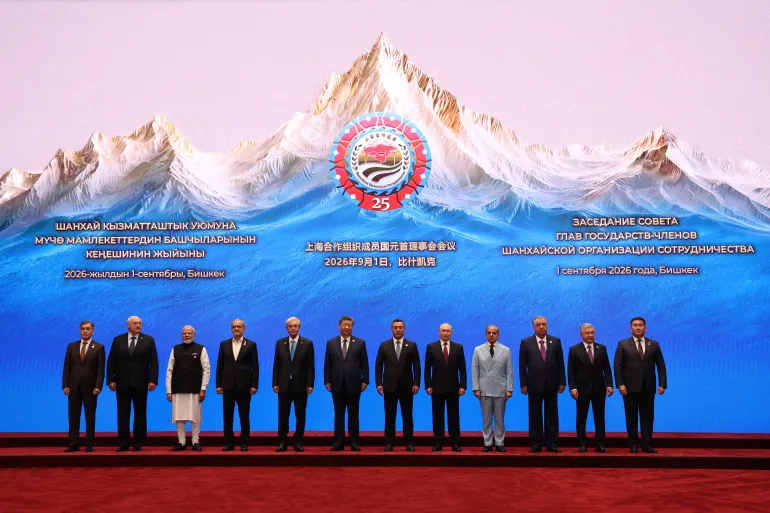







Following a two-day summit in Bishkek, the leaders of the Shanghai Cooperation Organisation (SCO) have formally condemned the ongoing military campaign against Iran, as well as the imposition of Western sanctions on several member states. The joint statement, known as the Bishkek Declaration, was signed by a coalition of leaders including Chinese President Xi Jinping, Russian President Vladimir Putin, Indian Prime Minister Narendra Modi, and Pakistani Prime Minister Shehbaz Sharif.
The SCO, which comprises Russia, China, India, Pakistan, Iran, Belarus, Uzbekistan, Kazakhstan, Tajikistan, and the Kyrgyz Republic, expressed strong opposition to the military strikes on Iranian territory. The declaration stated that these actions, led by the United States and Israel, violate international law and the UN Charter, creating significant risks to global security and stability. The member states noted that these strikes have caused substantial economic damage and numerous civilian casualties.
In a formal gesture of mourning, the SCO leaders extended their condolences to the Iranian government and the families of victims following the death of Supreme Leader Seyyed Ali Khamenei. The bloc reaffirmed its support for Iran’s sovereignty and territorial integrity, advocating for a resolution to the conflict through diplomatic and political channels rather than military force.
The declaration also addressed the broader crisis in West Asia, asserting that a just settlement of the Palestinian question is the only viable path to lasting peace in the region. Furthermore, the SCO expressed opposition to unilateral coercive measures that contradict the rules of the World Trade Organization and the United Nations, arguing that such sanctions negatively impact the global economy.
Regarding nuclear policy, the SCO members backed Iran’s rights under the Nuclear Non-Proliferation Treaty (NPT). While the US has long accused Iran of pursuing nuclear weapons, Iran maintains its program is strictly for civilian purposes. The 2015 nuclear deal, which limited uranium enrichment to 3 percent, was based on this premise. However, the situation escalated in 2025 when the US, under President Donald Trump, bombed Iran, followed by a joint US-Israel war launched in February 2026. The SCO leaders emphasized that all nations have an inalienable right to develop peaceful atomic energy for research and medicine without discrimination.
Economic cooperation remained a primary focus of the summit, particularly as the conflict in Iran continues to disrupt maritime trade routes like the Strait of Hormuz. The leaders committed to strengthening a transparent, inclusive, and non-discriminatory multilateral trading system. They also agreed to implement the SCO Economic Development Strategy through 2030 and expand energy cooperation to stabilize global markets affected by the ongoing war.
Tensions between India and Pakistan also surfaced during the proceedings, as the two nations traded accusations regarding terrorism. India has long alleged that Pakistan shelters armed groups responsible for violence in Indian-administered Kashmir and the 2008 Mumbai attacks. Prime Minister Modi urged member states to reject double standards on terrorism, calling it a grave challenge to humanity. Conversely, Pakistan has denied these claims, noting its own sacrifices in counter-terrorism efforts while accusing India of supporting militants that target Pakistani territory.
In the final declaration, the SCO leadership committed to a unified front against terrorism, separatism, and extremism, aiming to maintain regional stability despite the deep-seated bilateral frictions between some of its members. The report also notes that here are key takeaways from the summit. The report also notes that apart from the US, Russia, China, the United Kingdom and France, other NPT signatories cannot build nuclear weapons. The report also notes that though the US has long accused Iran of secretly harbouring the ambition of building nuclear bombs, Iran has consistently denied those accusations, insisting it is only interested in a peaceful programme. The report also notes that which is enough for civilian reactors, but well below the levels of enrichment needed for a nuclear bomb, it is on that basis that the US and Iran struck their 2015 nuclear deal – Iran agreed to limit uranium enrichment to 3 percent. The report also notes that pointing out that it would mean foregoing its NPT rights, iran has rejected that demand. The report also notes that itself an SCO member, the SCO on Tuesday upheld the position of Iran. The report also notes that they also said they would implement “the SCO Economic Development Strategy for the period up to 2030” in order to deepen economic cooperation and said they would continue “to develop practical dialogue to strengthen financial cooperation.”.