
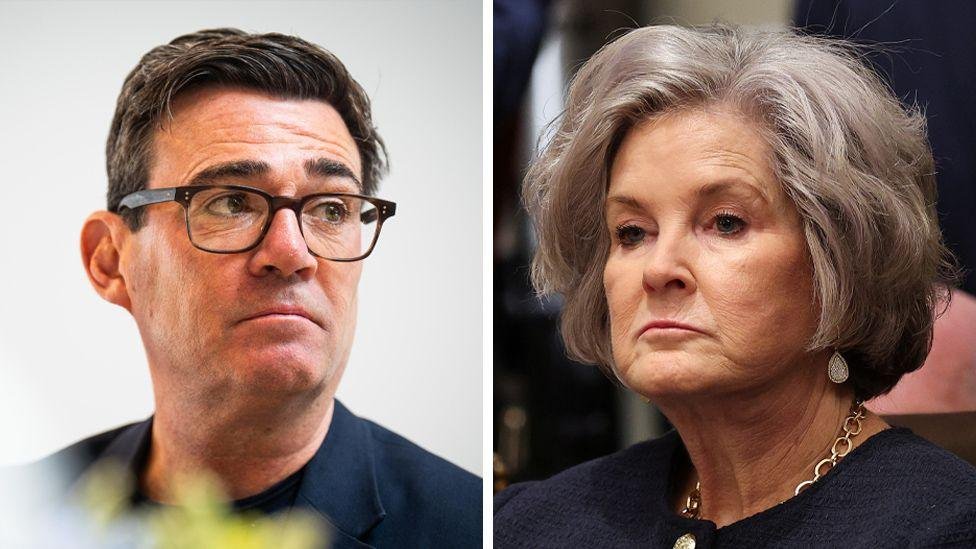








Prime Minister Andy Burnham has been involved in a security breach after exchanging messages with an individual falsely claiming to be Susie Wiles, the chief of staff to US President Donald Trump. Downing Street has declined to comment on the specifics of the incident, which was first reported by Politico.
Officials indicated that the Prime Minister communicated with the imposter “before becoming suspicious that the contact was illegitimate.” Sources stated that only a “few messages” were exchanged, and they were “quickly reported to the appropriate authorities” once the nature of the contact became clear. It is understood that the interaction was limited to text-based messaging with no direct conversation occurring.
A government spokesperson maintained a standard position regarding the event, stating, “We do not comment on national security matters.” Downing Street has not disclosed the timing of the exchange, the total number of messages sent, or the specific platform used for the communication.
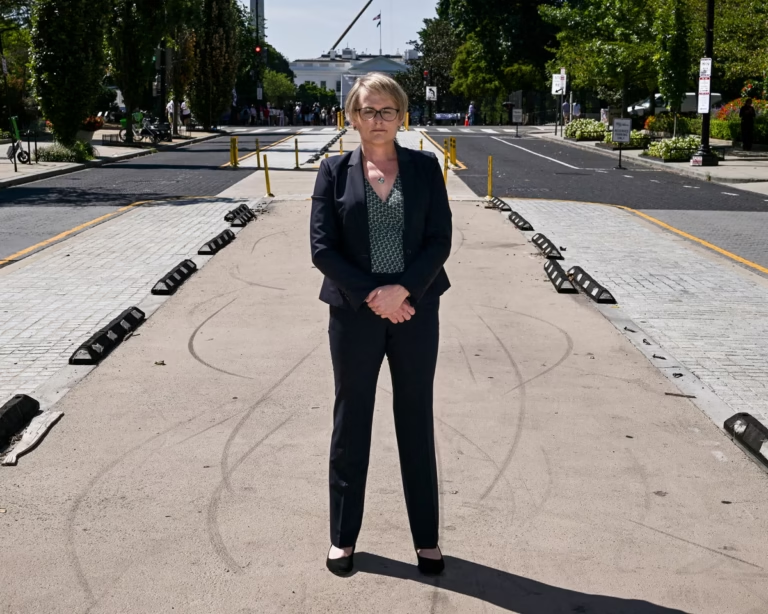
A White House official clarified on Monday that this incident was unrelated to the hacking of Susie Wiles’ personal phone, which was the subject of an FBI investigation in May last year. During that previous breach, Wiles reported that an impersonator had accessed her contacts to message various US officials, including senators, governors, and business executives. Wiles was also targeted in 2024 by a cyber espionage unit linked to Iran’s Revolutionary Guards.
In response to broader security concerns, the UK government is currently removing the personal mobile numbers of three cabinet ministers—Wes Streeting, Alex Norris, and Chris Bryant—from public websites. A spokesperson emphasized that the government maintains “robust procedures in place to ensure the security of sensitive information.”
This is not the first time UK officials have been targeted by impersonators. In 2024, the Foreign Office confirmed that former foreign secretary David Cameron had been the victim of a hoax involving someone posing as former Ukrainian President Petro Poroshenko. Lord Cameron exchanged text messages with the individual, believing it to be the former leader with whom he had previously held multiple meetings.
The Foreign, Commonwealth and Development Office (FCDO) eventually made details of the Cameron exchange public, citing concerns that the information could be “manipulated.”
Earlier incidents in 2022 saw two government ministers targeted by an imposter pretending to be former Ukrainian Prime Minister Denys Shmyhal. Then-Defence Secretary Ben Wallace attributed those calls, which were conducted via Microsoft Teams, to Russian “dirty tricks.” Home Secretary Priti Patel also confirmed she was a target of similar attempts at that time.
During the 2022 incidents, a Ministry of Defence source noted that the video calls were “fairly sophisticated” and gained credibility by appearing to originate from another government department. The report also notes that wiles, a key Trump ally, was also among those targeted by a cyber espionage unit associated with Iran’s Revolutionary Guards – a powerful branch of Iran’s armed forces – in 2024. The report also notes that who was president of Ukraine between 2014 and 2019, lord Cameron also exchanged some text messages with the impersonator pretending to be Poroshenko. The report also notes that by an imposter pretending to be Ukraine’s prime minister between 2020 and 2025, Denys Shmyhal, two more government ministers were targeted in 2022.