
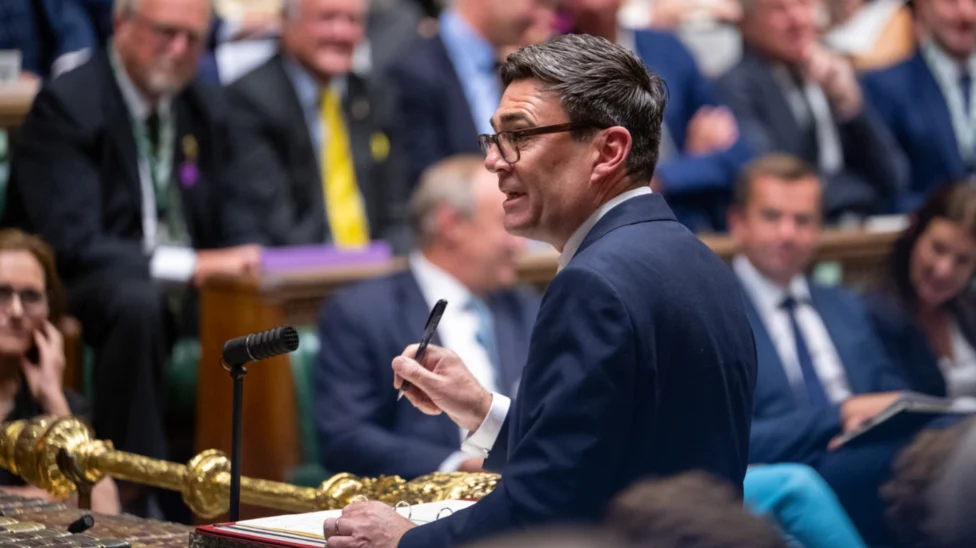







Prime Minister Andy Burnham has pledged to introduce a strategy for “stronger public control” over essential services, marking his first address to the House of Commons since assuming office. During his speech on Tuesday—the opening day of the new parliamentary session—Burnham argued that the UK has suffered from a “series of wrong turns” since the 1980s, which he claimed led to the privatization of economic power and the hollowing out of local councils.
Highlighting the water industry as a “leaking monument” to this privatization, the Prime Minister described the sector as a prime example of a system operating in private rather than public interest. While he stopped short of advocating for full nationalization, he confirmed that a formal plan to increase public oversight of water and energy services would be unveiled later this year.
When questioned by Conservative MP Alison Griffiths regarding his specific intentions for the water sector, Burnham acknowledged the complexity of the situation. He noted that the legacy of privatization has created a scenario that is “very difficult to reverse,” adding that his government is committed to examining all potential solutions.
Beyond utility reform, the Prime Minister emphasized his commitment to decentralization, announcing that he intends to extend devolution powers to additional regions across England. He argued that political power has been overly centralized for decades, a trend he believes was exacerbated by austerity measures and the economic damage caused by Brexit, which he linked to a decade of low growth and stalled regeneration.
Burnham, who took office on July 20 shortly after the summer recess began, told MPs he aims to foster a new sense of optimism despite his assessment that the country is not currently where it should be. He stated that he is returning to Parliament after a decade-long absence with a clear diagnosis of the nation’s structural failures.
The speech drew immediate fire from Conservative leader Kemi Badenoch, who characterized the Prime Minister’s agenda as a push for “more government control, more taxes and more politicians.” She dismissed his economic outlook, asserting that his theory of growth is fundamentally flawed and that his belief that increased government spending will generate wealth is incorrect.
Badenoch also cautioned the Prime Minister that his new role carries significantly more weight than his previous tenure as Mayor of Greater Manchester. She warned that the premiership requires navigating difficult trade-offs that were not present in his former local government position. The report also notes that following his 10 years away from Parliament, Burnham said he was returning with a “clear diagnosis” of what had gone wrong in the country.