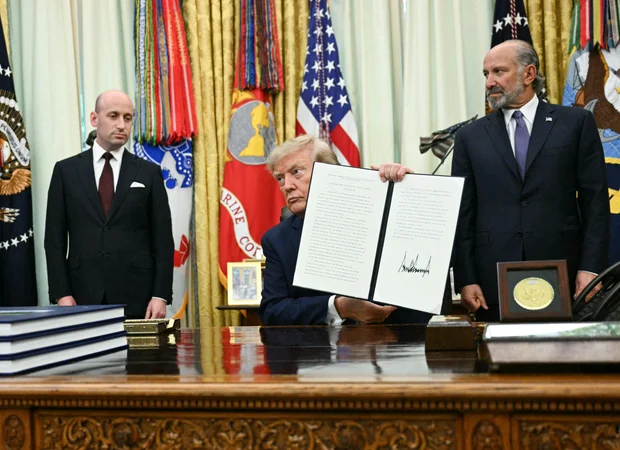







President Trump signed two new executive orders on Thursday in a renewed attempt to limit birthright citizenship for certain children born within the United States. This move follows a 6-3 Supreme Court ruling in June that invalidated his initial executive order on the subject, which he had signed on his first day in office in 2025.
Speaking from the Oval Office, the president described the previous Supreme Court decision as “very unfortunate” and “close,” noting that his administration is now “making adjustments” to its approach. When asked if he believed these new directives would withstand constitutional scrutiny, Trump expressed confidence, stating, “I think it will.”
White House deputy chief of staff Stephen Miller explained that one of the new orders specifically targets commercial “birth tourism.” Miller characterized this practice as a system where individuals enter the country under the guise of tourism to secure automatic citizenship for their children, thereby gaining access to welfare benefits and future voting rights. He emphasized that this issue has been a subject of debate for decades.
The second executive order seeks to broaden the categories of individuals ineligible for birthright citizenship. This includes children born to foreign citizens who are engaged in lobbying efforts on behalf of foreign governments. The administration continues to argue that the 14th Amendment, ratified in 1868, was originally intended only to address the status of children born to formerly enslaved people following the Civil War.
The legal debate surrounding these policies often centers on the 14th Amendment, which grants citizenship to all persons born or naturalized in the U.S. and subject to its jurisdiction. During recent Supreme Court oral arguments, the tension between modern global travel and constitutional interpretation was highlighted when U.S. Solicitor General John Sauer argued that “8 billion people are one plane ride away” from having a U.S. citizen child.
Chief Justice John Roberts challenged this perspective during the proceedings, noting that while the world has changed, the Constitution remains the same. Roberts also pushed back on the relevance of “birth tourism” to the core legal analysis, telling Sauer that such practices do not impact the constitutional interpretation of the Citizenship Clause.
The president has long maintained that the current interpretation of birthright citizenship is flawed. He reiterated his position on Thursday, stating that the amendment was meant for the “babies of slaves.” The administration’s latest actions represent a continued effort to challenge the prevailing legal understanding of citizenship by birth.
The initial report regarding the signing of these orders was provided by Axios. Melissa Quinn contributed to the reporting of these developments.
“This was done right after the Civil War,” Mr.
“It gives them access, under this broken system, to welfare benefits, ultimately to the voting booth, and all the other rights and privileges that belong solely to Americans.”