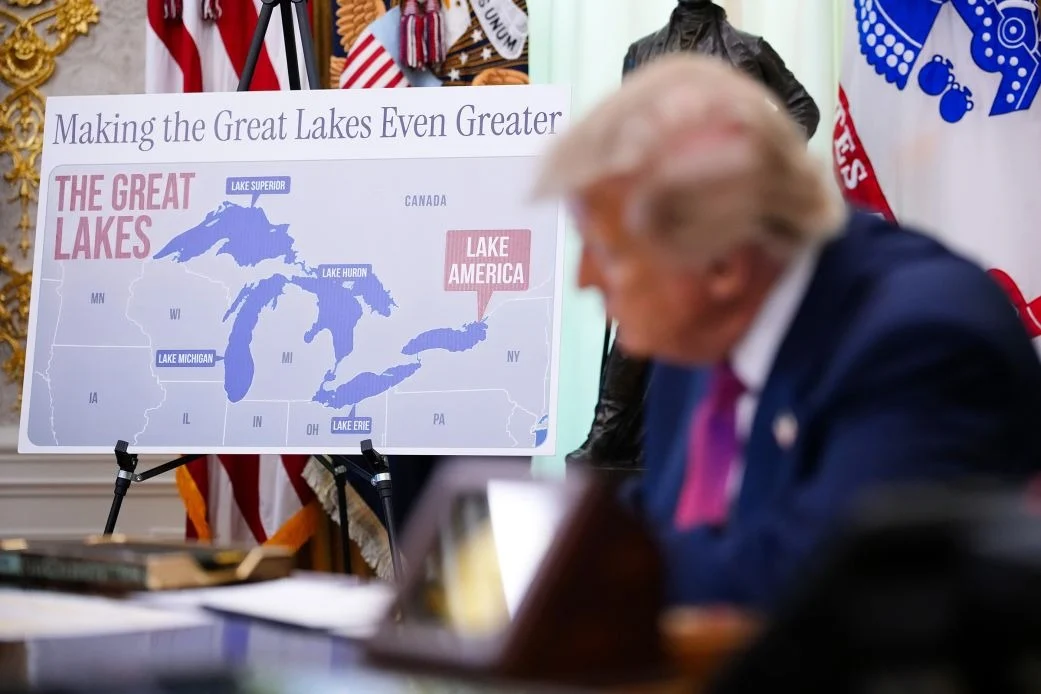








President Donald Trump signed an executive order on Thursday afternoon mandating that Lake Ontario be renamed “Lake America.” The directive serves as a significant escalation in the ongoing trade hostilities between the United States and its northern neighbor. During an Oval Office appearance, the president stood before large maps of the Great Lakes, including one labeled “Making the Great Lakes Even Greater,” which featured the new “Lake America” designation over the water body.
The president stated that the name change is effective immediately, noting that the idea had been under consideration for some time. He further suggested that the administration might eventually seek to rename the Atlantic and Pacific Oceans as well. The executive order instructs Interior Secretary Doug Burgum and the Board on Geographic Names to finalize the transition within 30 days, requiring the removal of all references to the name Lake Ontario from federal maps, contracts, and official communications.
Trump justified the change by claiming that the majority of the lake’s volume and deepest waters reside within U.S. territory, describing the area as a vital asset to the nation’s heritage. This action follows a similar move last year when the administration renamed the Gulf of Mexico the “Gulf of America.” That decision led to international pushback and a refusal by the Associated Press to adopt the new name, resulting in a legal battle after the White House restricted the outlet’s access to certain events—a move later deemed unconstitutional by a federal judge.
The current trade friction intensified over the weekend when Trump imposed 50% tariffs on approximately $20 billion worth of Canadian goods. Canada responded quickly by increasing tariffs on various American products. On Tuesday, Trump had signaled his intent to rename the lake, citing his expectation that the U.S. would no longer conduct significant business with the province of Ontario. Canada remains the second-largest trading partner of the United States, accounting for 12.6% of total trade.
Canadian Prime Minister Mark Carney dismissed the renaming effort, emphasizing that the name Lake Ontario is derived from the Wendat word “Ontari’io,” meaning “the lake is beautiful, the lake is big,” and has been in use for over 400 years. Carney stated on social media that his country would continue to use the original name “forever.” Nova Scotia Premier Tim Houston also criticized the order, calling it “foolishness.”
Domestic political pressure remains high, as Republican Senator Susan Collins of Maine recently urged the administration to return to the negotiating table. Collins noted that Canada had made a “good faith” effort to remove seafood and fish products from its retaliatory tariff list. However, U.S. Trade Representative Jamieson Greer confirmed on Wednesday that there are currently no active negotiations with his Canadian counterpart, Dominic LeBlanc. Greer noted that while he maintains a good relationship with LeBlanc, the Canadian side is currently evaluating its next steps.
During his Thursday remarks, the president reiterated his frustration with Canadian trade policies, labeling Canadian officials as “nasty people” and claiming they have treated the United States unfairly. As the trade dispute persists, the administration’s focus remains on enforcing the new geographic designations despite the lack of cooperation from international partners and the potential for continued diplomatic friction. The report also notes that pointing out in a post on X Thursday afternoon that the origin of Lake Ontario’s name is more than 400 years old, predating the founding of both the U, it didn’t take Canadian Prime Minister Mark Carney long to push back. The report also notes that but right now I think the Canadian side is, you know, talking about their next steps,” Greer told CBC News in an interview from the White House North Lawn, i have a good relationship with Minister LeBlanc. The report also notes that though he can’t force other countries to follow suit, trump has wide latitude over how the US government refers to geographic landmarks. The report also notes that their foreign policy, their national monuments, their hydronyms, their trade relations. The report also notes that and the tariffs will be acutely felt in her home state, collins is a top Democratic target in the midterm election.