








A powerful 7.4-magnitude earthquake struck western Colombia on Monday, resulting in at least 111 deaths and leaving 87 others injured. According to the Colombia Geological Service, the seismic event was the highest magnitude earthquake registered in the country over the past decade.
The epicenter was located near the municipality of San Jose del Palmar in the Choco region, approximately 400km (250 miles) west of Bogota. Data from the United States Geological Survey (USGS) placed the quake at a depth of 107km (66 miles). While the tremor caused significant destruction, the US tsunami warning system confirmed that no tsunami threat was issued.
In response to the disaster, newly inaugurated President Abelardo de la Espriella declared a state of emergency to expedite recovery funding and announced plans to visit the affected areas. Addressing the nation, he stated, “We aren’t going to leave people alone. They are in our hearts and we are going to tend to people with our full determination.”
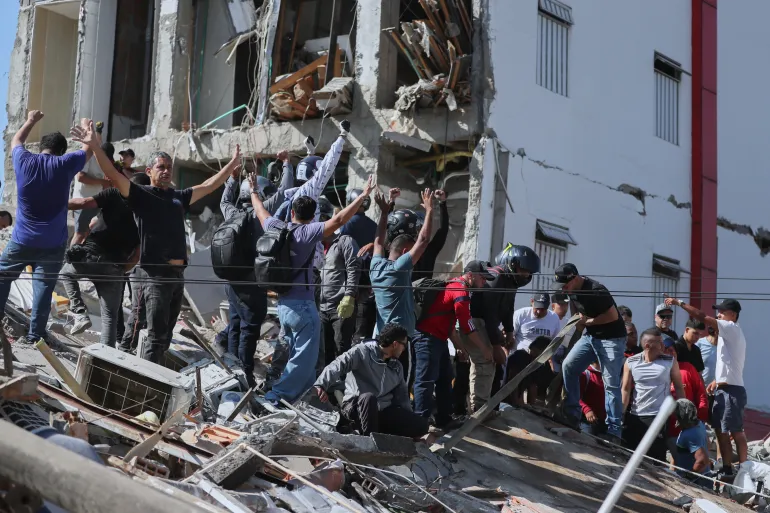
The impact was widespread, with dozens of buildings collapsing across multiple cities. In Pereira, local media captured scenes of airport ceilings failing and residents fleeing through debris. Mayor Mauricio Salazar reported that many individuals remained trapped under the rubble of collapsed structures. Consequently, aviation authorities suspended operations at airports in Pereira, Manizales, Quibdo, Armenia, Cartago, and Buenaventura, while the national football governing body postponed all upcoming matches.
The Choco region, characterized by its rural and isolated terrain, presents significant logistical challenges for rescue teams, as many areas are accessible only by boat or plane. Reporting from Bogota, Al Jazeera’s Alessandro Rampiett noted that the death toll is expected to rise as search operations continue in the most heavily impacted urban centers.
In the capital, Bogota, the tremors triggered building and car alarms, prompting residents to evacuate into the streets. Mayor Carlos Fernando Galan confirmed that while there was no serious structural damage or major injuries reported in the city, municipal resources have been mobilized to assist the rest of the country.
International support has begun to mobilize, with US Secretary of State Marco Rubio stating that Washington is monitoring the situation and stands ready to provide aid. European Union chief Ursula von der Leyen also pledged support, noting that the EU has already deployed its Copernicus satellite service to assist with ongoing rescue operations.
The earthquake was followed by two aftershocks measuring 2.8 and 4.8 in magnitude. While Colombia frequently experiences minor seismic activity, events exceeding a 6.0 magnitude are uncommon. The country’s history includes the 1999 disaster in the coffee region, where a 6.2 magnitude quake claimed over 1,000 lives.
This latest tragedy follows a series of deadly tremors in neighboring Venezuela in late June, where two earthquakes measuring 7.2 and 7.5 resulted in more than 6,000 fatalities and widespread destruction, marking one of the most severe seismic periods for the region in recent years.
While Colombia typically registers thousands of small quakes every month, those of magnitude 6.0 or higher are rare.
The quake comes weeks after two powerful earthquakes struck neighbouring Venezuela in late June, killing more than 6,000 people and destroying hundreds of buildings.
In Pereira, photos and videos published by local media showed pieces of the airport ceiling falling onto travelers taking shelter and people running through rubble.
Much of the area is rural and only reachable by boat or plane, which may pose a problem for authorities in assessing the wider toll.